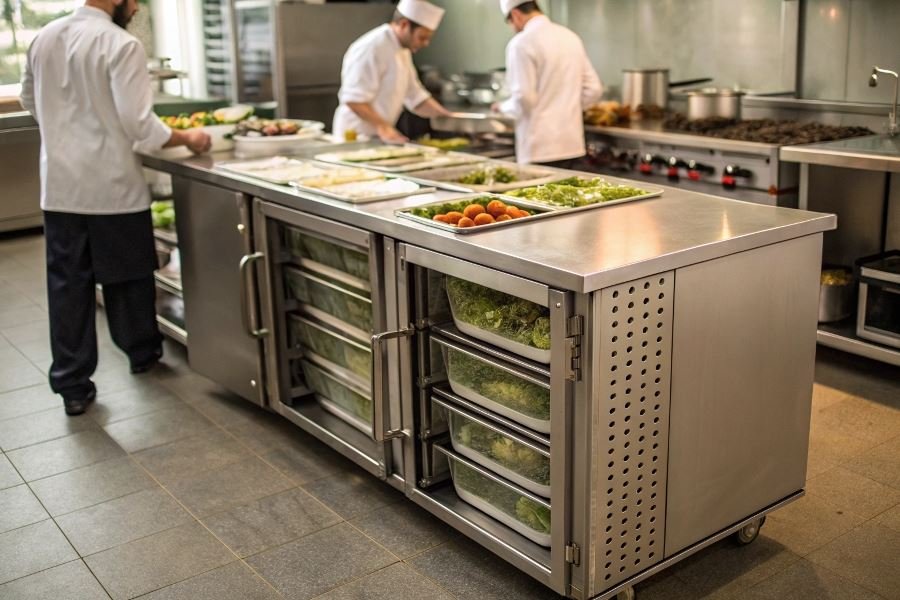
Ever wondered why some commercial refrigeration units hum along perfectly while others struggle to keep products at safe temperatures? The difference often lies not in the brand or price tag, but in something far more fundamental: correctly calculated power requirements.
When investing in commercial refrigeration, power calculation isn’t just a technical detail—it’s the foundation of operational efficiency and product preservation. A properly sized refrigeration table maintains optimal temperatures without excessive energy consumption, potentially saving thousands of dollars annually while extending equipment lifespan.
The critical components that influence power needs
Several key factors determine how much cooling power your refrigeration table requires:
- Ambient temperature – A unit operating in a 90°F kitchen needs significantly more power than one in a 70°F environment
- Product load – The volume and initial temperature of items being cooled
- Usage patterns – How frequently the door opens and closes
- Insulation quality – Higher R-value insulation reduces power requirements
The calculation roadmap
Determining the right power specifications involves a systematic approach:
- Measure your space dimensions – Calculate the cubic footage requiring cooling
- Assess heat load factors – Account for ambient temperature, product throughput, and usage patterns
- Apply safety factors – Add 10-15% capacity to handle unexpected demands
“Underpowered refrigeration is like trying to cool your house with a window AC unit—it might work on mild days, but will fail when you need it most.”
The difference between guesswork and precise calculations often determines whether your refrigeration investment thrives or struggles when it matters most.
Essential Factors for Calculating Refrigeration Table Power
When investing in commercial refrigeration equipment, getting the power calculations right isn’t just about efficiency—it’s about protecting your inventory and your bottom line. Let’s dive into the critical factors that determine exactly how much cooling capacity your refrigeration table needs to perform optimally.
Food Volume and Type: The Foundation of Cooling Requirements
The primary purpose of any refrigeration table is preserving food, making the volume and type of food your starting point for power calculations. How to correctly calculate the power of a refrigeration table begins with a thorough assessment of what you’ll be storing.
Different food types demand different cooling capacities:
- Dense proteins like meat and fish require approximately 25-30% more cooling power than vegetables
- Dairy products need consistent temperatures to prevent spoilage
- Prepared foods with varying densities create complex cooling demands
The thermal mass principle applies here—heavier, denser foods require more energy to cool and maintain temperature. For every cubic foot of dense food storage, expect to need approximately 200-300 BTU/hr of cooling capacity.
| Food Type | BTU/hr per Cubic Foot |
|---|---|
| Vegetables | 200-250 BTU/hr |
| Dairy | 250-300 BTU/hr |
| Meat/Fish | 300-350 BTU/hr |
| Mixed Use | 275-325 BTU/hr |
Environmental Conditions: The External Challenge
Your refrigeration table doesn’t exist in a vacuum—it battles constantly against ambient conditions that affect its performance.
Temperature differential is the invisible power drain. For every 10°F increase in ambient temperature above 70°F, cooling requirements increase by approximately 20%. A kitchen that reaches 90°F during peak service requires nearly 40% more cooling power than the same unit in a 70°F environment.
Humidity levels compound the challenge. High humidity environments (above 60% relative humidity) force refrigeration systems to work harder as they manage both temperature and moisture. This can increase power requirements by an additional 15-20%.
Other environmental factors to account for:
- Air circulation patterns around the unit
- Proximity to heat-generating equipment
- Direct sunlight exposure
- Seasonal temperature fluctuations
Heat Load Calculation: The Complete Picture
The comprehensive approach to refrigeration power calculation requires accounting for all heat sources:
1. Product Heat Load
This includes both the initial cooling of warm products and the maintenance cooling of already-refrigerated items. For every pound of room-temperature food (70°F) that needs cooling to 38°F, calculate approximately 0.5-0.8 BTU/hr.
2. Infiltration Load
Every time the refrigeration table is opened, warm air rushes in. For standard commercial usage:
- Light use (1-5 openings per hour): Add 10% to base load
- Medium use (6-10 openings per hour): Add 20% to base load
- Heavy use (11+ openings per hour): Add 30-40% to base load
3. Equipment Heat Generation
The refrigeration system itself generates heat through:
- Compressor operation (typically adds 5-10% to total load)
- Fan motors (both evaporator and condenser)
- Defrost systems (if applicable)
A properly sized refrigeration table should have 15-20% capacity buffer above your calculated requirements to account for peak demands and ensure longevity of the system components.
By methodically addressing these three essential factors—food requirements, environmental conditions, and comprehensive heat load—you’ll arrive at an accurate power calculation that ensures your refrigeration table performs reliably while optimizing energy consumption.
Calculating Refrigeration Table Power Like a Pro
Gathering the Essential Measurements
Calculating refrigeration table power isn’t just about plugging numbers into a formula—it’s about ensuring your commercial kitchen operates at peak efficiency. Let’s dive into the measurements you’ll need to collect before making any calculations.
First, measure the exact dimensions of your refrigeration table. Length, width, and height measurements should be in inches, converted to cubic feet for volume calculations. A standard 72″ × 30″ × 36″ refrigeration table has approximately 45 cubic feet of total volume, though only about 60-70% of this is usable storage space.
Next, document these critical specifications:
- Ambient temperature of your kitchen (typically 75-85°F in commercial settings)
- Desired internal temperature (usually 33-38°F for refrigeration)
- Door opening frequency (average number of times per hour)
- Type and quantity of products being stored (thermal mass)
Pro tip: Temperature differential is the single most influential factor in power requirements. Every 10°F increase in ambient temperature can increase power needs by up to 20%.
Record the insulation R-value of your unit—commercial-grade refrigeration tables typically have R-values between 30-50. Higher R-values mean better insulation and lower power requirements.
Mastering the Power Calculation Formula
With measurements in hand, it’s time to apply the refrigeration power calculation formula:
P = V × ΔT × F × C × U
Where:
- P = Power required (in watts)
- V = Internal volume (cubic feet)
- ΔT = Temperature differential (ambient minus desired internal temp)
- F = Usage factor (1.2-2.5 depending on door opening frequency)
- C = Contents factor (1.0-1.8 based on product density and temperature)
- U = Insulation factor (0.6-1.2 based on R-value)
Let’s break this down with a practical example:
| Parameter | Value | Notes |
|---|---|---|
| Volume | 30 cu ft | Usable internal space |
| Temp differential | 45°F | 80°F ambient – 35°F internal |
| Usage factor | 1.8 | Moderate-high usage |
| Contents factor | 1.4 | Mixed food products |
| Insulation factor | 0.8 | Good insulation |
Calculating: 30 × 45 × 1.8 × 1.4 × 0.8 = 2,721.6 watts or approximately 2.7 kW
Verifying and Adding Safety Margins
Your calculation is just the starting point. Professional refrigeration engineers always add a safety margin of 15-25% to account for:
- Compressor startup surge (requires 3-5× running wattage)
- Seasonal temperature fluctuations
- Equipment aging and efficiency loss
- Unexpected usage patterns
For our 2.7 kW example, applying a 20% safety margin gives us 3.24 kW as the recommended power capacity.
Verification methods include:
- Cross-reference with manufacturer specifications for similar units
- Thermal load testing during peak usage periods
- Energy consumption monitoring over 24-72 hours
Always round up to the next standard compressor size. If your calculations suggest 3.24 kW but standard compressors come in 3.0 kW and 3.5 kW, choose the 3.5 kW option.
Remember that undersized refrigeration leads to compressor strain, shortened equipment lifespan, and potential food safety issues—costs that far outweigh the initial savings from a smaller unit. Properly sized refrigeration, on the other hand, maintains consistent temperatures while optimizing energy efficiency and operational costs.
Learn how to accurately calculate refrigeration table power requirements with our comprehensive guide. Discover essential factors affecting cooling capacity, heat load considerations, and step-by-step calculation methods for optimal commercial refrigeration performance.
Learn how to accurately calculate refrigeration table power requirements with our comprehensive guide. Discover essential factors affecting cooling capacity, heat load considerations, and step-by-step calculation methods for optimal commercial refrigeration performance.