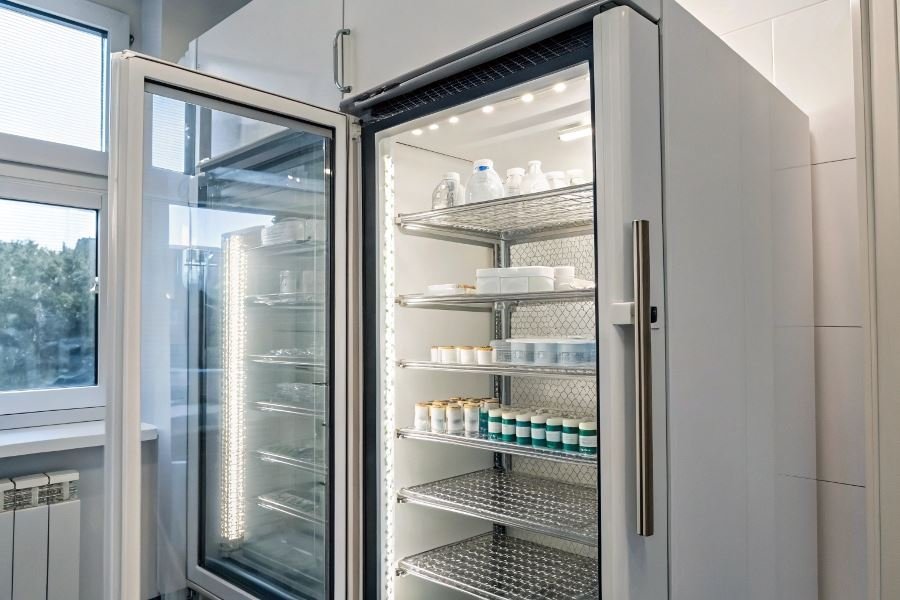
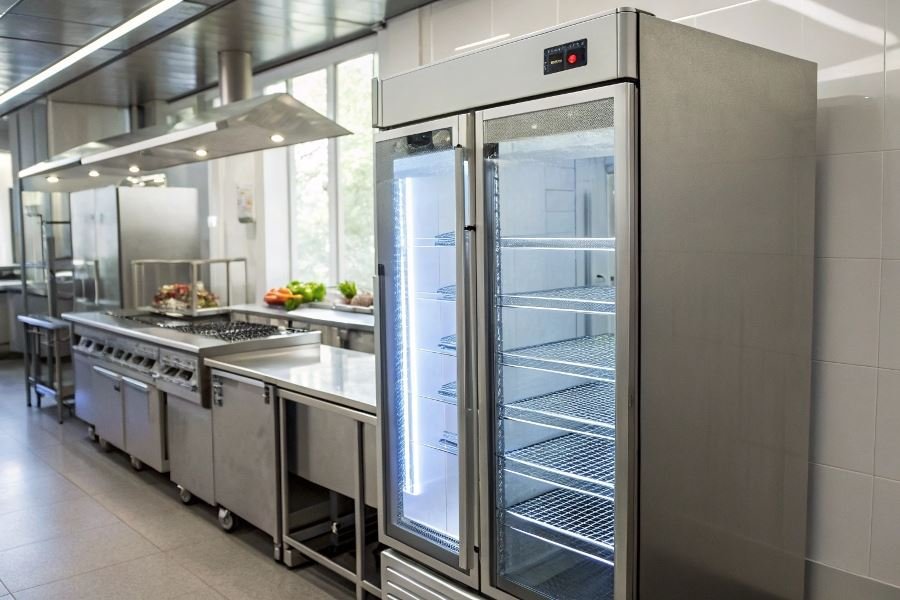
Ever walked into a store and immediately noticed something was off about the refrigerated products? Perhaps the ice cream looked crystallized, or the meat had an unusual color. That’s not just a product issue—it’s a refrigeration failure that’s costing that business customers and revenue.
Selecting the right refrigeration cabinet for your store isn’t just another equipment decision—it’s a critical investment that directly impacts your bottom line. The refrigeration system you choose today will affect your product quality, energy bills, and operational efficiency for years to come.
Product integrity isn’t negotiable. When refrigeration fails, food safety becomes compromised. According to FDA data, improper cooling contributes to over 40% of foodborne illness outbreaks in retail environments. The right refrigeration cabinet maintains consistent temperatures that preserve not just safety, but also flavor, texture, and appearance—qualities your customers absolutely notice.
Energy consumption represents another crucial consideration. Modern, energy-efficient refrigeration cabinets can reduce electricity costs by up to 35% compared to older models. With commercial refrigeration typically accounting for nearly 50% of a food retailer’s energy usage, this efficiency translates to thousands of dollars saved annually.
Beyond these fundamentals, your selection process should evaluate:
- Visibility and merchandising potential that drives impulse purchases
- Space utilization that maximizes your selling area
- Maintenance requirements that won’t disrupt daily operations
- Adaptability to changing inventory needs
The refrigeration cabinet you select ultimately becomes the silent guardian of your perishable inventory—and by extension, your reputation for quality.
Technical Specifications That Make or Break Your Store Refrigeration
When selecting refrigeration equipment for your retail space, the technical specifications aren’t just numbers on a spec sheet—they’re the blueprint for your operational success. The process of choosing a refrigeration cabinet for a store requires understanding three critical technical dimensions that determine performance, cost-effectiveness, and longevity.
Temperature Range and Cooling Systems That Deliver
The heart of any refrigeration cabinet is its cooling system and temperature capabilities. Modern commercial units typically offer temperature ranges from -4°F to 41°F (-20°C to 5°C), but your specific needs should drive your selection.
Cooling system types matter tremendously:
- Forced-air systems circulate cold air throughout the cabinet, providing uniform cooling but potentially drying out unpackaged products
- Static cooling systems maintain higher humidity levels—ideal for fresh produce and meats
- Hybrid systems offer zone-specific cooling for versatile merchandising
Temperature recovery time after door openings is equally crucial. Premium models from brands like True Refrigeration and Hussmann can recover optimal temperatures within 3-5 minutes compared to 8-10 minutes for economy models.
The difference between a cabinet that maintains 34°F consistently versus one that fluctuates between 32-40°F can mean days of additional product shelf life.
Size Considerations That Maximize Sales Per Square Foot
Dimensional efficiency transforms your refrigeration investment from a necessity into a profit center.
When evaluating cabinet dimensions, consider:
| Measurement | Retail Impact | Operational Consideration |
|---|---|---|
| External Footprint | Floor space consumed | Installation clearances needed |
| Internal Volume | Product capacity | Stocking efficiency |
| Shelf Configuration | Merchandising flexibility | Product visibility |
| Height | Sight lines across store | Accessibility for all customers |
Linear footage efficiency has become the gold standard measurement—how much sellable product can you display per foot of floor space? Modern slim-profile designs from Arneg and Carrier Commercial Refrigeration can increase this metric by up to 15% compared to older models.
Energy Efficiency That Protects Your Bottom Line
Energy consumption represents the largest operational cost for refrigeration equipment over its lifetime.
The math is compelling:
A cabinet with an ENERGY STAR rating typically consumes 40% less electricity than non-certified models. For a medium-sized unit, this translates to approximately $300-500 in annual savings.
Key efficiency indicators to evaluate:
- Annual kWh consumption (lower is better)
- Defrost cycle efficiency (smart defrost systems activate only when needed)
- Insulation quality (polyurethane foam thickness and density)
- LED lighting (reduces heat load while improving product visibility)
Advanced models now incorporate variable speed compressors that adjust cooling output based on actual need rather than cycling on and off at full power. This technology from manufacturers like Emerson can reduce energy consumption by up to 25% compared to fixed-speed systems.
The most efficient cabinets also feature electronic expansion valves that precisely control refrigerant flow, optimizing system performance across varying conditions and reducing energy consumption by an additional 10-15%.
Remember that operational costs typically exceed purchase price within 2-3 years—making energy efficiency perhaps the most important long-term specification when selecting your refrigeration equipment.
Sealing the Deal: The Final Decision Framework
Warranty and Service Support That Won’t Let You Down
When investing in commercial refrigeration, the warranty isn’t just fine print—it’s your financial safety net. Leading manufacturers like Hussmann and True Manufacturing typically offer 2-5 year warranties on parts, with compressor coverage extending to 5-7 years. What separates exceptional warranties from adequate ones is on-site labor coverage, which can save thousands in unexpected repair costs.
Service response time becomes critical when your inventory is at risk. Manufacturers with dedicated service networks can often dispatch technicians within 24 hours, while those relying on third-party contractors might leave you waiting 2-3 days. Before signing any purchase agreement, verify:
- Availability of certified technicians in your area
- Parts warehousing locations and typical delivery timeframes
- Emergency service protocols and guaranteed response times
Manufacturer reputation speaks volumes. Research industry forums, speak with other store owners, and examine customer retention rates. A manufacturer with 85%+ customer retention typically delivers on their promises.
The True Cost Equation
The sticker price is merely the opening chapter in your refrigeration cabinet’s financial story. Consider this breakdown of a typical commercial refrigeration cabinet’s lifetime costs:
| Cost Component | Percentage of Total Cost |
|---|---|
| Initial Purchase | 30-40% |
| Energy Consumption | 35-45% |
| Maintenance | 15-20% |
| Repairs | 5-15% |
A cabinet priced $2,000 lower upfront but consuming 15% more energy will cost approximately $4,500 more over a 10-year lifespan. The most expensive cabinet you can buy is the one you’ll need to replace prematurely.
When evaluating long-term value, factor in:
- Annual energy consumption (kWh)
- Documented mean time between failures (MTBF)
- Availability and cost of replacement parts
- Potential for firmware/component upgrades
The wisest investment often isn’t the cheapest or the most expensive option, but rather the one offering the optimal balance between reliability, efficiency, and initial cost.
From Purchase to Operation
The timeline from purchase decision to fully operational equipment typically spans 4-12 weeks, depending on customization requirements and manufacturing lead times. Custom units from manufacturers like Arneg may require 8-12 weeks, while standard models from Turbo Air might ship within 2-3 weeks.
Installation considerations extend beyond the physical placement:
- Electrical requirements: Most commercial units require dedicated circuits with specific voltage requirements (208-230V)
- Ventilation clearances: Inadequate airflow can reduce efficiency by up to 25% and shorten compressor life
- Floor load capacity: Full commercial units can weigh 600-1,200 pounds
- Drainage access: Condensate removal systems need proper drainage connections
Pre-installation site assessments prevent costly surprises. Engage your facilities team or contractor to verify all requirements before finalizing your purchase. Many retailers discover too late that their chosen location lacks adequate power supply or requires expensive electrical upgrades.
Remember that the first 24-48 hours after installation are critical for proper temperature stabilization. Plan your product loading schedule accordingly, allowing the cabinet to reach and maintain target temperature before stocking perishable inventory.
Discover essential criteria for selecting the perfect store refrigeration cabinet. Learn about temperature requirements, energy efficiency, and long-term value to maximize product freshness while minimizing operational costs.
Discover essential criteria for selecting the perfect store refrigeration cabinet. Learn about temperature requirements, energy efficiency, and long-term value to maximize product freshness while minimizing operational costs.