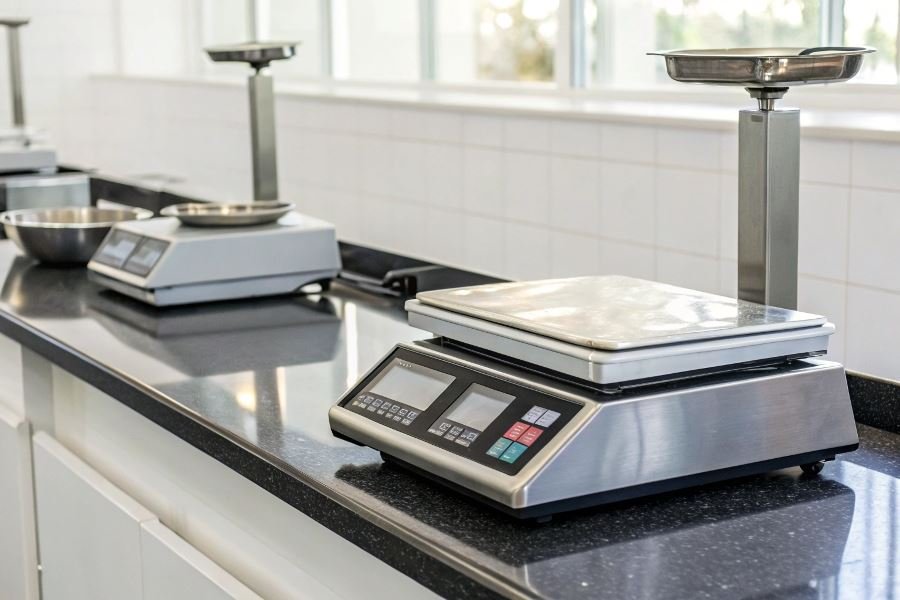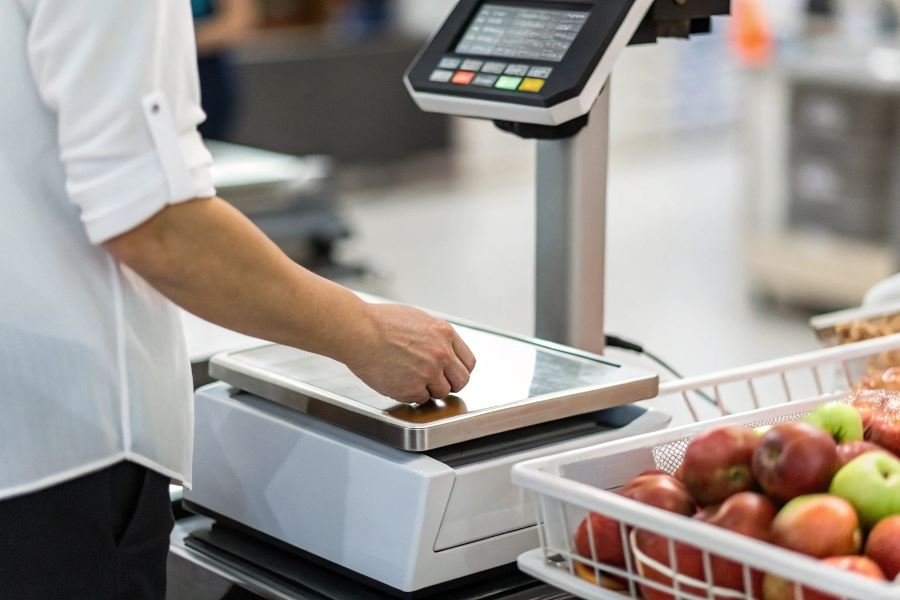
$4.2 billion – that’s the projected value of the global weighing scales market. Behind this staggering figure lies a critical decision facing every business that relies on precise measurements: electronic or mechanical scales?
The humble scale has transformed from ancient balance beams to sophisticated digital systems that can measure with microscopic precision. Yet in commercial settings—from bustling farmers’ markets to high-end jewelry stores—the choice between electronic and mechanical trading scales remains surprisingly nuanced.
Trading scales serve as the silent arbiters of fair commerce. They determine profits, ensure regulatory compliance, and build customer trust. A butcher’s reputation hinges on accurate meat weights just as surely as a gold dealer’s business depends on precise measurements of precious metals.
From stones to silicon: The evolution of measurement
The journey from primitive balancing rocks to today’s advanced weighing technology spans millennia. Ancient Egyptians pioneered the equal-arm balance around 5000 BCE. The Romans introduced the steelyard with its sliding counterweight. But the true revolution came in 1770 when Richard Salter invented the spring scale—the grandfather of modern mechanical scales.
Electronic scales emerged in the 1940s but only became commercially viable decades later. By the 1980s, digital scales began appearing in retail environments, offering features mechanical predecessors couldn’t match.
Decision factors beyond the obvious
When choosing between these technologies, businesses must consider more than just accuracy:
- Initial investment vs. long-term value
- Environmental conditions (temperature fluctuations affect both differently)
- Power requirements (mechanical scales need no electricity)
- Calibration frequency and complexity
- Regulatory compliance capabilities
The right choice ultimately depends on your specific business needs, operating environment, and budget constraints—factors we’ll explore in depth throughout this guide.
The Ultimate Scale Showdown: Electronic vs Mechanical
When choosing trading scales for your business, the decision between electronic and mechanical models can significantly impact your operations, profitability, and customer satisfaction. The debate around electronic vs mechanical trading scales: which is better continues to evolve as technology advances, but the right choice ultimately depends on your specific business requirements.
Precision that pays for itself
Electronic scales dominate when it comes to accuracy, typically offering precision to 0.01-0.1 gram compared to mechanical scales’ 1-5 gram resolution. This difference might seem negligible until you’re pricing high-value items like saffron or truffles, where a fraction of a gram translates to dollars.
Real-world impact: A butcher shop using electronic scales can save approximately $2,500 annually by eliminating over-weighing errors that commonly occur with mechanical scales.
Built to last or built for performance?
Mechanical scales boast impressive longevity with fewer components to fail—many vintage models from the 1950s remain functional today. However, this durability comes with trade-offs:
| Aspect | Mechanical Scales | Electronic Scales |
|---|---|---|
| Average Lifespan | 15-20+ years | 5-8 years |
| Maintenance | Annual calibration, occasional spring replacement | Battery replacement, calibration, potential circuit repairs |
| Environmental Sensitivity | Minimal | Vulnerable to moisture, temperature extremes |
| Repair Complexity | Simple, often DIY | Usually requires technical expertise |
The simplicity of mechanical scales means fewer things can go wrong, but when electronic scales are properly maintained, their performance advantages often outweigh durability concerns.
The true cost equation
Initial investment for quality mechanical scales (200 − 600)typicallyrunslowerthancomparableelectronicmodels(400-1,200). However, the calculation changes when considering long-term value:
- Hidden costs of mechanical: Manual calculations lead to transaction errors and slower checkout times
- Electronic efficiencies: Automatic calculation, inventory integration, and data tracking capabilities
- ROI timeline: Most businesses recoup the additional investment in electronic scales within 12-18 months through labor savings alone
Speed and efficiency in daily operations
Electronic scales process transactions in seconds—displaying weight, calculating price, and often printing labels automatically. This efficiency creates a ripple effect:
- Reduced customer wait times (35-50% faster transactions)
- Decreased employee training requirements
- Minimized calculation errors
- Streamlined inventory management
Mechanical scales require manual calculations and recording, creating bottlenecks during busy periods and increasing the potential for human error.
Adapting to your business reality
Your business environment should heavily influence your decision:
Mechanical scales excel in:
- Remote locations with unreliable power
- Outdoor markets with variable conditions
- Environments with extreme temperature fluctuations
- Businesses with minimal transaction volume
Electronic scales thrive in:
- High-volume retail environments
- Businesses requiring inventory integration
- Operations needing detailed sales data
- Settings where customer throughput is critical
The versatility of modern electronic scales from manufacturers like Mettler Toledo and OHAUS continues to narrow the gap in challenging environments, with improved battery life and ruggedized designs addressing traditional weaknesses.
The choice between scale technologies ultimately requires balancing immediate budget constraints against long-term operational benefits, with most growing businesses finding that electronic scales deliver superior return on investment despite higher initial costs.
Making the Right Choice for Your Business Scales
When it comes to weighing equipment, the decision between electronic and mechanical scales isn’t just about preference—it’s about precision, efficiency, and future-proofing your business. Let’s distill what we’ve learned and provide a clear path forward for your weighing needs.
The fundamental differences that matter
Electronic and mechanical scales represent two distinct approaches to measurement, each with their own strengths:
| Feature | Electronic Scales | Mechanical Scales |
|---|---|---|
| Accuracy | ±0.01g or better | Typically ±1-5g |
| Speed | Instant readings | Requires stabilization |
| Features | Tare, memory, connectivity | Basic weighing only |
| Power needs | Batteries/electricity | None required |
| Maintenance | Software updates, calibration | Physical adjustments |
| Initial cost | 150−2,000+ | 50−500 |
The precision gap between these technologies continues to widen, with electronic scales now offering accuracy levels that were unimaginable in purely mechanical systems. While mechanical scales rely on springs and levers that can wear down over time, electronic load cells maintain their calibration far longer under normal use.
Matching scale type to business needs
Your business type and transaction volume should drive your decision:
High-volume retail environments benefit tremendously from electronic scales. The speed of measurement, integration with point-of-sale systems, and features like preset memory buttons for common items create significant time savings that compound with each transaction.
Specialty food businesses like butcher shops, delis, and bakeries often find that electronic scales with label printing capabilities and product lookup databases justify the higher initial investment through improved inventory management and customer service.
Farmers markets and mobile vendors might still prefer mechanical scales for their portability and independence from power sources. A quality mechanical scale from Ohaus or Detecto can provide years of reliable service in these environments.
Businesses in regions with unreliable electricity should consider either mechanical options or electronic scales with exceptional battery life and power-saving features.
The decision framework ultimately comes down to transaction volume, precision requirements, and operating environment.
The weighing technology horizon
The scale industry isn’t standing still. Several trends are reshaping what businesses can expect:
-
Cloud connectivity is becoming standard in premium electronic scales, allowing centralized management of multiple devices across locations.
-
AI-powered recognition systems are emerging that can identify products placed on the scale, reducing cashier training needs and improving checkout speed.
-
Sustainability improvements include longer-lasting batteries, solar options, and more durable components that extend the lifespan of electronic scales.
-
Hybrid designs are appearing that combine the reliability of mechanical systems with digital readouts, offering a middle ground for businesses in transition.
While mechanical scales will always have their place in certain environments, the trajectory clearly favors electronic solutions as they become more affordable, durable, and feature-rich. Businesses planning for long-term growth should consider the expandability of electronic systems and their ability to integrate with evolving retail technologies.
The scale you choose today will impact thousands of transactions over its lifetime—making this decision worthy of careful consideration rather than a simple price comparison.
Discover the crucial differences between electronic and mechanical trading scales for your business. Compare accuracy, durability, cost-efficiency, and operational benefits to make an informed investment decision that matches your specific commercial needs.
Discover the crucial differences between electronic and mechanical trading scales for your business. Compare accuracy, durability, cost-efficiency, and operational benefits to make an informed investment decision that matches your specific commercial needs.