Ever wondered why some businesses consistently deliver exactly what customers expect while others fall short? The answer might be sitting right on your counter or warehouse floor: your commercial scale.
Behind every successful transaction lies a perfectly calibrated scale. When a customer pays for a pound of artisanal cheese or when a shipping company calculates freight charges, accuracy isn’t just good practice—it’s the foundation of trust and profitability. A mere 1% weighing error can translate to thousands of dollars lost annually for businesses operating on tight margins.
Maintaining properly calibrated commercial scales isn’t just smart business—it’s often legally required. The National Institute of Standards and Technology (NIST) established Handbook 44 back in 1949, which continues to evolve as the gold standard for weighing equipment. Most states require commercial scales to undergo certification by weights and measures officials, with penalties for non-compliance ranging from fines to business suspension.
Scale types demand different calibration approaches. Consider these common commercial scales:
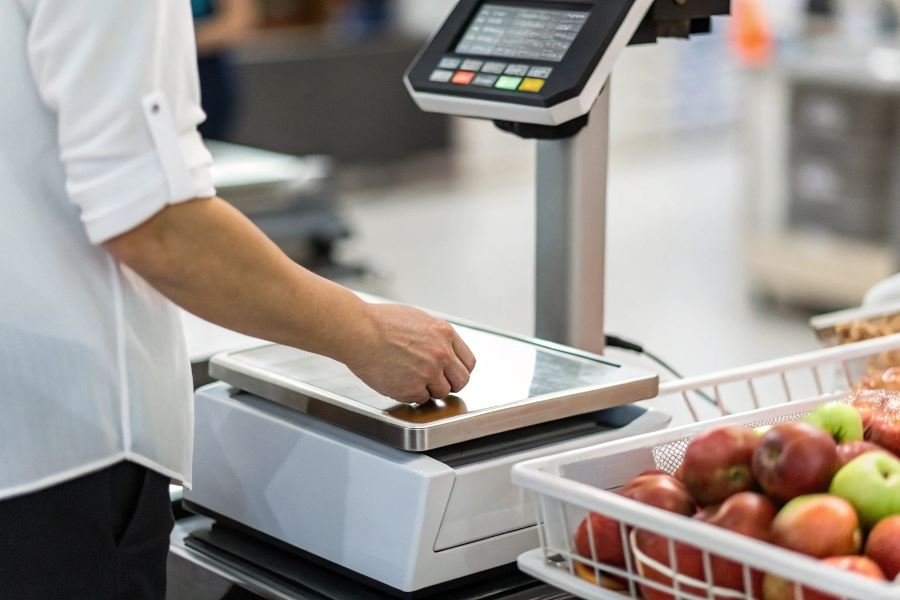
- Retail counter scales: Typically requiring quarterly calibration and daily zero checks
- Floor scales: Need semi-annual professional calibration due to heavy usage
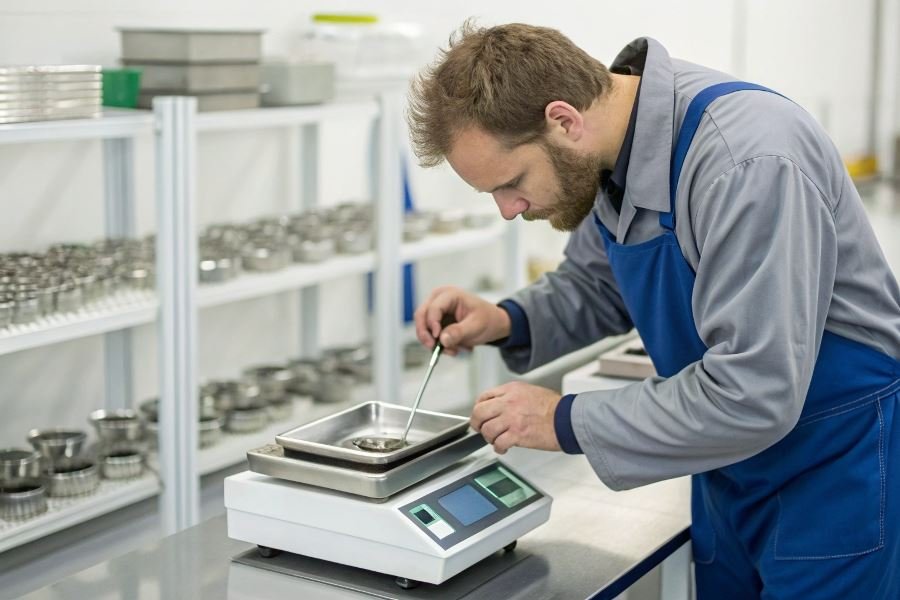
- Precision laboratory scales: Demand monthly calibration with certified weights
“The scale that measures your product ultimately measures your reputation.”
Regular maintenance extends beyond calibration. Dust, temperature fluctuations, and mechanical wear all threaten accuracy. A comprehensive maintenance program includes cleaning contact points, checking level indicators, and protecting electronics from moisture—simple steps that preserve both accuracy and equipment lifespan.
The Precision Pathway to Scale Calibration
Preparing Your Scale for Success
Before diving into calibration, proper preparation sets the foundation for accuracy. Start by placing your scale on a level, stable surface away from air currents, vibrations, and electromagnetic interference. A dedicated calibration station with a solid workbench is ideal for commercial environments.
The process of properly calibrating and maintaining commercial scales requires meticulous attention to detail that pays dividends in accuracy and longevity. Begin with a thorough cleaning using non-abrasive materials—remove all debris from the weighing platform, check for corrosion, and inspect load cells for damage. For digital scales, verify battery levels or power connections, as fluctuating power can compromise calibration results.
Pre-calibration inspection checklist:
- Verify the scale is level using built-in bubble indicators
- Check for physical damage to weighing mechanisms
- Ensure all connections are secure and corrosion-free
- Allow electronic scales to warm up (typically 30 minutes)
- Confirm the surrounding environment maintains stable temperature
Mastering the Calibration Sequence
Calibration isn’t just a procedure—it’s a precision ritual that demands respect for physics and metrology principles. Always use NIST-traceable certified weights that match your scale’s capacity and readability.
The quality of your calibration weights directly influences your results—never substitute with makeshift alternatives.
Start with zero calibration (sometimes called “zeroing” or “taring”) with an empty platform. Most digital scales have dedicated buttons for this function. Once zeroed, follow this progressive loading sequence:
- Place a weight at 10% of the scale’s capacity
- Record the reading and any deviation
- Remove the weight and verify return to zero
- Repeat with weights at 25%, 50%, 75%, and 100% of capacity
- Test at the most commonly used weight ranges for your specific application
For multi-range scales, perform calibration checks at critical transition points between ranges. Modern scales from manufacturers like Mettler Toledo or OHAUS often have internal calibration programs—follow manufacturer protocols precisely.
Documenting Your Calibration Journey
Documentation transforms calibration from a one-time event into a valuable data point in your quality assurance system. Create detailed calibration records that include:
| Documentation Element | Details to Include |
|---|---|
| Scale Information | Model, serial number, location, capacity, readability |
| Calibration Weights | Certificate numbers, traceability, class, last certification date |
| Environmental Conditions | Temperature, humidity, barometric pressure |
| Test Results | Applied weight, displayed weight, deviation, pass/fail status |
| Personnel | Name and qualification of technician performing calibration |
| Next Calibration | Scheduled date based on usage patterns and regulatory requirements |
Verification is non-negotiable. After completing the calibration sequence, perform verification tests at three critical points: near minimum, mid-range, and maximum capacity. Record these results separately from calibration data.
For regulatory compliance in commercial environments, maintain calibration records for a minimum of two years. Consider implementing digital record-keeping systems with automatic reminders for recalibration intervals.
Remember: Calibration isn’t just about meeting regulations—it’s about building customer trust through unwavering accuracy.
Mastering Commercial Scale Maintenance
Commercial scales are the unsung heroes of countless businesses—from delis and jewelry shops to industrial warehouses. Yet, their accuracy and longevity depend entirely on how well you maintain them. Let’s dive into the maintenance strategies that separate scale professionals from amateurs.
Daily cleaning rituals that preserve accuracy
The foundation of scale maintenance is a consistent daily cleaning routine. Dust, debris, and product residue are the silent killers of precision measurement.
For food-related scales, use food-safe sanitizing wipes after each shift. For industrial scales, a microfiber cloth lightly dampened with isopropyl alcohol works wonders for removing oils and contaminants without leaving residue.
Pro tip: Never spray cleaning solution directly onto the scale. Instead, apply it to your cloth first to prevent moisture from seeping into sensitive electronic components.
Daily inspection should include:
- Checking the level bubble (if equipped)
- Examining load cells for debris
- Verifying display clarity
- Testing zero function
- Inspecting power connections
The most expensive scale in the world becomes worthless the moment its accuracy is compromised by poor maintenance.
Strategic preventative maintenance schedules
Preventative maintenance isn’t just reactive—it’s a proactive investment in your equipment’s longevity.
| Maintenance Task | Frequency | Personnel |
|---|---|---|
| Calibration check | Weekly | Trained staff |
| Full calibration | Quarterly | Certified technician |
| Load cell inspection | Monthly | Maintenance staff |
| Software updates | As released | IT or scale technician |
| Battery backup test | Monthly | Maintenance staff |
Document all maintenance activities in a dedicated log. Trimble and other scale manufacturers offer digital maintenance tracking solutions that can alert you when service is due.
The ideal preventative maintenance checklist includes:
- Calibration verification using certified test weights
- Power supply assessment to ensure stable electrical input
- Connection inspection of all cables and junction boxes
- Environmental evaluation for temperature, humidity, and vibration factors
- Software diagnostics to identify potential electronic issues
Troubleshooting scale problems like an expert
Even with perfect maintenance, issues can arise. Knowing how to diagnose common problems saves both time and money.
When scales display inconsistent readings, first check for:
- Environmental factors: Air currents, vibration, or temperature fluctuations
- Mechanical interference: Objects touching the platform or lodged underneath
- Power issues: Unstable power supply or battery degradation
For digital scales showing error codes, consult your manual—most manufacturers like Mettler Toledo provide comprehensive error code libraries online.
When to call the professionals:
- After significant impact or damage
- When calibration drifts repeatedly despite adjustment
- If error codes persist after basic troubleshooting
- For annual certification requirements
- When scale components need replacement
Remember that certified scale technicians aren’t just repairpeople—they’re consultants who can identify issues before they become catastrophic failures.
By implementing these maintenance strategies, your commercial scales will deliver years of accurate service, protecting both your bottom line and your reputation for quality and precision.
Learn expert techniques for commercial scale calibration and maintenance to ensure accuracy and compliance. Discover step-by-step procedures, preventative maintenance strategies, and troubleshooting tips for all types of business weighing equipment.
Learn expert techniques for commercial scale calibration and maintenance to ensure accuracy and compliance. Discover step-by-step procedures, preventative maintenance strategies, and troubleshooting tips for all types of business weighing equipment.