$13,000 per year – that’s how much the average grocery store loses to checkout errors when using traditional weighing methods. But what if your scale could talk directly to your cash register?
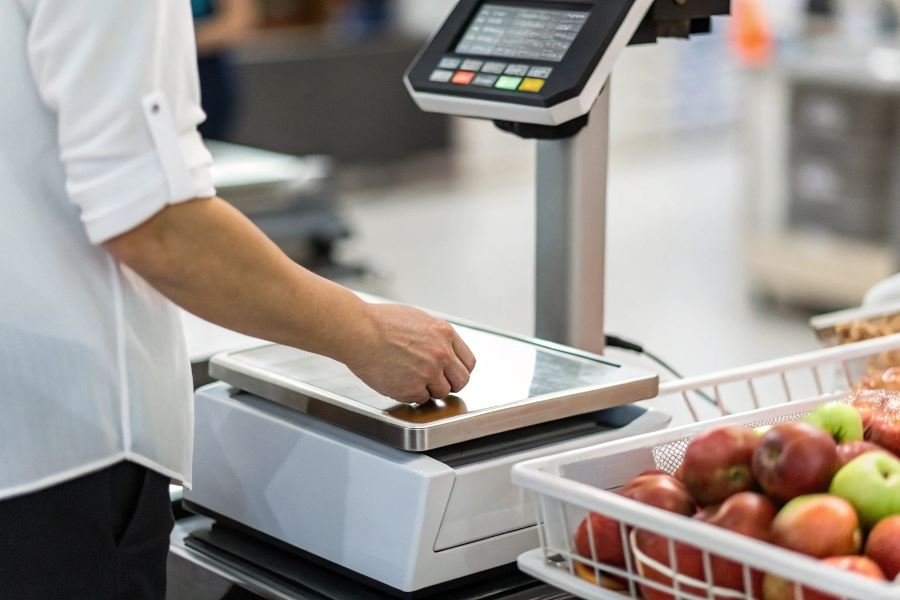
Commercial scales with POS integration represent the seamless marriage between precision weighing technology and point-of-sale systems. These sophisticated devices don’t just weigh products – they communicate weight data directly to your cash register, eliminating manual entry errors while streamlining operations across retail environments.
The evolution of “weigh and pay”
The journey from mechanical counter scales to today’s integrated systems tells a fascinating story of retail innovation. In the 1970s, electronic scales first appeared in stores, but they remained standalone units. By the 1990s, basic communication protocols emerged, allowing limited data exchange between scales and registers. The real breakthrough came in the early 2000s with network-capable scales that could be fully integrated into POS ecosystems.
Today’s integrated scale landscape
The market now offers three distinct categories:
| System Type | Best For | Key Advantage |
|---|---|---|
| Counter-integrated | Small retailers | Space efficiency |
| Network scales | Supermarkets | Multi-department coordination |
| Mobile solutions | Farmers markets | Flexibility |
Modern integrated scales don’t just weigh – they calculate prices, store product data, print labels, track inventory, and even help with compliance requirements. For businesses handling weighted goods, these systems have transformed from luxury to necessity, delivering accuracy, efficiency, and insights that mechanical predecessors simply couldn’t provide.
Transforming Retail Through Integrated Scale Technology
Operational Efficiency That Changes Everything
When seconds count at checkout, integrated commercial scales deliver. Businesses implementing these systems report transaction time reductions of 15-30% compared to traditional setups. The seamless connection between weighing equipment and point-of-sale systems eliminates the manual entry step that plagues conventional retail operations.
The revolution in commercial scales with integration into the cash register system: advantages and functions extends far beyond simple time savings. These systems fundamentally transform workflow by automating price calculations based on weight, applying appropriate taxes, and generating receipts—all in one fluid motion. For busy delis, produce sections, and specialty food retailers, this means serving more customers without sacrificing attention to detail.
Real-world impact: A mid-sized grocery chain in Minneapolis implemented NCR Freshpro integrated scales and documented a 22% increase in checkout throughput during peak hours, while simultaneously reducing cashier training time by nearly half.
Precision Pricing and Inventory Control
The margin for error in retail pricing can make or break profitability. Integrated scale systems deliver accuracy rates exceeding 99.9% in price calculations—a dramatic improvement over manual methods.
The elimination of human calculation errors translates directly to bottom-line protection.
These systems excel in inventory management through:
| Capability | Business Impact |
|---|---|
| Real-time stock updates | 40-60% reduction in overstock situations |
| Automatic reorder triggers | Prevents revenue-killing stockouts |
| Shrinkage tracking | Identifies loss patterns for intervention |
| Product performance metrics | Guides merchandising decisions |
When Mettler Toledo integrated scales were deployed across a specialty cheese shop network, inventory accuracy improved from 82% to 97%, while reducing physical inventory time by two-thirds.
Business Intelligence That Drives Growth
Modern integrated scale systems function as data collection powerhouses. They capture crucial metrics that transform into actionable business intelligence:
- Purchase pattern analysis: Identifies which products sell best at specific times
- Customer preference tracking: Reveals buying habits that inform merchandising
- Pricing optimization data: Shows price sensitivity across product categories
- Labor efficiency metrics: Highlights peak periods requiring additional staffing
This wealth of information flows automatically into reporting systems through the ShopKeep or Lightspeed POS integration, creating a continuous feedback loop for business improvement.
The most valuable aspect of integrated scale technology isn’t the hardware—it’s the insights that emerge from the data ecosystem they create.
For specialty retailers dealing with variable-weight products, these systems provide unprecedented visibility into product performance. A butcher shop in Portland implemented Bizerba integrated scales and discovered that premium cuts sold 40% better during Thursday evenings—knowledge that allowed them to adjust staffing and inventory accordingly.
The intelligence capabilities extend to customer-facing operations as well, with digital displays showing nutritional information, origin details, and preparation suggestions—all while capturing customer engagement metrics that further refine the business model.
Maximizing Business Efficiency Through Integrated Scale Systems
Technical features that drive business transformation
Commercial scales with cash register integration represent a technological leap for retail and food service operations. Modern integrated scales operate on 32-bit processors with processing speeds up to 1.2 GHz, enabling instantaneous weight calculation and data transfer. The most advanced models feature high-resolution touchscreens (1024×768 pixels) that allow cashiers to navigate inventory systems while simultaneously weighing products.
Compatibility considerations are crucial when implementing these systems. Leading manufacturers like Mettler Toledo and DIGI design scales with open API architecture that connects seamlessly with popular point-of-sale systems including Square, Shopify POS, and Lightspeed. The integration protocols typically utilize TCP/IP connections or USB direct links, with newer models incorporating Bluetooth 5.0 technology for wireless implementation.
The difference between a good scale integration and a great one often comes down to latency—anything above 300 milliseconds creates noticeable delays that compound throughout the business day.
Memory capacity ranges from 8GB to 32GB in premium models, allowing for storage of extensive product databases with thousands of SKUs, complete with pricing tiers and promotional information.
Strategic implementation across business models
Different business types require tailored implementation approaches:
| Business Type | Optimal Scale Configuration | Key Integration Points |
|---|---|---|
| Grocery | Multi-range scales with label printing | Inventory management, promotional pricing |
| Butcher/Deli | Moisture-resistant scales with tare memory | Recipe costing, portion control |
| Bakery | Scales with flour-resistant keypads | Batch production tracking, waste reduction |
| Bulk Foods | Self-service scales with customer interfaces | Customer engagement, inventory control |
For small specialty retailers, phased implementation often works best—beginning with a single master scale at the main checkout and expanding to department-specific units. Larger operations typically benefit from a centralized database architecture where all scales pull from the same product information, ensuring pricing consistency across multiple points of sale.
Implementation success hinges on thorough staff training. Businesses that invest in at least 4 hours of hands-on training per employee report 62% fewer errors during the critical first month of operation.
ROI analysis and future-proofing strategies
The investment in integrated scale systems typically ranges from $1,200 for basic models to $5,800 for advanced systems with full integration capabilities. However, the ROI timeline is compelling:
- Labor efficiency gains of 15-22% at checkout
- Pricing accuracy improvement of 99.8% (compared to 96.2% with manual entry)
- Inventory shrinkage reduction of 1.3% on average
- Customer throughput increase of 8-12 customers per hour during peak periods
Most businesses achieve complete ROI within 7-14 months depending on transaction volume. The most significant savings come from elimination of pricing errors and reduced labor costs.
Future-proofing your investment requires selecting systems with modular software architecture that can accommodate emerging retail technologies. Look for scales that support:
- AI-based visual recognition capabilities
- Blockchain integration for supply chain verification
- Customer loyalty program connectivity
- Remote management through cloud-based dashboards
The most forward-thinking retailers are already implementing scales with predictive inventory algorithms that automatically adjust ordering based on seasonal patterns and real-time sales data, creating a truly intelligent weighing ecosystem that grows smarter with every transaction.
Discover how integrated scale-POS systems streamline retail operations, enhance pricing accuracy, and provide valuable business intelligence. Learn implementation strategies and ROI benefits for your business.
Discover how integrated scale-POS systems streamline retail operations, enhance pricing accuracy, and provide valuable business intelligence. Learn implementation strategies and ROI benefits for your business.