
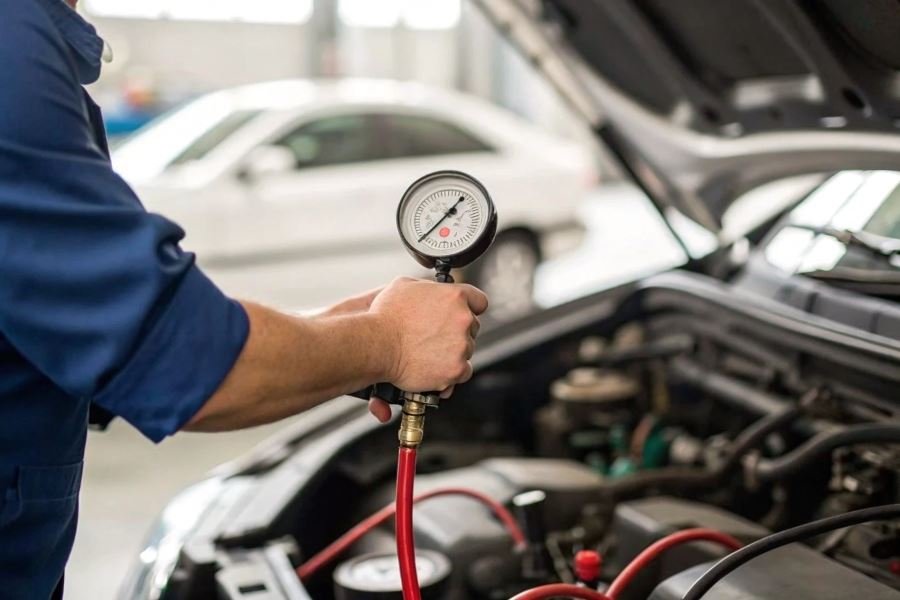
Ever watched a master mechanic diagnose an engine problem in minutes while others spend hours guessing? The secret often lies in their approach to oil pressure testing—the diagnostic procedure that speaks volumes about an engine’s health without requiring a single part to be removed.
Professional auto services distinguish themselves through precision diagnostics, with oil pressure testing serving as the cornerstone of engine health assessment. When a vehicle’s lifeblood—its oil—doesn’t maintain proper pressure, catastrophic engine failure becomes not a question of if, but when. This critical measurement reveals problems ranging from worn bearings to failing oil pumps before they escalate into $5,000+ repairs.
A professional-grade oil pressure tester consists of several key components that work in harmony: a high-quality pressure gauge (ideally glycerin-filled for stability), various adapters to fit different engine makes, reinforced high-pressure hoses, and quick-connect fittings that prevent messy leaks. The difference between economy and professional units isn’t just price—it’s reliability when diagnosing a $100,000 vehicle.
“The quality of your diagnostics determines the quality of your repairs. Period.” — Veteran Master Technician
What truly separates exceptional auto services from average shops is their commitment to accurate testing. When customers receive definitive answers rather than educated guesses, their confidence in your expertise skyrockets. This translates directly to higher customer retention rates—studies show that shops using professional diagnostic equipment enjoy 37% better customer loyalty than those relying on basic tools.
The right oil pressure tester doesn’t just find problems—it builds trust.
Essential Factors for Selecting the Perfect Oil Pressure Tester
When selecting diagnostic equipment for your auto service operation, few tools are as critical as a reliable oil pressure tester. The right tester doesn’t just verify readings—it provides the confidence to make accurate diagnoses that protect your customers’ engines and your shop’s reputation.
Professional mechanics understand that choosing an oil pressure tester for an auto service requires balancing several key factors including measurement capabilities, vehicle compatibility, and long-term durability. The difference between a quality tester and a subpar one often becomes apparent at the most inconvenient moment—when you’re troubleshooting a complex engine issue with a customer waiting.
Pressure Range and Measurement Accuracy
Pressure range versatility is non-negotiable in a professional setting. Modern oil pressure testers should offer:
- Ranges from 0-100 PSI (basic) up to 0-300 PSI (comprehensive)
- Accuracy within ±1.5% of full scale
- Clear, easy-to-read gauges (preferably 2.5″ or larger)
The Mityvac MV5530 Professional Oil Pressure Test Kit exemplifies this with its 0-300 PSI range and ±1% accuracy rating, making it suitable for everything from standard passenger vehicles to high-performance engines.
Precision matters more than you might think. A variance of just 5-10 PSI can be the difference between diagnosing a worn oil pump versus condemning an entire engine.
Vehicle Compatibility Considerations
Modern auto service operations handle diverse vehicle fleets, requiring adaptable testing equipment.
| Compatibility Factor | What to Look For |
|---|---|
| Adapter Variety | Minimum 10+ adapters covering domestic, European, Asian |
| Thread Types | M10x1.0, M12x1.5, M14x1.5, M16x1.5, 1/8″ NPT, 1/4″ NPT |
| Hose Length | Minimum 36″ for easy access to difficult mounting locations |
The OTC 5610 Master Oil Pressure Kit stands out with its 25+ adapters that cover virtually every vehicle from 1986 through current models, including specialized fittings for BMW, Mercedes, and other European manufacturers.
Adapter quality deserves special attention—brass adapters typically offer better durability and sealing properties than aluminum alternatives, particularly for high-pressure applications.
Durability and Warranty Considerations
The build quality of your oil pressure tester directly impacts both accuracy and longevity.
Premium testers feature:
- Stainless steel gauge housings resistant to shop chemicals and impacts
- Reinforced hose connections with double crimping or braided coverings
- Vibration-dampening glycerin-filled gauges for stable readings
- Organized storage cases that protect components between uses
The Snap-on EEPV304A demonstrates exceptional durability with its all-metal construction and lifetime calibration warranty—a significant advantage considering most shops can expect 5-7 years of service from quality testers before recalibration becomes necessary.
Warranty terms reveal manufacturer confidence. Look for minimum 1-year coverage on gauges and 3+ years on adapters and fittings. The Mac Tools EETOIL300A offers an industry-leading 5-year comprehensive warranty that covers even accidental damage.
When evaluating cost versus quality, remember that a $300-400 professional-grade tester typically delivers 10+ years of service, while budget options under $100 often require replacement within 12-18 months—making the premium option significantly more economical over time.
By focusing on these essential factors—pressure range capabilities, vehicle compatibility, and build quality—you’ll select an oil pressure tester that delivers accurate diagnostics and exceptional value for your auto service operation.
The Ultimate Guide to Oil Pressure Testers for Auto Service Professionals
When diagnosing engine health, nothing speaks louder than oil pressure readings. The right testing equipment can mean the difference between accurate diagnostics and costly guesswork. Let’s dive into the world of oil pressure testers with the enthusiasm they deserve—these unsung heroes of preventative maintenance deserve their moment in the spotlight.
Digital vs analog testers in professional settings
Digital oil pressure testers have revolutionized diagnostics with their precision and data-logging capabilities. Modern digital units offer readings accurate to within 0.5 PSI and can store historical data for trend analysis—something impossible with analog gauges.
Digital advantages:
- LCD displays eliminate parallax reading errors
- Data logging capabilities for tracking pressure changes over time
- Multiple measurement units (PSI, BAR, kPa) at the touch of a button
- Integration with diagnostic software for comprehensive reports
However, analog testers still command respect in many professional garages. Their simplicity means fewer electronic components to fail, especially in harsh shop environments where oil and temperature extremes are common.
Analog testers shine in environments where reliability trumps features, and their typically lower cost makes them excellent backup tools even in shops that primarily use digital equipment.
Standalone vs integrated diagnostic systems
The standalone oil pressure tester represents the traditional approach—a dedicated tool for a specific job. These units typically cost between 75−300 depending on quality and features, offering portability and simplicity.
Integrated diagnostic systems, meanwhile, incorporate oil pressure testing into comprehensive vehicle analysis platforms. These systems connect to multiple vehicle systems simultaneously, providing context for pressure readings.
| Feature | Standalone Testers | Integrated Systems |
|---|---|---|
| Initial Cost | 75−300 | 1, 200−5,000+ |
| Learning Curve | Minimal | Moderate to steep |
| Versatility | Single-purpose | Multi-system diagnostics |
| Upgrade Path | Limited/replacement | Software updates available |
| Portability | Excellent | Limited |
The decision often comes down to workflow and business model. High-volume shops handling diverse vehicle makes benefit tremendously from integrated systems like those from Snap-on or Autel, while specialized repair shops might prefer dedicated testers.
Professional-grade vs economy equipment analysis
The price gap between economy and professional-grade oil pressure testers can be substantial, but so can the performance difference.
Economy testers (50−100) typically feature:
- Basic pressure gauges with limited range
- Fewer adapter fittings
- Standard materials prone to wear
- Limited or no warranty
Professional-grade equipment (200−500+) delivers:
- Higher pressure tolerances (often up to 300 PSI vs 100 PSI)
- Reinforced hoses rated for high-temperature environments
- Comprehensive fitting kits covering domestic and import vehicles
- Calibration certificates and longer warranties
The return on investment becomes clear when considering durability. Professional shops report economy testers typically lasting 1-2 years with regular use, while professional units from manufacturers like OTC Tools often remain in service for 5+ years.
The true cost of economy equipment isn’t the purchase price—it’s the combined expense of replacement units, inaccurate readings, and diagnostic errors that lead to unnecessary parts replacement.
For high-volume shops performing multiple oil pressure tests weekly, the professional-grade equipment pays for itself through accuracy and longevity. However, for occasional use in smaller operations, economy options provide adequate functionality when budget constraints are primary concerns.
Discover how to select the ideal oil pressure tester for your auto service with our comprehensive guide. Learn about pressure ranges, vehicle compatibility, and durability factors that ensure accurate diagnostics and improved customer satisfaction.
Discover how to select the ideal oil pressure tester for your auto service with our comprehensive guide. Learn about pressure ranges, vehicle compatibility, and durability factors that ensure accurate diagnostics and improved customer satisfaction.
