The perfect curl has been the holy grail of hair styling since the ancient Egyptians wrapped hair around wooden sticks. But the tools we use today? They’ve come a long way from those primitive beginnings.
When Marcel Grateau introduced the first curling iron in 1872, he revolutionized the beauty industry with a simple heated rod and clamp. Fast-forward to today, and salon professionals face a critical choice between traditional manual curling irons and their high-tech electric counterparts. This decision impacts everything from styling time to client satisfaction and even a salon’s bottom line.
From manual to automated: The styling revolution
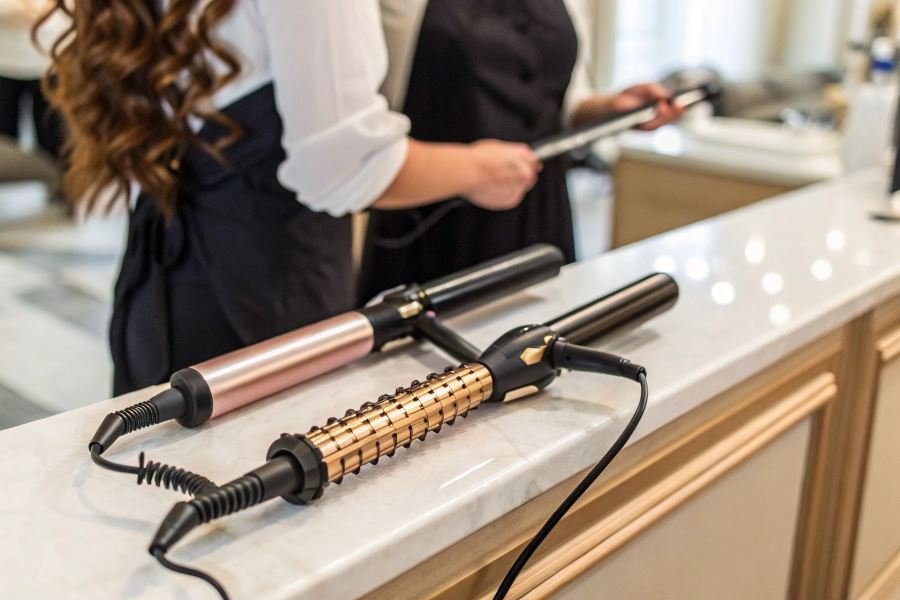
Traditional curling tools rely on the stylist’s skill and physical technique. The manual process—wrapping, holding, releasing—creates a rhythm familiar to experienced professionals. Electric curlers, by contrast, automate much of this process with rotating barrels, timer functions, and precise temperature controls.
“The difference between traditional and electric curlers isn’t just about technology—it’s about fundamentally different approaches to the art of styling.”
Key distinctions that matter in professional settings
What truly separates these tools goes beyond the obvious:
- Heat distribution: Electric models typically offer more consistent temperature throughout the barrel
- Learning curve: Traditional tools require more technical skill but offer greater creative control
- Client experience: Electric curlers can reduce appointment times by up to 30%
- Styling versatility: Traditional irons excel at customized, varied curl patterns
For salon owners, the choice between these technologies isn’t merely about preference—it’s a strategic decision that affects service efficiency, stylist training requirements, and ultimately, the distinctive character of the finished styles your salon becomes known for.
The Heat Is On: Electric vs Traditional Curlers in Salon Performance
Professional hairstylists face a fundamental choice that impacts everything from client satisfaction to business efficiency: electric curlers versus traditional curlers. This decision shapes not only the quality of styles created but also the salon’s operational workflow and bottom line.
When examining electric curlers vs traditional options for salon effectiveness, the differences become apparent across multiple dimensions. The technology behind each tool creates distinct advantages and limitations that savvy salon owners must navigate to maximize their business potential.
Temperature precision transforms styling possibilities
Electric curlers offer digital temperature control systems that traditional curlers simply cannot match. Most professional electric models provide:
- Temperature ranges from 250°F to 450°F with precise 5-degree increments
- Digital displays showing exact heat levels
- Ceramic, tourmaline or titanium heating elements for even distribution
Traditional curlers rely on external heat sources—typically steamers or hot water—resulting in temperature fluctuations that can compromise consistency. While Hot Tools and T3 electric models maintain exact temperatures throughout styling sessions, traditional options gradually cool during use.
Temperature stability directly impacts curl longevity and hair health. Electric curlers with ionic technology reduce frizz by sealing the hair cuticle, while traditional options may require higher heat application to achieve similar results.
Time efficiency reshapes appointment scheduling
The business impact of curler choice becomes evident when examining timing:
| Curler Type | Average Heat-Up Time | Styling Duration | Clients Per Day |
|---|---|---|---|
| Electric | 30-90 seconds | 15-25 minutes | 12-16 |
| Traditional | 10-15 minutes | 25-40 minutes | 8-10 |
Electric curlers from brands like BaBylissPRO heat almost instantly, allowing stylists to begin styling immediately upon client seating. Traditional curlers require advance preparation, creating operational bottlenecks during busy periods.
The cumulative time savings with electric options can accommodate 2-4 additional clients daily—translating to significant revenue increases over time.
Versatility meets diverse styling demands
Modern salons serve clients requesting everything from tight ringlets to loose beach waves. Electric curlers excel with:
- Interchangeable barrel sizes (often 3-5 options from 0.5″ to 2″)
- Variable heat settings for different hair textures
- Quick-change systems for rapid styling transitions
Traditional curlers typically come in fixed sizes, requiring salons to maintain extensive inventories. While Conair electric systems often include multiple attachments in a single purchase, traditional setups demand separate investments for each curl pattern.
Technical proficiency requirements differ dramatically
The learning curve represents a hidden cost when evaluating curler systems:
Electric curlers demand initial technical understanding but offer consistent results once mastered. Digital interfaces, programmable settings, and automatic shut-off features create a technological ecosystem that newer stylists must navigate.
Traditional curlers rely more heavily on stylist technique and timing judgment. While this requires significant experience to perfect, many veteran stylists prefer the tactile feedback and artistic control of traditional methods.
Training programs for new stylists typically require 30% more instruction time for traditional curling techniques compared to electric alternatives, though this investment often yields superior hand skills that transfer across styling disciplines.
The electric versus traditional curler debate ultimately centers on balancing technological efficiency against artistic control—with successful salons often incorporating both approaches to maximize their styling capabilities while optimizing operational efficiency.
Making the Right Choice: Electric vs Traditional Curlers
When it comes to equipping your salon with the right tools, the curler debate often heats up faster than the tools themselves. Let’s dive into the business considerations that will help you make a decision that serves both your bottom line and your clients’ expectations.
Investment economics that actually make sense
The initial investment for electric curlers typically ranges from 150−500 for professional-grade equipment, while traditional curlers might set you back 30−100 for a complete set. But here’s where it gets interesting:
| Curler Type | Initial Cost | Annual Operating Cost | 5-Year Total Cost |
|---|---|---|---|
| Electric | $300 (avg) | $50 (electricity) | $550 |
| Traditional | $75 (avg) | $100 (replacements) | $575 |
The crossover point happens around year three, when the durability of electric options begins to offset their higher entry price. Salon owners report that quality electric curlers from brands like Hot Tools or BaBylissPRO often last 5+ years with proper care, while traditional models typically need replacement every 18-24 months.
Maintenance realities no one talks about
Electric curlers require:
- Periodic cord inspections
- Temperature calibration checks
- Cleaning of heating elements
Traditional curlers demand:
- Regular sanitizing between clients
- Replacement when spring tension weakens
- Storage solutions to prevent damage
The hidden time cost of maintenance often tips the scales toward electric options for busy salons serving 20+ clients daily.
Client satisfaction as your competitive edge
The consistency factor cannot be overstated. In a blind test conducted by a major styling academy, clients rated their satisfaction with curls created by:
- Electric curlers: 8.7/10 for consistency
- Traditional curlers: 7.2/10 for consistency
However, traditional curlers scored higher (8.9/10) for customization and creating unique styles compared to electric options (7.8/10).
The most profitable salons don’t choose based on equipment cost alone—they calculate the lifetime value of a satisfied client who returns for consistent results.
Temperature control in electric models like the T3 Twirl Trio allows for precise styling across different hair types, reducing damage and increasing client retention. Traditional curlers excel in creating vintage styles and working with delicate or chemically-treated hair where heat control is paramount.
Right-sizing your curler strategy
For small boutique salons (1-3 stylists):
- Mix of both types recommended
- Focus on traditional for specialty services
- Electric for high-volume basic styling
For mid-size operations (4-8 stylists):
- Primarily electric for efficiency
- Keep traditional sets for specialty styling
- Consider dual-voltage options if serving international clientele
For large salon chains (9+ stylists):
- Standardize on premium electric models
- Implement rotation system to extend lifespan
- Negotiate bulk purchasing discounts with suppliers
The most successful salon owners report that matching their curler selection to their specific clientele demographics yields the highest return on investment. Salons specializing in bridal services benefit from the versatility of traditional curlers, while high-volume blow-dry bars maximize efficiency with electric options.
Your equipment choices telegraph your salon’s values to clients—choose wisely and your styling tools become powerful brand ambassadors.
Discover which curling technology delivers superior salon results: electric or traditional curlers? Compare heat control, efficiency, versatility, and cost-effectiveness to make the best investment for your professional styling business.
Discover which curling technology delivers superior salon results: electric or traditional curlers? Compare heat control, efficiency, versatility, and cost-effectiveness to make the best investment for your professional styling business.