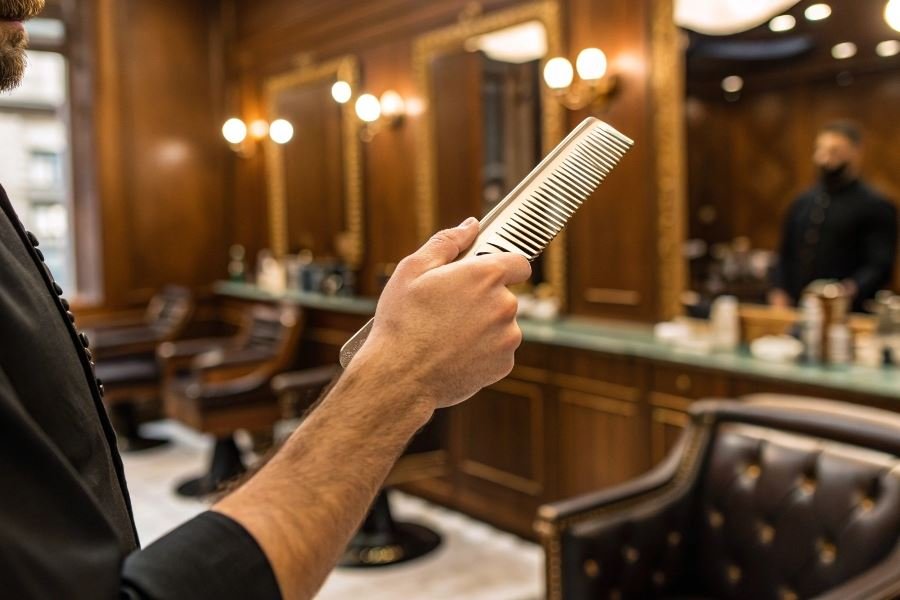
Ever watched a master barber transform an ordinary head of hair into a work of art with seemingly effortless precision? Behind that magic lies an often-overlooked hero: the professional haircut comb.
The difference between good and extraordinary haircuts often comes down to the tools in a stylist’s hands. While scissors get all the glory, it’s the humble comb that guides every snip, controls tension, and creates the foundation for perfect cuts. Professional stylists know that selecting the right comb isn’t just about preference—it’s about performance.
When master stylists discuss their craft, the relationship between comb selection and haircut quality emerges as fundamental. A precision-crafted comb with properly spaced teeth creates consistent tension across hair sections, allowing for clean, deliberate cutting lines. The wrong comb? It can lead to uneven sections, imprecise angles, and ultimately, disappointed clients.
Consider this: a carbon fiber cutting comb with fine teeth might cost $25-35, while a basic plastic version runs under $5. That price difference reflects durability, precision, and performance under pressure. The professional’s comb isn’t just a tool—it’s an extension of their artistic vision.
The comb’s material, tooth spacing, and handle design all influence technique execution. Wide-tooth combs glide through textured hair without causing damage, while fine-tooth versions create the tension needed for precision cutting. The right comb becomes invisible in a master’s hand, allowing their creativity and expertise to take center stage.
Material Matters: Choosing the Perfect Haircut Comb
When it comes to professional haircutting, the humble comb is anything but ordinary. The right tool can mean the difference between precision work and constant frustration. Professional stylists understand that selecting appropriate haircut combs based on their material and construction directly impacts cutting accuracy, client comfort, and even the longevity of the tool itself.
For professionals seeking to elevate their craft, understanding the features of choosing for a master haircut comb becomes essential knowledge. The material composition affects everything from how the comb moves through hair to how it responds to heat and chemicals commonly found in salon environments. Let’s explore the three premier materials that dominate professional haircutting tools today.
Carbon Fiber: The Modern Marvel
Carbon fiber combs represent the cutting edge of haircutting technology, offering exceptional benefits that justify their premium price point:
Heat Resistance: These combs withstand temperatures up to 410°F (210°C), making them ideal companions for blow-drying and hot tool work.
Lightweight Durability: Despite their incredible strength, carbon fiber combs typically weigh 40-60% less than comparable metal options, reducing hand fatigue during long styling sessions.
The seamless construction of quality carbon fiber combs eliminates rough edges that can snag and damage hair strands.
Carbon fiber’s anti-static properties also prevent the frustrating “flyaway effect” that can compromise precision cutting. These combs maintain their shape even under extreme salon conditions, with many manufacturers offering lifetime guarantees against warping.
Hard Rubber: The Classic Performer
Hard rubber combs (often called vulcanite or ebonite) have earned their place in professional kits for generations:
Static Prevention: The natural properties of hard rubber neutralize static electricity, keeping hair manageable and in place during cutting.
Scalp Comfort: The smooth, rounded teeth glide through hair with minimal pulling, making these combs particularly suitable for clients with sensitive scalps.
| Feature | Benefit |
|---|---|
| Seamless molding | No rough edges to catch hair |
| Chemical resistance | Withstands salon products |
| Temperature stability | Minimal expansion/contraction |
Hard rubber combs from manufacturers like Mason Pearson have achieved legendary status for their hand-polished finish and precise tooth spacing. While they require more careful handling than carbon fiber or metal alternatives, their gentle performance on natural hair textures remains unmatched.
Metal Combs: Precision Incarnate
Metal combs, typically crafted from aluminum or stainless steel, excel in specific applications:
Sectioning Mastery: The rigid structure and precise teeth allow for clean, accurate partings essential for complex cutting techniques.
Cutting Guide Accuracy: When used as cutting guides, metal combs provide unwavering stability that translates to consistent results.
The weight of quality metal combs provides tactile feedback that many experienced stylists rely on for their cutting rhythm.
Metal combs from YS Park feature precisely measured teeth spacing and innovative designs that facilitate advanced cutting techniques. Their durability makes them particularly cost-effective for high-volume salons, though they require occasional teeth realignment to maintain optimal performance.
Each material offers distinct advantages depending on the cutting technique, hair type, and personal preference. Many master stylists maintain a collection of all three, selecting the perfect tool for each specific task rather than compromising with a one-size-fits-all approach.
Maximizing Your Professional Comb Arsenal
Extending the life of your cutting tools
Professional haircut combs are investments that demand proper care. Quality combs from manufacturers like Kent or YS Park can last for years—sometimes decades—with appropriate maintenance. The key is establishing a consistent cleaning routine after each client.
Daily maintenance is non-negotiable. Remove hair debris between teeth using a fine brush, then sanitize with barbicide or a professional-grade disinfectant solution. For carbon combs, avoid prolonged soaking as this can compromise structural integrity over time.
The difference between amateur and professional comb maintenance isn’t the products used—it’s the consistency of the cleaning routine.
Temperature extremes are the silent killers of quality combs. Store them away from direct sunlight and heat sources, which can warp even premium materials. Many professionals use UV sanitizing cabinets like the Salon Sundry units that disinfect without heat damage.
Building a strategic comb collection
The versatility of your cutting technique depends directly on your comb arsenal. Rather than accumulating random tools, strategic collection-building focuses on technique coverage:
Foundation combs should include:
- Wide-tooth detangling comb (7-9 teeth per inch)
- Fine-tooth cutting comb (15+ teeth per inch)
- Sectioning comb with pointed tail
- Barber comb with graduated teeth
Specialized technique combs expand your capabilities:
| Technique | Recommended Comb Type | Key Feature |
|---|---|---|
| Precision cutting | Fine-tooth carbon | Rigidity for clean lines |
| Texturizing | Wide-tooth with irregular spacing | Creates natural movement |
| Fades/tapers | Flat-top comb | Provides consistent elevation |
| Curly hair | Wide-tooth with rounded tips | Minimizes disruption of curl pattern |
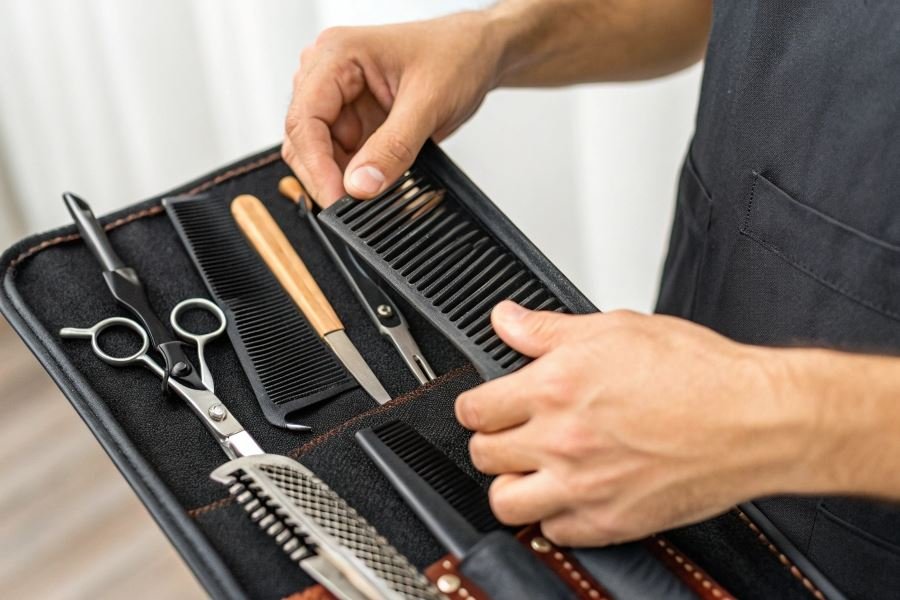
The mark of a master isn’t owning every comb available but having the perfect tool for each cutting scenario. Most professionals find their sweet spot with 5-7 carefully selected combs that cover their service menu completely.
Quality economics in comb selection
The financial calculation for professional combs extends beyond initial purchase price. Premium combs from Mason Pearson or Hercules Sägemann might command $20-45 per tool, but their longevity transforms this from expense to investment.
Cost-per-use analysis reveals the true value. A $35 professional comb used 1,000 times costs 3.5 cents per application—significantly less than replacing $8 combs that crack or warp after 100 uses (8 cents per use).
Material selection drives both performance and economics:
- Carbon fiber offers supreme durability and heat resistance
- Cellulose acetate provides flexibility with excellent durability
- Hard rubber delivers anti-static properties and gentle scalp interaction
The most successful professionals view their comb collection as a career-spanning toolkit rather than disposable implements. By investing in quality, implementing proper maintenance, and strategically building a versatile collection, you create a competitive advantage that pays dividends with every client service.
Discover the essential features of professional haircut combs for master stylists. Learn how material, construction, and design impact cutting precision and client comfort. Expert guide to selecting the perfect combs for your styling toolkit.
Discover the essential features of professional haircut combs for master stylists. Learn how material, construction, and design impact cutting precision and client comfort. Expert guide to selecting the perfect combs for your styling toolkit.