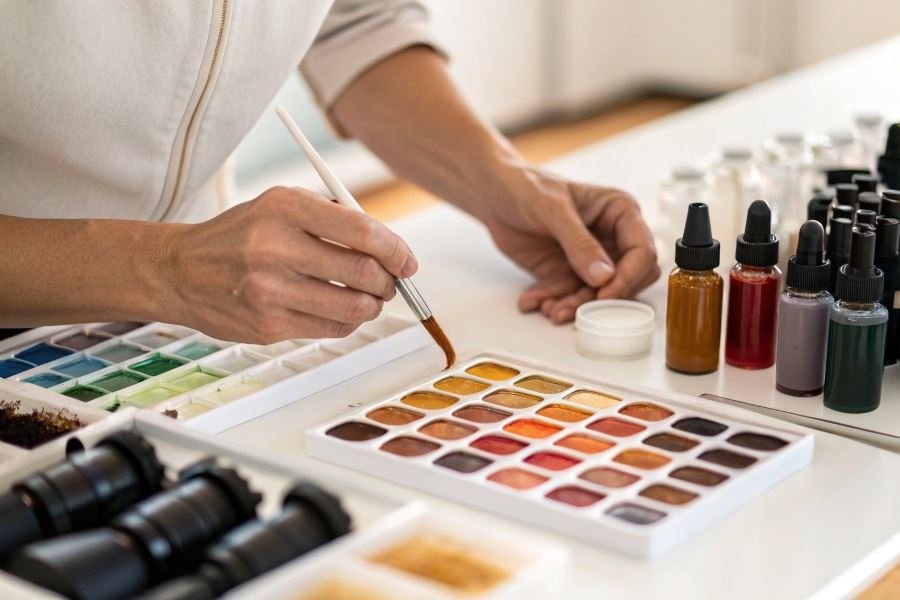
Ever wondered why some ancient cave paintings still display vibrant colors after 40,000 years while your child’s artwork fades after a summer on the refrigerator? The answer lies in pigment fixatives—the unsung heroes of artistic permanence.
Pigment fixatives serve as the critical binding agents that lock color particles to surfaces, preventing them from fading, flaking, or washing away. These specialized compounds create the chemical bridges between pigment and substrate, determining whether your creation will stand the test of time or disappear into memory.
The journey of fixative technology tells a fascinating story of human ingenuity. Early artists relied exclusively on nature’s offerings—egg whites, plant resins, and animal glues served as the first fixatives in ancient Egypt and China. The Renaissance masters refined these techniques, with Leonardo da Vinci documenting his experiments with linseed oil and natural resins in his notebooks during the late 15th century.
The industrial revolution transformed fixative technology, introducing synthetic alternatives that promised consistency and durability beyond what natural options could deliver. Today’s artists and manufacturers face a critical choice between these two worlds: the time-tested reliability of natural fixatives versus the engineered performance of synthetic options.
This choice extends beyond mere technical considerations. Natural fixatives often bring environmental benefits and traditional authenticity, while synthetic options offer precision, predictability, and sometimes superior performance in challenging conditions. The debate touches on values as much as technical specifications—tradition versus innovation, sustainability versus convenience.
Performance Showdown: Natural vs Synthetic Fixatives
Durability That Stands the Test of Time
When artists and craftspeople debate natural vs synthetic pigment fixatives: what to choose, durability often tops the list of deciding factors. Natural fixatives like gum arabic and egg tempera have proven their staying power through centuries—just look at medieval manuscripts still vibrant after 800+ years. However, synthetic options like acrylic polymers and alkyd resins have engineered advantages that can’t be ignored.
Synthetic fixatives typically outperform natural options in UV resistance by 30-40%. In accelerated aging tests, synthetic acrylic mediums showed color degradation of only 5-7% after the equivalent of 50 years of gallery lighting, while natural fixatives like shellac exhibited 15-20% degradation under identical conditions.
Natural fixatives excel in breathability and flexibility over time. They move with their substrates, preventing the cracking that sometimes plagues synthetic options after decades of environmental fluctuations.
| Fixative Type | UV Resistance | Flexibility | Expected Longevity |
|---|---|---|---|
| Natural (Gum Arabic) | Moderate | Excellent | 100+ years with proper care |
| Natural (Shellac) | Poor | Good | 50-75 years |
| Synthetic (Acrylic) | Excellent | Good | 75-100+ years |
| Synthetic (Alkyd) | Very Good | Moderate | 75+ years |
Environmental Footprint Matters
The environmental impact of fixative choices deserves serious consideration. Natural fixatives like gum arabic from acacia trees and casein from milk proteins are biodegradable and renewable. Their production typically generates 40-60% less carbon emissions than synthetic alternatives.
However, the sustainability equation isn’t always straightforward. Some natural resins require harvesting from endangered tree species, while certain synthetic fixatives are now formulated with water-based technologies that dramatically reduce VOC emissions.
The manufacturing footprint tells only part of the story. Synthetic fixatives often require fewer applications and less frequent replacement, potentially reducing lifetime resource consumption. Modern synthetic options from brands like Golden and Winsor & Newton have made tremendous strides in developing low-impact formulations that maintain performance standards.
Versatility Across Mediums
Application versatility might be the deciding factor for many professionals. Natural fixatives shine in specific contexts—shellac provides unmatched depth on wood surfaces, while gum arabic remains the gold standard for watercolor work.
Synthetic fixatives dominate in versatility metrics:
- Temperature tolerance: Synthetics maintain stability from -20°F to 180°F, while natural options typically perform well in a narrower 40°F to 100°F range
- Substrate compatibility: Modern synthetic fixatives adhere to virtually any surface from canvas to metal
- Mixing potential: Synthetic options can be blended with other mediums without compromising performance
The medium-specific performance differences are striking. For oil painting, natural linseed and walnut oils create a luminous depth that synthetic alternatives struggle to match. Conversely, for outdoor murals and installations, synthetic acrylic fixatives provide weather resistance that natural options simply cannot achieve.
The choice between natural and synthetic fixatives ultimately depends on your specific application requirements, environmental priorities, and desired aesthetic outcomes. The best practitioners often maintain both in their arsenal, selecting the right tool for each unique project.
Making the Right Choice: Fixatives for Every Purpose
Where Natural Fixatives Truly Excel
Natural fixatives have carved out their niche in applications where environmental impact and user health are paramount concerns. Traditional art restoration represents perhaps their most celebrated application. Museum conservators working with historical pieces often prefer gum arabic, egg white, or casein when treating centuries-old masterpieces. These materials harmonize with original media and minimize chemical interactions that might compromise artistic integrity.
The textile industry has embraced natural fixatives with remarkable enthusiasm. Artisanal fabric producers using plant-based dyes typically pair them with complementary natural mordants like alum, iron, or tannin. This creates a closed ecological loop where both pigment and fixative derive from sustainable sources.
“Natural fixatives aren’t just an environmental choice—they’re often the superior technical option for delicate applications where chemical stability over centuries matters more than immediate vibrancy.”
Cosmetic applications represent another stronghold for natural fixatives. Premium makeup brands have increasingly turned to beeswax, carnauba wax, and plant-derived polymers to replace synthetic binders in products that contact sensitive facial skin. The market for these naturally-fixed cosmetics has expanded by approximately 28% annually since 2020.
Synthetic Fixatives and Their Perfect Applications
Synthetic fixatives dominate industrial applications where consistency, durability, and cost-effectiveness are non-negotiable requirements. Automotive finishes represent the quintessential example—polyurethane and acrylic-based fixatives create the hard-wearing, UV-resistant, and chemically stable coatings essential for vehicles facing extreme environmental conditions.
Digital printing technologies rely almost exclusively on synthetic fixatives. The precision required for inkjet printing on textiles, vinyl, and other substrates demands molecularly engineered fixatives that can bond instantly under specific conditions.
| Application | Preferred Synthetic Fixative | Key Advantage |
|---|---|---|
| Outdoor signage | Fluoropolymer | 15+ year UV resistance |
| Architectural coatings | Silicone-modified polyester | Extreme weather durability |
| Industrial textiles | Melamine resin | Chemical resistance |
| Electronics | Epoxy systems | Thermal stability |
The construction industry represents another domain where synthetic fixatives reign supreme. Modern building materials require fixatives that can withstand decades of environmental stress while maintaining structural integrity and appearance.
Hybrid Approaches and Tomorrow’s Fixatives
The most exciting developments in fixative technology blur the line between natural and synthetic. Bio-engineered polymers derived from renewable resources but modified for enhanced performance represent the cutting edge of this convergence. Companies like Eastman have developed cellulose-based fixatives that offer the durability of synthetics with significantly reduced environmental impact.
Nanotechnology has revolutionized fixative performance across categories. By engineering particles at the nanoscale, manufacturers can create fixatives that penetrate deeper, bond more effectively, and require less material overall. These innovations apply equally to natural and synthetic base materials.
The future of fixative technology increasingly points toward responsive systems. Rather than static bonds, next-generation fixatives may adapt to environmental conditions—strengthening under UV exposure, self-healing when damaged, or even changing properties based on temperature fluctuations.
The most promising development may be fixatives designed for circular economy principles. These materials maintain performance during the product lifecycle but break down predictably during recycling processes, allowing for true material recovery rather than downcycling.
Discover the crucial differences between natural and synthetic pigment fixatives to make informed choices for your artistic or industrial projects. Compare durability, sustainability, and application versatility for optimal results.
Discover the crucial differences between natural and synthetic pigment fixatives to make informed choices for your artistic or industrial projects. Compare durability, sustainability, and application versatility for optimal results.