Ever watched a skilled woodworker try to set up shop in a client’s backyard, struggling with makeshift surfaces and unstable workbenches? For the 12.5 million Americans who make their living through mobile craftsmanship, this scenario isn’t just frustrating—it’s a daily productivity killer.
The mobile craftsman’s dilemma has always been balancing professional-grade workspace needs with the reality of constant movement. Carpenters, jewelry makers, leatherworkers, and restoration specialists face unique challenges: they need stability for precision work, organization for countless tools, and portability for their nomadic business model. Traditional solutions often forced an impossible choice between quality and mobility.
What began as simple folding sawhorses in the 1950s has evolved into sophisticated systems that would make yesterday’s craftsmen green with envy. Today’s portable workshop solutions incorporate aircraft-grade aluminum, carbon fiber components, and ingenious folding mechanisms that can support hundreds of pounds yet collapse to fit in a standard vehicle.
The investment in quality folding furniture pays dividends beyond mere convenience:
- Expanded client reach: Serve customers anywhere without sacrificing work quality
- Reduced overhead: Eliminate fixed workshop rental costs
- Professional image: Present a polished, prepared appearance to clients
- Physical preservation: Properly designed ergonomic solutions prevent the back and joint injuries that plague 68% of career craftspeople
For mobile artisans, the right folding furniture isn’t just equipment—it’s the foundation that makes their business model possible in the first place.
Essential Folding Furniture for the Mobile Workshop
The modern craftsman is no longer chained to a permanent workshop. Today’s artisans need mobility without sacrificing functionality. Folding furniture for mobile craftsmen has evolved dramatically, offering compact solutions that deliver professional-grade performance in portable packages. Let’s explore the essential categories that are revolutionizing how skilled professionals work on the go.
Collapsible Workbenches That Won’t Buckle
The foundation of any mobile workshop starts with a reliable workbench. Modern collapsible options have shattered the old compromise between portability and stability.
The Keter Folding Work Table stands out with its impressive 1,000-pound weight capacity despite weighing just 30 pounds itself. Its quick-release legs deploy in seconds, transforming from a 4.5-inch flat package to a full 29.75-inch tall workspace.
For heavier applications, the WORX Pegasus multi-function table converts between workbench and sawhorse modes, supporting up to 300 pounds as a table and 1,000 pounds as a sawhorse pair. The integrated clamping system adds versatility for securing materials during precision work.
Weight capacity comparison:
| Workbench Model | Weight Capacity | Folded Dimensions | Setup Time |
|---|---|---|---|
| Keter Folding | 1,000 lbs | 33.5″ × 21.7″ × 4.5″ | Under 30 sec |
| WORX Pegasus | 300 lbs (table) | 31″ × 25″ × 4.5″ | Under 3 min |
| Kreg Mobile | 350 lbs | 44.3″ × 16.9″ × 6.5″ | Under 1 min |
Tool Storage That Travels Smart
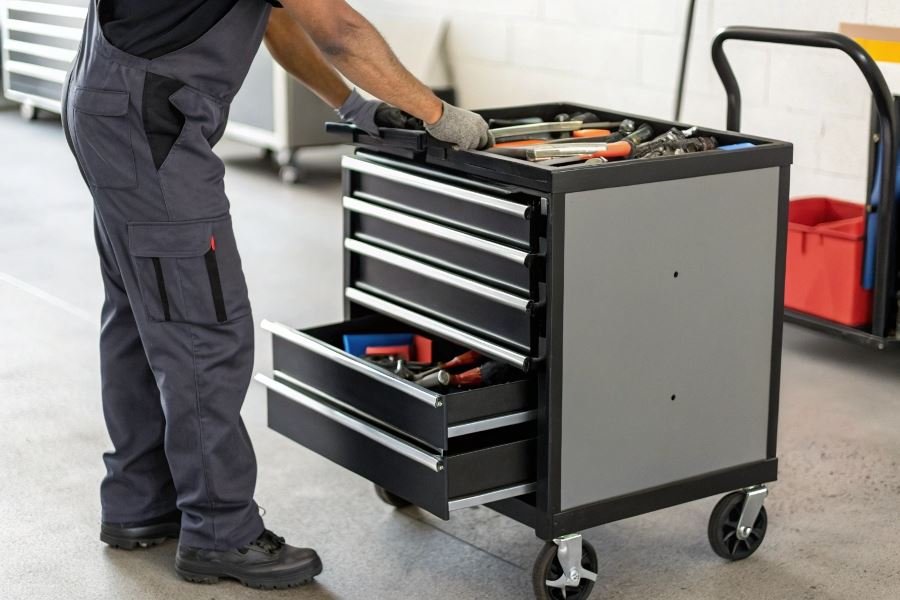
Portable tool storage has transcended the basic toolbox with integrated organization systems that maximize efficiency in minimal space.
The Milwaukee Packout modular storage system represents the gold standard with customizable, stackable components that lock together. The water-resistant design protects valuable tools while the reinforced corners withstand job site abuse.
The versatility of these systems allows craftsmen to configure exactly what they need for each job, eliminating the frustration of hauling unnecessary weight.
For precision tool organization, the DeWalt ToughSystem offers specialized inserts for power tools with custom-cut foam that prevents movement during transport. The clear-top options allow for quick visual inventory without opening containers.
Key features to look for:
- Modular connectivity between components
- Weather resistance (minimum IP54 rating)
- Integrated wheels on larger components
- Load-bearing capacity indicators
- Quick-release latches operable with gloved hands
Multi-functional Seating With Hidden Storage
The craftsman’s seating has evolved far beyond the basic stool, now incorporating clever storage solutions that maximize efficiency.
The Stanley FatMax mobile work station combines a comfortable seat with three drawers, a lockable storage bin, and a weight capacity of 350 pounds. Its 7-inch rubber wheels navigate rough terrain while the telescoping handle makes transport effortless.
For more compact needs, the Ridgid JobMax step stool supports 300 pounds while concealing a storage compartment perfect for frequently used hand tools. The non-slip surface provides stability during use.
Innovative features worth noting:
- Padded seats with waterproof, oil-resistant coverings
- Quick-conversion mechanisms between sitting and standing heights
- Integrated power strips and charging ports
- Reinforced corners to withstand job site conditions
- Locking casters that activate with foot pressure
The integration of these three essential furniture categories creates a complete mobile workshop system that rivals permanent installations in functionality while maintaining the flexibility modern craftsmen demand. When selecting components, prioritize compatibility between systems to create a cohesive workflow that enhances productivity rather than hindering it.
Mastering the Selection of Folding Furniture
When your craft follows you from job site to job site, the furniture that supports your work becomes as crucial as your tools themselves. Mobile craftsmen face unique challenges that demand thoughtful equipment choices. Let’s dive into the critical factors that separate merely adequate folding furniture from game-changing workspace solutions.
Durability vs. Weight: The Material Equation
The materials debate sits at the heart of every mobile craftsman’s decision-making process. Aluminum frames have revolutionized the portable furniture landscape, offering strength-to-weight ratios that were unimaginable just decades ago. A typical Festool folding workbench weighing under 30 pounds can support over 300 pounds of working weight—an engineering marvel that transforms any location into a professional workspace.
The material choice extends beyond the frame to every component:
- Tabletops: Bamboo composites deliver exceptional durability while maintaining reasonable weight profiles
- Joints and hinges: Aircraft-grade aluminum and reinforced polymers provide thousands of fold cycles without failure
- Support structures: Carbon fiber components are entering the market, offering unmatched strength at minimal weight penalties
For woodworkers, the Kreg mobile solutions incorporate steel reinforcements at critical stress points while maintaining manageable overall weight. Metalworkers might gravitate toward the heavier but virtually indestructible Milwaukee folding workstations that prioritize stability during high-vibration tasks.
Setup Efficiency That Respects Your Time
The most beautifully engineered folding furniture becomes worthless if it requires 20 minutes of assembly before you can begin work. Modern designs have dramatically improved deployment metrics:
| Furniture Type | Average Setup Time | Number of Steps | Tool Requirements |
|---|---|---|---|
| Premium Workbenches | 45-90 seconds | 3-5 | None |
| Mid-range Tables | 2-4 minutes | 5-8 | None |
| Budget Options | 5-10 minutes | 8-12 | May require hex key |
The DeWalt folding workstation exemplifies this efficiency with its one-motion deployment system that transforms from compact to fully operational in under 60 seconds. Similarly, the Worx Pegasus series features intuitive locking mechanisms that eliminate guesswork during setup.
Time spent setting up is time not spent crafting. The best systems incorporate:
- One-handed locking mechanisms
- Color-coded deployment sequences
- Self-aligning components that eliminate fumbling
- Integrated storage for any required assembly tools
Transportation Compatibility and Space Optimization
The final consideration—perhaps the most critical for truly mobile craftsmen—is how the furniture integrates into your existing transportation ecosystem.
Dimensional awareness matters. The most powerful folding system becomes useless if it doesn’t fit in your vehicle or storage space. Leading manufacturers now provide detailed folded dimensions that allow craftsmen to verify compatibility before purchase.
Smart design features that enhance transportation include:
- Nesting capabilities that allow multiple pieces to stack efficiently
- Integrated carrying handles positioned at the center of gravity
- Protective edge guards that prevent damage during transport
- Standardized folded dimensions that align with common vehicle storage areas
The Bora Portamate folding workbench exemplifies this thinking with its slim 4.5-inch profile when collapsed, allowing it to slide behind truck seats or into narrow storage spaces that would reject bulkier alternatives.
When evaluating transportation compatibility, consider not just the primary furniture but your entire mobile workshop ecosystem. The best solutions create a cohesive system where each component complements rather than competes with others for precious cargo space.
Discover the best folding workbenches and portable workshop solutions for craftsmen on the go. Our comprehensive guide explores durable, space-saving options that combine functionality with easy transport for your mobile business needs.
Discover the best folding workbenches and portable workshop solutions for craftsmen on the go. Our comprehensive guide explores durable, space-saving options that combine functionality with easy transport for your mobile business needs.