Ever wondered why your feet ache after a long workday? The culprit might be standing right under you. American workers lose an estimated 24 million workdays annually to foot injuries—many preventable with properly fitted footwear.
When it comes to work boots, the right size isn’t just about comfort—it’s about safety, productivity, and long-term foot health. Think of your work boots as the foundation of your occupational well-being. Just as a house built on a weak foundation eventually crumbles, your body can’t perform optimally when supported by ill-fitting footwear.
The sizing dilemma goes beyond simple numbers. Many workers make the critical mistake of applying their regular shoe size to work boots, not realizing that industrial footwear often fits differently. Others compromise fit for convenience, grabbing whatever’s available rather than what’s right for their unique foot structure.
These seemingly minor compromises can lead to major consequences:
- Plantar fasciitis from inadequate arch support
- Bunions and hammertoes from too-narrow toe boxes
- Blisters and calluses from friction points
- Increased risk of trips and falls from poor stability
Throughout this guide, we’ll explore the science of proper boot sizing, decode confusing measurement systems, and provide practical strategies for finding your perfect fit. You’ll discover why afternoon fittings yield better results, how to account for specialized socks, and which telltale signs indicate it’s time for a size adjustment.
Your feet carry you through every workday—they deserve protection that fits perfectly.
Measuring for Perfect Work Boot Fit
Finding work boots that fit properly isn’t just about comfort—it’s about safety, productivity, and preventing long-term foot problems. The foundation of selecting the right size work boots begins with precise measurements and understanding sizing systems that vary across manufacturers and regions.
Getting accurate measurements is the critical first step in how to choose the right size of work boots for comfortable wear throughout long workdays. Without proper sizing, even the most expensive, high-quality boots will cause discomfort, blisters, and potentially serious foot issues over time.
Mastering the Measurement Process
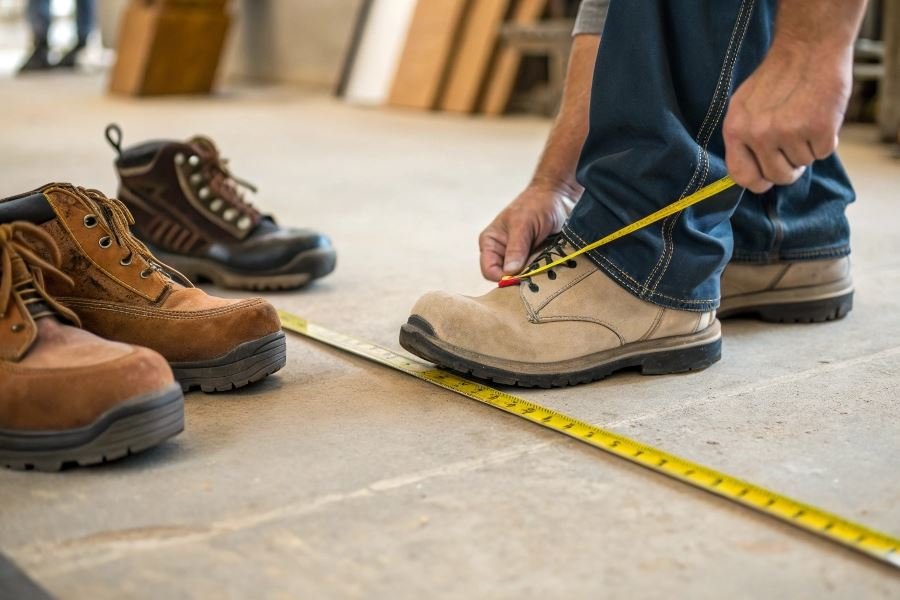
To measure your feet correctly, start late in the day when feet are naturally at their largest. Wear the socks you’ll typically use with your work boots, then follow these steps:
-
Length measurement: Stand on a piece of paper with your heel against a wall. Mark the longest point of your foot (usually the big toe, but not always). Measure from heel to the mark in inches or centimeters.
-
Width measurement: Wrap a flexible measuring tape around the widest part of your foot (typically the ball). For greater accuracy, have someone help you while you stand with full weight on your foot.
-
Arch length: Measure from your heel to the ball of your foot where it bends. This often-overlooked measurement helps determine where the boot should flex with your foot.
Always measure both feet—most people have one foot slightly larger than the other. Always buy for your larger foot.
Decoding Boot Sizing Systems
Work boot sizing can feel like learning a foreign language with different systems used worldwide:
| Sizing System | Characteristics | Width Designations |
|---|---|---|
| US | Whole and half sizes | A (narrow), B, C, D (medium), E, EE, EEE (wide) |
| UK | Typically one size smaller than US | C, D, E (medium), F, G, H (wide) |
| EU | Measured in centimeters (39-48) | No standard width system |
Most American work boot manufacturers use a width scale where “D” represents a medium width for men, while “B” is medium for women. Each letter increase (D to E to EE) represents approximately a 1/8″ increase in width.
The Sock Factor
Never underestimate sock thickness when sizing work boots. The difference between a thin dress sock and a thick winter work sock can easily change your required boot size by half to a full size.
For cold weather work environments, consider:
- Sizing up by ½ size for medium-weight work socks
- Sizing up by a full size for heavyweight thermal socks
For year-round wear, purchase boots that accommodate your thickest regular work socks without feeling tight. Remember that quality merino wool socks from brands like Darn Tough or Smartwool provide cushioning without excessive bulk.
Testing the Fit
After measuring, when trying boots on:
- Your toes should have about ½” of space from the front
- The widest part of your foot should align with the widest part of the boot
- Your heel should remain firmly in place with minimal slippage
- The arch support should match your foot’s natural arch
Walk around, bend, squat, and stand on the balls of your feet. A properly sized work boot will feel secure but not constrictive, with no pinching or sliding.
Remember that leather work boots typically stretch width-wise but not length-wise, so if they feel too tight across the width initially, they may improve with wear—but if they’re too short, they’ll never be comfortable.
Perfect Fit: Mastering the Final Steps of Work Boot Selection
Finding work boots that fit just right isn’t just about comfort—it’s about safety, productivity, and long-term foot health. These final considerations will transform your boot-buying experience from guesswork to precision.
Shop during the afternoon hours
Timing matters more than you might think. Your feet naturally expand throughout the day, typically reaching their maximum size in late afternoon.
Wisdom nugget: A boot that fits perfectly at 9 AM might feel uncomfortably tight by 3 PM when you’re on hour six of your shift.
The ideal window for trying on work boots is between 2 PM and 5 PM. This ensures you’re fitting boots to your feet at their largest state, preventing the unpleasant surprise of tightness during long workdays. For those working night shifts, try on boots after you’ve been awake and on your feet for at least 5-6 hours.
Test drive before committing
Don’t just stand up and take two steps when trying boots. Implement this comprehensive testing protocol:
- The walking test: Walk at least 50 steps, including up and down inclines if possible
- The squat test: Perform 3-5 deep squats to check flexibility at the ball of the foot
- The toe wiggle: Ensure you can comfortably wiggle your toes without hitting the front
- The heel lift: Your heel should lift no more than ¼ inch when walking
Many specialty retailers like Red Wing and Thorogood offer in-store testing areas with different surfaces and inclines. Take advantage of these facilities to simulate real working conditions.
When standard sizes don’t cut it
Sometimes, even the most thorough shopping can’t overcome unique foot characteristics. Consider specialized options when:
| Foot Characteristic | Specialized Solution |
|---|---|
| Very wide forefoot with narrow heel | Combination last boots or custom fitting |
| High arches | Boots with removable insoles for orthotic insertion |
| Different sized feet | Brands offering split sizing or adjustable features |
| Foot conditions (bunions, hammertoes) | Medical-grade work boots with stretch panels |
Custom work boots from manufacturers like Nick’s Handmade Boots or White’s Boots represent an investment, typically starting at $400, but can provide unmatched comfort for those with unique requirements. The customization process typically involves detailed measurements and sometimes even foot molds.
For less severe cases, consider aftermarket solutions like heat-moldable insoles from Superfeet that can be customized to your foot’s contours while maintaining safety standards.
Remember that proper fit isn’t a luxury—it’s essential protection. Boots that don’t fit correctly compromise the safety features they were designed to provide. The extra time spent ensuring perfect fit pays dividends in comfort, safety, and longevity of both your boots and your career.
Discover how to measure your feet correctly, understand sizing systems, and find perfectly fitting work boots that provide all-day comfort and safety. Includes expert tips for testing fit and accommodating sock thickness.
Discover how to measure your feet correctly, understand sizing systems, and find perfectly fitting work boots that provide all-day comfort and safety. Includes expert tips for testing fit and accommodating sock thickness.