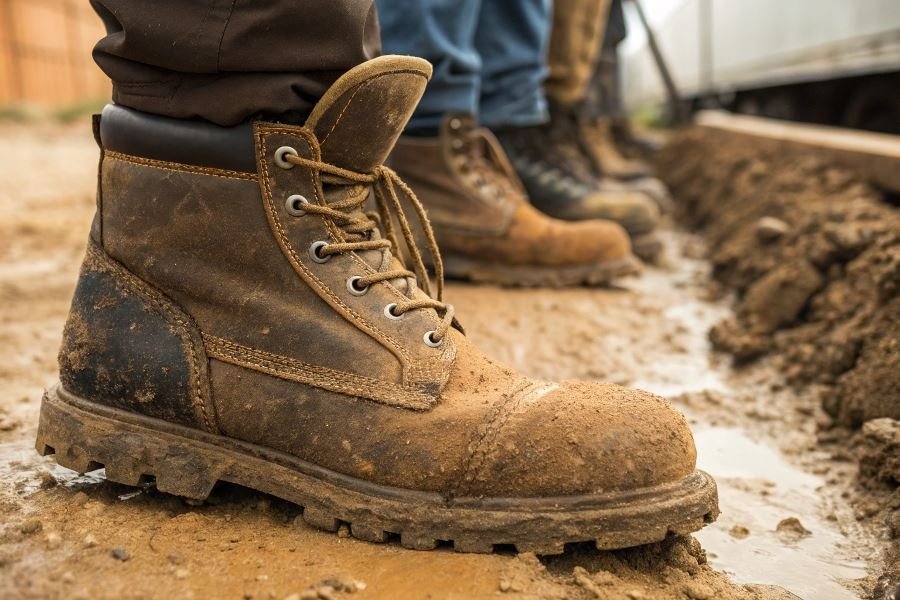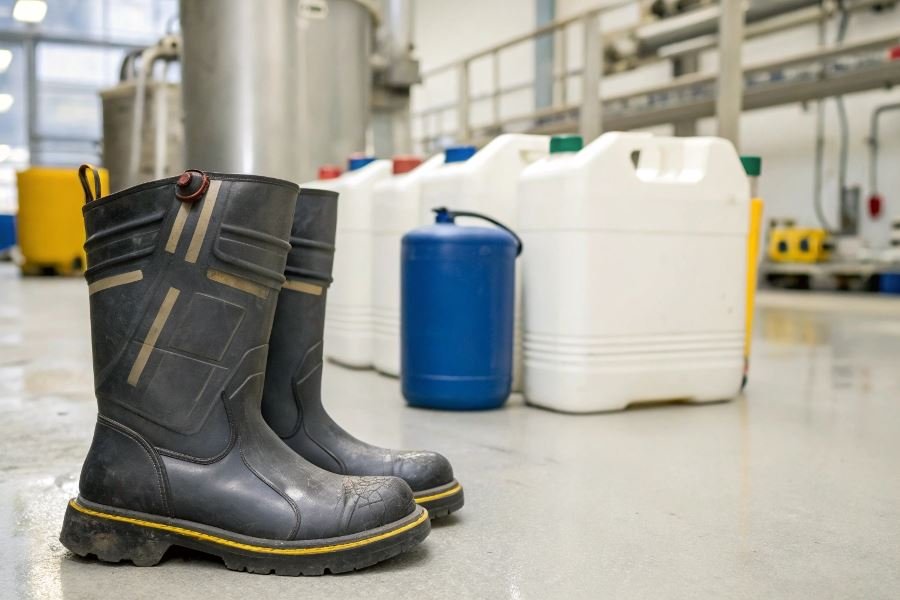
Did you know that over 25,000 chemical exposure incidents occur annually in American workplaces? For professionals working with hazardous substances, the right footwear isn’t just about comfort—it’s about survival.
When caustic acids, corrosive bases, or toxic solvents threaten to compromise safety, chemical-resistant work boots become the critical barrier between devastating injury and going home safely. These specialized boots are engineered with materials specifically designed to withstand contact with dangerous chemicals, preventing penetration and protecting the wearer from potentially life-altering exposure.
“The right chemical protection footwear isn’t an expense—it’s an investment in your future.”
Industries where chemical protection is non-negotiable
Chemical hazards lurk in surprising places. Beyond obvious settings like laboratories and chemical manufacturing, workers in agriculture (pesticide exposure), healthcare (disinfectants), construction (solvents), and even food processing face daily chemical risks. Each industry presents unique challenges, from splash hazards to immersion scenarios, requiring specialized protection.
Understanding regulatory frameworks
The Occupational Safety and Health Administration (OSHA) established clear standards for protective footwear through ASTM F2413, which specifically addresses chemical resistance requirements. These aren’t arbitrary guidelines—they’re science-backed protections developed after analyzing real-world incidents. Employers must provide appropriate footwear that meets these standards, while workers should verify compliance through proper certification markings.
Selecting the right chemical-resistant boots means understanding both the specific hazards in your environment and the regulatory standards designed to keep you safe. Your feet carry you through your workday—make sure they’re properly protected.
The Engineering Behind Chemical-Resistant Footwear
When industrial environments throw acids, solvents, and caustic compounds at workers daily, standard footwear simply disintegrates. Chemical-resistant work boots represent a fascinating intersection of materials science, ergonomic design, and safety engineering that deserves closer examination.
Selecting appropriate work boots with chemical protection features requires understanding the complex interplay between material composition, construction techniques, and comfort considerations. The specialized footwear must create an impenetrable barrier against hazardous substances while remaining comfortable enough for 12-hour shifts. This balance doesn’t happen by accident—it’s the result of decades of research and technological advancement.
Material Science Meets Chemical Warfare
The foundation of any chemical-resistant boot begins with its materials. Neoprene and butyl rubber lead the charge against acids and caustics, while nitrile excels against petroleum derivatives and solvents. The most advanced boots utilize polyvinyl chloride (PVC) and polyurethane (PU) compounds that manufacturers engineer specifically to resist degradation from multiple chemical families simultaneously.
Material performance varies dramatically by chemical exposure:
| Material | Strong Against | Vulnerable To |
|---|---|---|
| Neoprene | Acids, caustics, alcohols | Petroleum solvents |
| Nitrile | Oils, petroleum, many solvents | Ketones, acetates |
| PVC | Acids, bases, alcohols | Organic solvents |
| Butyl | Ketones, esters, aldehydes | Petroleum oils |
The highest-performing boots often feature multi-layer construction with different materials handling specific protection needs—much like how a hazmat suit employs multiple barriers.
Construction Techniques That Defy Degradation
Material selection is only half the equation. How these materials come together determines whether chemicals find weak points to exploit. The most effective chemical-resistant boots employ:
Vulcanization bonding creates molecular cross-links between rubber polymers, dramatically increasing chemical resistance compared to adhesive-based construction. This process essentially transforms separate components into a single, unified material.
Seamless molding techniques eliminate traditional stitching—a notorious entry point for liquids. Advanced manufacturers use injection molding to create one-piece uppers that provide uninterrupted protection.
The critical junction between sole and upper receives special attention through direct soling technology from companies like Dunlop and Honeywell. This technique creates a molecular bond that chemicals cannot penetrate, unlike traditional cementing methods that deteriorate over time.
Ergonomics: The Forgotten Defender
Protection becomes meaningless if workers remove uncomfortable boots. The ergonomic considerations in chemical-resistant footwear represent some of the most innovative aspects of their design.
Weight distribution systems prevent fatigue during extended wear, while anatomical footbeds provide support that reduces musculoskeletal stress. The best manufacturers incorporate:
- Removable cushioned insoles that wick moisture away from feet
- Metatarsal guards that flex with natural foot movement
- Ankle stabilizers that prevent twisting without restricting mobility
- Shock-absorbing midsoles that reduce impact forces by up to 40%
Tingley Rubber Corporation pioneered breathable linings that maintain chemical resistance while allowing heat dissipation—solving the traditional sauna-like environment inside rubber boots.
The most advanced chemical-resistant footwear now incorporates smart materials that adjust cushioning response based on temperature and pressure, ensuring comfort remains consistent throughout shifts in varying conditions.
When selecting chemical-resistant work boots, remember that protection, durability, and comfort aren’t competing priorities—they’re interdependent requirements that determine whether the footwear succeeds in its fundamental mission: keeping workers safe while enabling them to perform their jobs effectively.
The Ultimate Chemical Protection Footwear Guide
Identifying Your Workplace Chemical Threats
Chemical hazards vary dramatically across industries. In manufacturing environments, workers might encounter solvents like toluene and xylene, while agricultural settings present exposure to pesticides and fertilizers. Healthcare professionals face disinfectants and chemotherapy agents daily.
Start by conducting a comprehensive chemical inventory at your workplace. Document every substance you encounter, including concentrations and exposure frequency. This isn’t just good practice—it’s the foundation of your protection strategy.
The difference between adequate and optimal protection often comes down to understanding the specific chemical threats in your environment.
For example, petroleum-based chemicals require different boot materials than acids or caustics. Nitrile excels against petroleum products but may deteriorate rapidly when exposed to ketones. Meanwhile, neoprene offers outstanding protection against acids but performs poorly against hydrocarbon solvents.
Understanding Protection Standards That Matter
Chemical-resistant footwear must meet rigorous testing standards to ensure worker safety. The American Society for Testing and Materials (ASTM) F2413 standard specifically addresses protective footwear requirements, while ASTM F903 tests for liquid chemical permeation resistance.
Look for these critical certifications when evaluating work boots:
| Certification | What It Tests | Why It Matters |
|---|---|---|
| ASTM F2413 | Impact, compression, metatarsal protection | Ensures basic safety features beyond chemical resistance |
| ASTM F903 | Liquid chemical permeation | Measures how long chemicals take to penetrate material |
| EN 13832 | Protection against chemicals | European standard with three protection levels |
| NFPA 1991 | Chemical vapor protection | Critical for hazardous materials response |
Degradation testing results should be clearly indicated on quality footwear. These tests measure how boot materials physically change when exposed to specific chemicals—swelling, stiffening, or dissolving.
The highest-performing boots will provide a chemical resistance chart showing breakthrough times for common industrial chemicals. Longer breakthrough times (measured in minutes) indicate superior protection.
Maximizing Protection Through Proper Care
Even the most advanced chemical-resistant boots require proper maintenance to deliver consistent protection. Contaminated footwear can become a hazard itself, transferring chemicals to clean areas or degrading unexpectedly.
Implement these maintenance practices:
- Decontaminate after every exposure using manufacturer-recommended cleaning agents
- Inspect regularly for signs of material degradation—discoloration, stiffening, or tackiness
- Document exposure incidents to track cumulative chemical contact
- Store boots in cool, dry locations away from direct sunlight
The replacement timeline for chemical-resistant footwear isn’t universal. While some manufacturers suggest 6-12 month replacement cycles, actual replacement should be determined by:
- Visible degradation indicators
- Cumulative exposure to aggressive chemicals
- Manufacturer’s specific guidance for your model
- Changes in workplace chemical hazards
Chemical protection fails gradually, not suddenly. Regular inspection is your early warning system.
Remember that chemical breakthrough can occur without visible damage. If boots have been exposed to highly corrosive substances or have reached 80% of their documented breakthrough time, replacement becomes a priority regardless of appearance.
By systematically assessing your specific chemical hazards, understanding relevant protection standards, and implementing proper maintenance protocols, you’ll maximize both safety and the value of your protective footwear investment.
Discover how to select proper chemical-resistant work boots that meet safety standards while providing comfort. Learn about essential features, material properties, and industry-specific protection requirements for hazardous workplace environments.
Discover how to select proper chemical-resistant work boots that meet safety standards while providing comfort. Learn about essential features, material properties, and industry-specific protection requirements for hazardous workplace environments.