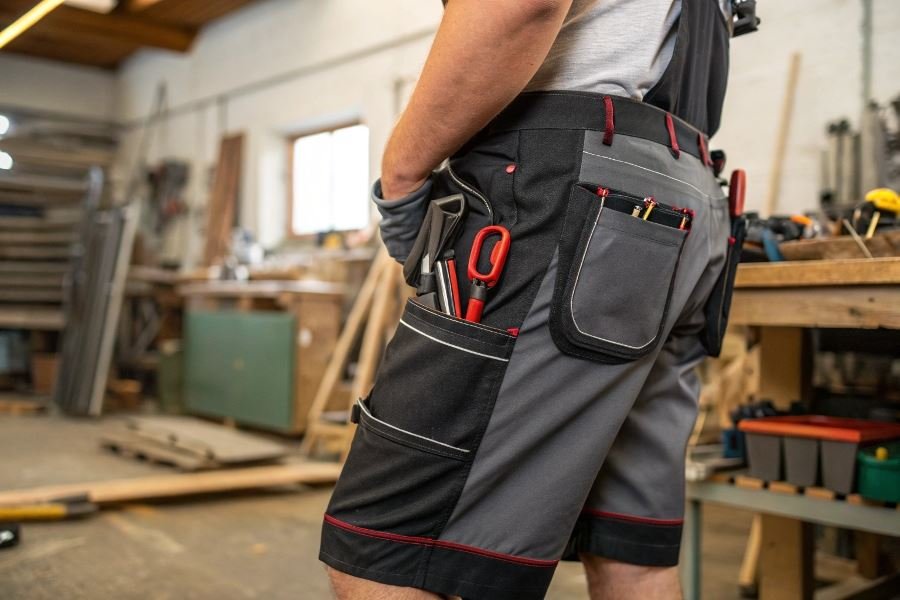
Ever stood in front of your closet, staring at yet another pair of blown-out work shorts, wondering why they couldn’t last just a few months longer? You’re not alone. The average tradesperson goes through 4-5 pairs of work shorts annually—a silent drain on both wallets and patience.
The material of your work shorts isn’t just a specification on a tag—it’s the difference between reliability and frustration in demanding environments. Whether you’re kneeling on abrasive surfaces, catching your pocket on a nail, or working through summer heat, your shorts are taking a beating that regular casual wear simply doesn’t experience.
What separates truly durable work shorts from the pretenders comes down to three critical factors: tensile strength (resistance to tearing), abrasion resistance (how it handles friction), and recovery (ability to return to original shape). The most demanding work environments require materials that excel in all three areas—not just one.
After analyzing performance data and interviewing master craftsmen who put their gear through punishing conditions daily, three materials consistently outperform all others: reinforced ripstop cotton, heavyweight canvas blends, and technical synthetics with mechanical stretch. Each brings distinct advantages to specific work environments, from construction sites to machine shops.
Let’s examine why these three materials have earned their reputation as the gold standard for professionals who demand performance without compromise.
Battle-Tested Materials for Workwear Endurance
When it comes to demanding work environments, your shorts need to withstand more than just a casual day at the office. The foundation of truly dependable work shorts lies in their material composition—the unsung hero determining whether they’ll survive a week or serve faithfully for years.
The quest for identifying top 3 materials for work shorts in terms of durability has led industry experts to consistently recommend three standout contenders that balance toughness with practical wearability. These aren’t just marketing claims; they’re performance-proven materials that have earned their reputation through countless jobsite battles.
Canvas/Duck Cotton: The Time-Tested Workhorse
Canvas (also known as duck cotton) stands as perhaps the most historically respected material in workwear. This tightly woven cotton fabric offers:
- Exceptional abrasion resistance that improves with age
- Natural breathability despite its substantial weight
- Remarkable resistance to punctures and tears
What distinguishes canvas from regular cotton is its specialized weaving technique—typically using a plain weave with heavier yarns—creating a material that can withstand repeated friction against rough surfaces. Carhartt pioneered the use of 12-ounce duck canvas in workwear, establishing a gold standard that continues to influence the industry.
Canvas doesn’t just resist wear—it develops character over time, conforming to your movements while maintaining structural integrity.
Ripstop Nylon: Engineered for Failure Prevention
Ripstop nylon represents a significant engineering advancement in fabric technology, incorporating a unique reinforcement technique:
| Feature | Benefit |
|---|---|
| Reinforcement grid pattern | Prevents tears from spreading |
| Lightweight composition | Reduces fatigue during extended wear |
| Water resistance | Maintains performance in variable conditions |
Originally developed for military parachutes, ripstop’s defining characteristic is its grid-like pattern of reinforcement threads woven into the base material. This ingenious design means that even when punctured, tears remain contained rather than propagating across the entire garment.
5.11 Tactical has perfected ripstop implementation in their professional-grade work shorts, often blending it with other materials to create hybrid fabrics that maximize both durability and comfort.
Cordura: The Technical Performance Leader
At the premium end of the durability spectrum sits Cordura—a technical fabric that represents the culmination of decades of textile innovation:
- Superior tear strength (up to 3x stronger than standard nylon)
- Exceptional abrasion resistance that outperforms natural fibers
- Advanced color-fastness even under harsh UV exposure
Developed by INVISTA, Cordura isn’t a single material but rather a family of advanced fabrics engineered at the molecular level. The most common variant used in work shorts is Cordura nylon 6,6, which offers an unmatched combination of toughness and reasonable weight.
What truly distinguishes Cordura is its performance metrics—laboratory testing shows it can withstand more than 100,000 abrasion cycles before showing significant wear, making it the undisputed champion for environments where failure isn’t an option.
When selecting work shorts, these three materials represent the pinnacle of durability engineering—each offering distinct advantages depending on your specific work demands and environmental conditions.
Making the Right Material Choice for Work Shorts
When it comes to work shorts that can withstand the daily grind, material selection isn’t just a preference—it’s a strategic decision that affects your comfort, productivity, and wallet. After examining the durability champions—canvas, ripstop, and duck cotton—let’s determine which material deserves your investment based on your specific work demands.
Performance across work environments
Different work settings demand different material properties. Here’s how our top contenders measure up:
| Material | Construction Sites | Landscaping | Mechanical Work | Heat Resistance | Water Resistance |
|---|---|---|---|---|---|
| Canvas | ★★★★★ | ★★★★☆ | ★★★★☆ | ★★★☆☆ | ★★★☆☆ |
| Ripstop | ★★★☆☆ | ★★★★★ | ★★★☆☆ | ★★★★☆ | ★★★★☆ |
| Duck Cotton | ★★★★☆ | ★★★☆☆ | ★★★★★ | ★★★★☆ | ★★★★★ |
Canvas excels in high-abrasion environments where you’re constantly moving against rough surfaces. The tight weave of canvas creates a fortress against sharp objects and rough edges, making it ideal for construction workers who frequently brush against concrete and metal.
Ripstop’s grid pattern provides exceptional tear resistance while maintaining breathability—perfect for landscapers who need protection without overheating. The reinforced structure prevents small tears from expanding, giving you more time between replacements.
Duck cotton delivers unmatched performance for mechanics and fabricators. Its dense weave resists oil penetration while providing enough flexibility to move comfortably under vehicles or in tight spaces.
Maintenance strategies for maximum lifespan
Each material requires specific care to maintain its protective qualities:
Canvas shorts benefit from cold water washing and air drying. Avoid fabric softeners which break down the protective fibers. A stiff brush can remove dried mud without damaging the weave—extending life by up to 30% compared to machine washing alone.
Ripstop requires gentler treatment. Turn shorts inside out before washing to protect the grid reinforcement. Mild detergent preserves the water-resistant coating many manufacturers apply. One maintenance advantage: ripstop typically dries 40% faster than canvas or duck cotton.
Duck cotton shorts should be washed in cold water with similar colors to prevent dye transfer. The material actually improves with wear, developing a personalized fit while maintaining its protective qualities. A light iron on medium heat restores water resistance after multiple washes.
The true cost equation
Initial price rarely tells the complete story when evaluating work shorts.
Canvas shorts typically range from $45-70 and last 18-24 months with proper care. The cost per wear averages around $0.13 for professionals wearing them daily.
Ripstop options command $55-85 but may require replacement after 12-18 months in high-abrasion environments. However, in landscaping applications, they often outperform canvas with a cost per wear of approximately $0.17.
Duck cotton represents the premium option at $65-95, but with a potential lifespan of 2-3 years in mechanical environments. This brings the cost per wear down to roughly $0.11—making it the most economical long-term investment for certain professions.
The most expensive work shorts aren’t always the most costly—calculate your cost per wear based on your specific work environment.
The verdict? Canvas offers the best all-around value for construction professionals. Landscapers should invest in quality ripstop for its combination of breathability and tear resistance. For mechanics and fabricators, duck cotton’s superior oil resistance and longevity justify the higher initial investment.
Choose wisely, maintain diligently, and your work shorts will serve you faithfully through countless projects.
Discover the top 3 most durable materials for work shorts: Canvas/Duck Cotton, Ripstop Nylon, and Cordura. Learn how these premium fabrics withstand demanding work environments and maximize your investment in quality workwear.
Discover the top 3 most durable materials for work shorts: Canvas/Duck Cotton, Ripstop Nylon, and Cordura. Learn how these premium fabrics withstand demanding work environments and maximize your investment in quality workwear.