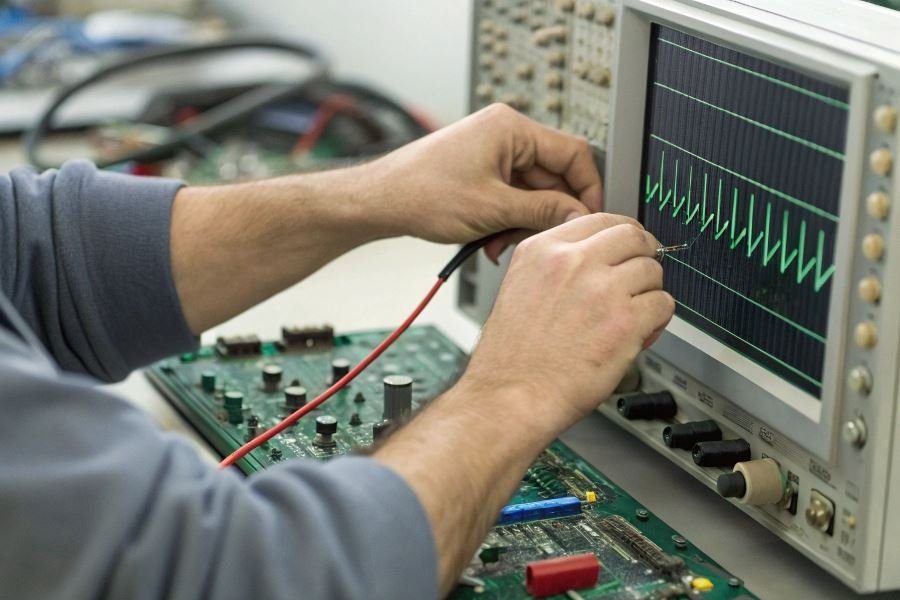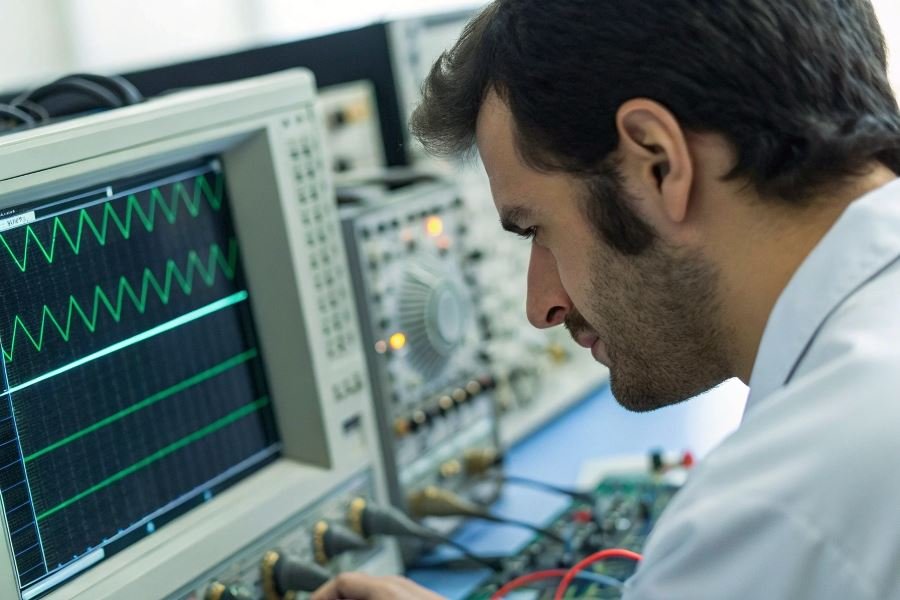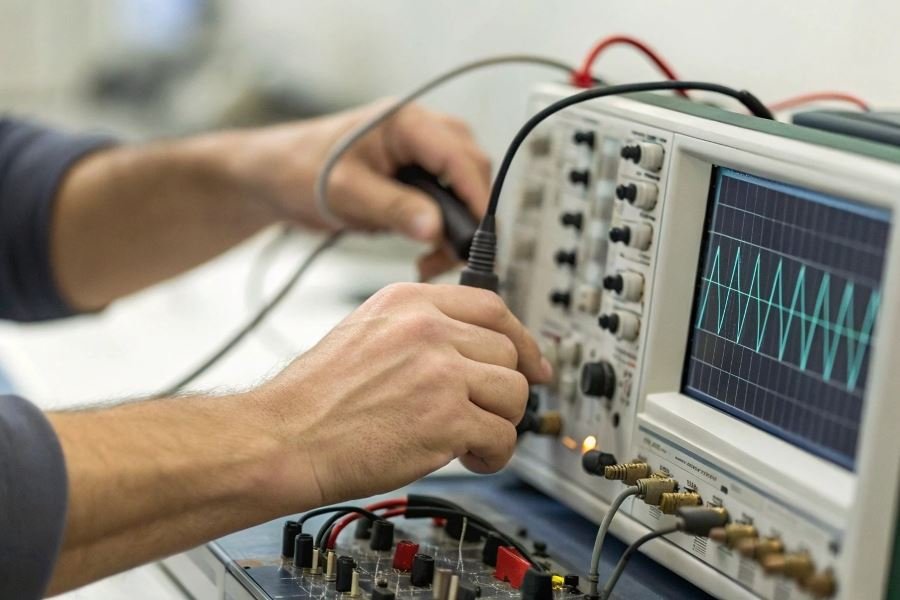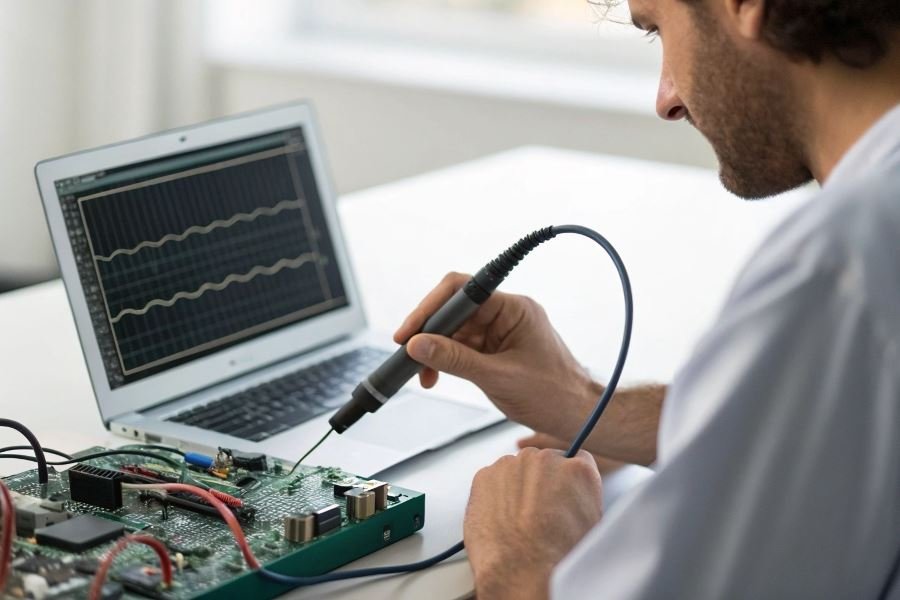
Remember when oscilloscopes were hulking machines that dominated lab benches? Those days are rapidly fading into memory as a new breed of test equipment transforms how engineers and hobbyists visualize electrical signals.
USB oscilloscopes—compact measurement devices that connect directly to computers—have quietly disrupted the test and measurement industry. These powerful tools capture, display, and analyze electrical signals just like their traditional counterparts, but with a fraction of the footprint and often at a significantly lower price point. The core functionality remains unchanged: they sample voltage over time, allowing users to troubleshoot circuits, verify signal integrity, and diagnose electronic issues.
The evolution from standalone bench oscilloscopes to USB-connected devices represents more than miniaturization—it’s a fundamental shift in approach. Traditional oscilloscopes emerged in the 1940s as critical tools for electronics development, with Tektronix pioneering many advances through the 1950s and 1960s. By comparison, USB oscilloscopes only gained serious traction in the early 2000s when computing power and USB standards matured enough to handle high-speed data acquisition.
Today’s market reflects this transformation dramatically. While established players like Keysight and Tektronix have adapted with their own USB offerings, companies like Pico Technology and Digilent have built entire business models around these portable alternatives. Industry analysts project the USB oscilloscope segment to grow at nearly 15% annually through 2030, outpacing traditional oscilloscope sales by a significant margin.
What’s driving this shift? Beyond portability and cost advantages, USB oscilloscopes leverage your computer’s processing power, display capabilities, and storage—turning limitations into strengths for many applications where bench space is premium and flexibility paramount.
Key Advantages of USB Oscilloscopes
When engineers and electronics enthusiasts need to visualize electrical signals, the oscilloscope remains an indispensable tool. USB oscilloscopes have emerged as compelling alternatives to traditional benchtop models, transforming how professionals approach signal analysis in the field and lab alike.
The transition from bulky traditional oscilloscopes to compact USB-connected devices represents one of the most significant shifts in test equipment evolution. USB oscilloscopes: an alternative to traditional models offer capabilities that were once exclusive to high-end laboratory equipment but in a fraction of the space and often at a substantially lower price point. This transformation has democratized access to professional-grade measurement tools across industries.
Portability that transforms workflows
The most immediate advantage of USB oscilloscopes is their remarkable portability. While traditional oscilloscopes typically weigh between 5-15 pounds and occupy significant bench space, USB models often weigh less than a pound and can fit in a laptop bag.
| Feature | Traditional Oscilloscope | USB Oscilloscope |
|---|---|---|
| Weight | 5-15 lbs | 0.5-2 lbs |
| Footprint | 12-18″ deep × 6-10″ wide | 4-6″ × 2-3″ |
| Power Requirements | AC outlet | USB bus power |
| Setup Time | 3-5 minutes | Under 1 minute |
This portability enables on-site diagnostics that would be impractical with traditional equipment. Automotive technicians can bring Pico Technology oscilloscopes directly to vehicles, while field service engineers can troubleshoot equipment without dismantling systems for bench testing.
Cost efficiency without compromise
The value proposition of USB oscilloscopes becomes particularly compelling when examining acquisition and ownership costs:
Initial investment: Entry-level USB oscilloscopes from manufacturers like Hantek start around $100-200, compared to $1,000+ for basic traditional models. Even professional-grade USB options from Keysight typically cost 30-50% less than equivalent benchtop alternatives.
Total ownership costs favor USB models significantly:
- No calibration services required (typically $300-500 annually for traditional scopes)
- No dedicated power consumption
- No specialized storage requirements
- Software updates rather than hardware replacements
Software integration that expands capabilities
Perhaps the most transformative advantage comes from the software ecosystem surrounding USB oscilloscopes:
Advanced analysis features become accessible through software rather than expensive hardware upgrades. The Saleae Logic platform, for instance, offers protocol analyzers, custom decoders, and automated measurements through software that continuously improves.
The software-defined nature of USB oscilloscopes means your investment actually gains capabilities over time, unlike traditional hardware that begins depreciating immediately.
Cross-platform compatibility allows engineers to use preferred operating systems rather than proprietary interfaces. Most USB oscilloscopes work with Windows, macOS, and Linux, with some offering mobile device support.
Data export and integration capabilities enable seamless workflows with other engineering tools. Measurements can be directly exported to Excel, MATLAB, Python, or custom applications through APIs provided by manufacturers like Digilent.
The digital nature of these devices also enables remote monitoring setups, automated testing sequences, and collaborative analysis that traditional oscilloscopes simply cannot match without significant additional investment.
For professionals who value flexibility, efficiency, and forward compatibility, USB oscilloscopes deliver capabilities that make traditional models seem increasingly like relics of a bygone era.
USB Oscilloscopes in Action: Real-World Applications and Performance Boundaries
Where USB Oscilloscopes Truly Shine
USB oscilloscopes have carved out impressive niches across multiple industries where portability and flexibility outweigh absolute performance requirements. Field service technicians troubleshooting equipment on-site find these compact devices invaluable—imagine diagnosing a malfunctioning industrial controller without lugging a bench oscilloscope up three flights of stairs.
Educational environments have embraced USB oscilloscopes with particular enthusiasm. Engineering and physics departments at universities nationwide report significant cost savings while providing more students hands-on measurement experience. Rather than sharing limited lab equipment, students can connect affordable Pico Technology or Digilent oscilloscopes to their laptops, extending learning beyond scheduled lab hours.
Small electronics repair shops and independent makers represent another sweet spot for USB oscilloscopes. The ability to quickly set up, measure, and pack away without dedicating permanent bench space makes these tools perfect for businesses with space constraints or professionals who travel between client locations.
“The best measurement tool is the one you actually have with you when you need it. USB oscilloscopes win on availability alone.”
Performance Reality Check
When comparing USB oscilloscopes to traditional benchtop models, understanding the performance trade-offs becomes critical:
| Specification | Typical USB Oscilloscope | Mid-Range Benchtop | High-End Benchtop |
|---|---|---|---|
| Bandwidth | 20-200 MHz | 350-1000 MHz | 1-6+ GHz |
| Sample Rate | 100 MSa/s – 1 GSa/s | 2-5 GSa/s | 10-20+ GSa/s |
| Channels | 2-4 | 4 | 4-8 |
| Buffer Memory | 8-128 MB | 10-100 MB | 100 MB-2 GB |
| Price Range | 150−2,000 | 3, 000−10,000 | 15, 000−100,000+ |
The bandwidth limitations of USB oscilloscopes present the most significant constraint. While a 100 MHz USB oscilloscope handles audio circuits, power supplies, and microcontroller signals admirably, it simply cannot capture high-speed digital signals like PCIe, USB 3.0, or RF communications accurately. The physics of signal integrity through USB connections creates an inherent ceiling.
Sampling rates follow a similar pattern. Most USB oscilloscopes offer 1 GSa/s or less, sufficient for general electronics work but inadequate for capturing extremely fast transient events or analyzing high-frequency signal details.
Making the Right Choice
Selecting between USB and traditional oscilloscopes ultimately depends on your specific measurement needs:
Choose a USB oscilloscope when:
- Portability ranks as a top priority
- Budget constraints are significant
- Your signals stay below 200 MHz
- You need basic functionality for educational or hobbyist projects
- Space limitations make a permanent bench setup impractical
Stick with traditional benchtop models when:
- You regularly work with high-frequency signals
- Advanced triggering capabilities are essential
- You need deep memory for complex signal analysis
- Multiple simultaneous measurements require 4+ channels
- Measurement accuracy is absolutely critical
For professionals straddling both worlds, Keysight and Tektronix offer hybrid solutions—benchtop-quality instruments with USB connectivity options, providing flexibility without sacrificing performance.
The most pragmatic approach? Many engineers maintain both types: a high-quality benchtop oscilloscope for demanding lab work and a USB model for field diagnostics and quick measurements. This combination delivers maximum versatility across all measurement scenarios.
Discover how USB oscilloscopes offer portable, cost-effective alternatives to traditional bench models. Compare performance specs, software integration benefits, and determine which type best suits your testing needs in today's electronics environment.
Discover how USB oscilloscopes offer portable, cost-effective alternatives to traditional bench models. Compare performance specs, software integration benefits, and determine which type best suits your testing needs in today's electronics environment.