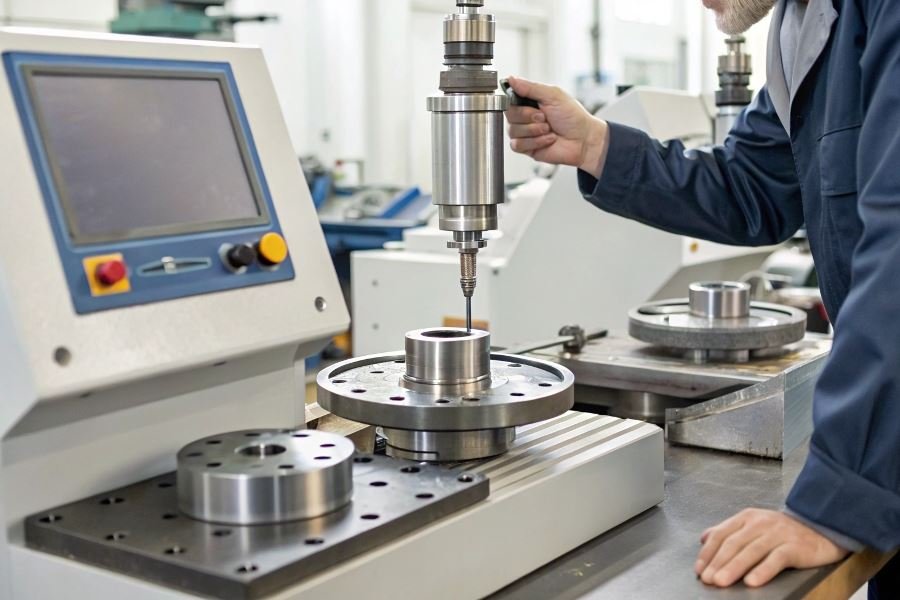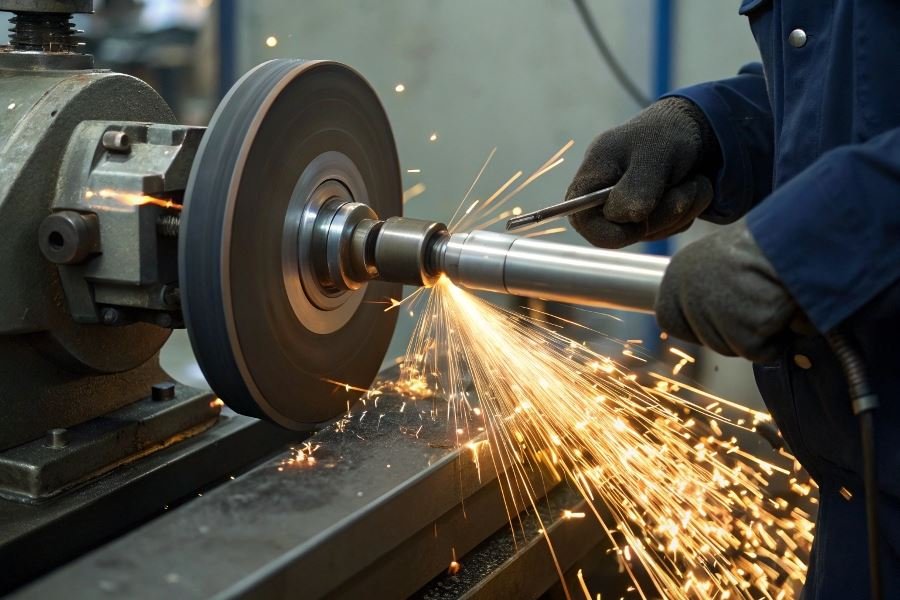
Ever wondered why some manufactured parts feel silky smooth while others have that barely perceptible roughness? The difference often comes down to one critical production step: precision grinding.
Behind every perfectly machined component—from aerospace turbine blades to automotive crankshafts—stands a grinding machine turning rough-cut metal into components with tolerances measured in microns. Selecting the right grinding equipment isn’t just a purchasing decision; it’s a strategic investment that directly impacts your production quality, efficiency, and bottom line.
The manufacturing backbone you can’t ignore
Grinding machines serve as the unsung heroes of industrial production, performing the crucial finishing operations that transform good parts into exceptional ones. These precision workhorses remove material with abrasive wheels, delivering surface finishes and dimensional accuracy that other machining processes simply cannot achieve.
What makes grinding truly indispensable is its ability to process hardened materials. After heat treatment makes components too hard for conventional cutting tools, grinding steps in to provide that final, perfect finish.
Navigating the grinding landscape
The grinding machine family is surprisingly diverse, each member specialized for specific applications:
- Surface grinders create flat, parallel surfaces with exceptional precision
- Cylindrical grinders handle round workpieces like shafts and bearings
- Centerless grinders excel at high-volume production of cylindrical parts
- Tool and cutter grinders maintain the sharp edge on cutting tools
- Creep-feed grinders remove significant material in a single pass
Decision drivers: Beyond the price tag
When evaluating grinding machines, several factors should guide your selection process:
- Workpiece characteristics – size, material, hardness, and geometry
- Production volume – from one-off prototypes to high-volume manufacturing
- Precision requirements – tolerances and surface finish specifications
- Automation potential – labor costs versus initial investment
- Total cost of ownership – including maintenance, consumables, and energy efficiency
The grinding machine you select today will influence your production capabilities for years to come. The right choice aligns perfectly with your specific manufacturing needs, production volumes, and quality standards.
Technical Specifications That Make or Break Industrial Grinding Machines
When manufacturing precision components, the grinding machine you select becomes the cornerstone of your production quality. The technical specifications of these machines aren’t just numbers on a datasheet—they’re the DNA that determines whether your operation will thrive or struggle. Let’s dive into the critical specifications that separate exceptional grinding machines from mediocre ones.
Power Requirements That Match Your Ambitions
The heart of any industrial grinding machine is its power system. Modern high-performance grinding systems typically require between 10-75 kW depending on application scope. When evaluating how to choose a grinding machine for industrial production, power requirements should be your starting point—they directly impact throughput capacity and material handling capabilities.
Power-to-production ratio becomes critical when scaling operations. A machine with insufficient power will:
- Create bottlenecks in production flow
- Struggle with harder materials like hardened steel or ceramics
- Overheat during extended operation cycles
- Deliver inconsistent results as components wear
The Studer S33 cylindrical grinder, for example, offers power configurations from 15kW to 30kW, allowing operations to match power consumption with actual production needs.
Precision That Pays For Itself
In industrial grinding, microns matter. Modern precision grinding machines can achieve tolerances as tight as ±0.001mm (1 micron), but this capability comes with significant cost implications.
The precision-cost relationship isn’t linear—it’s exponential.
| Precision Level | Typical Tolerance | Application Examples | Relative Cost |
|---|---|---|---|
| Standard | ±0.01mm | General components | Base cost |
| High | ±0.005mm | Automotive parts | 1.5-2x |
| Ultra-high | ±0.001mm | Aerospace, medical | 3-5x |
When selecting precision capabilities, match them to your actual requirements rather than defaulting to the highest spec. The JUNKER Jumat offers modular precision packages that can be upgraded as production requirements evolve.
Automation Features That Transform Workflow
The automation landscape for grinding machines has evolved dramatically. Today’s systems offer everything from basic programmable grinding cycles to fully integrated Industry 4.0 capabilities.
Key automation features worth the investment include:
- Adaptive control systems that automatically adjust grinding parameters based on material feedback
- In-process measurement capabilities that eliminate separate quality control steps
- Multi-axis synchronization for complex geometries without multiple setups
- Recipe management for rapid changeover between production runs
The Okamoto ACC-DXNC series exemplifies modern automation with its conversational programming interface that reduces setup time by up to 60% compared to conventional systems.
Automation isn’t just about reducing labor—it’s about consistency at scale.
When evaluating control systems, consider not just current capabilities but upgrade pathways. The best machines offer modular control architectures that can evolve with your production requirements without complete system replacement.
Remember that the most sophisticated specifications mean nothing if they don’t align with your production goals. The ideal grinding machine balances power, precision, and automation in proportions that match your specific manufacturing challenges—creating a foundation for production excellence that competitors will struggle to match.
Beyond the Price Tag: Making Your Final Grinding Machine Decision
The true cost equation
When investing in industrial grinding equipment, the sticker price is just the tip of the financial iceberg. Smart manufacturers evaluate the total cost of ownership (TCO) with surgical precision. A $50,000 machine that consumes 30% less energy than a $40,000 alternative typically pays for itself within 18-24 months of continuous operation.
Consider these often-overlooked TCO factors:
- Energy efficiency ratings and consumption patterns
- Consumable parts replacement schedules and costs
- Maintenance requirements and associated downtime
- Floor space requirements and facility modifications
- Waste management and disposal considerations
One manufacturing plant manager in Ohio discovered that their seemingly budget-friendly Okamoto surface grinder actually cost 22% more over five years than a premium Studer model when accounting for higher energy consumption and more frequent wheel replacements.
The cheapest machine to buy is rarely the cheapest machine to own.
Reputation and support infrastructure
The manufacturer standing behind your grinding equipment can prove as crucial as the machine itself. Established companies with proven track records typically offer:
| Support Element | Impact on Operations | Warning Signs |
|---|---|---|
| Technical support | Minimizes troubleshooting time | Limited hours, offshore-only support |
| Spare parts availability | Reduces downtime during repairs | Parts backordered for weeks/months |
| Warranty coverage | Protects against manufacturing defects | Excessive exclusions, short duration |
| Field service network | Faster on-site repairs | No local technicians, high travel charges |
The reputation of manufacturers like JUNKER and Toyoda isn’t built on equipment quality alone, but on their ability to keep customers operational through comprehensive support ecosystems.
Implementation and human factors
Even the most sophisticated grinding machine requires skilled operators to deliver its promised performance. Implementation considerations should include:
Training requirements: Assess whether the manufacturer provides comprehensive operator training or if you’ll need to develop in-house programs. Modern CNC grinding machines from companies like Haas often come with simulation software that accelerates the learning curve.
Integration complexity: Evaluate how the new equipment will mesh with existing production workflows. Will it require modifications to material handling systems or quality control processes?
Operator ergonomics: Machines with thoughtful control layouts and accessibility features reduce operator fatigue and increase productivity. The UNITED GRINDING machines consistently score high marks for their attention to human factors engineering.
Documentation quality: Clear, comprehensive manuals and troubleshooting guides are invaluable for maintenance teams. Request sample documentation before purchase to evaluate clarity and completeness.
The most successful grinding machine implementations balance technical specifications with human considerations. One aerospace components manufacturer found that investing an additional $15,000 in extended on-site training yielded a 15% productivity improvement within the first quarter of operation.
When making your final decision, remember that the right grinding machine isn’t just about meeting today’s production requirements—it’s about providing the flexibility, reliability, and efficiency to support your manufacturing evolution for years to come.
Discover the essential factors for selecting the right industrial grinding machine for your manufacturing needs. Learn about technical specifications, automation options, and cost considerations to make an informed investment decision.
Discover the essential factors for selecting the right industrial grinding machine for your manufacturing needs. Learn about technical specifications, automation options, and cost considerations to make an informed investment decision.