
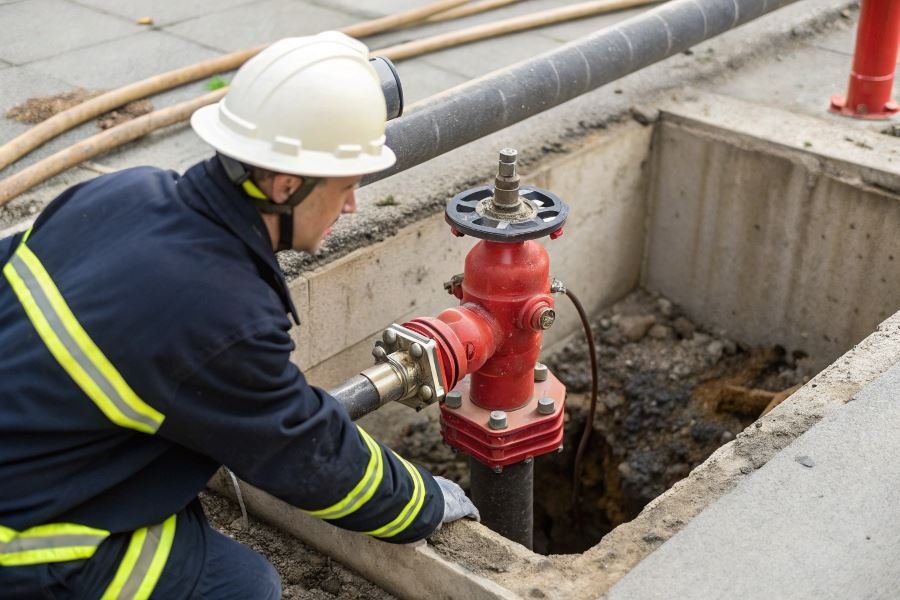
Ever wondered why those red sentinels stand guard on street corners across America? They’re not just dog pit stops—they’re life-saving infrastructure with a fascinating evolution.
Fire hydrants represent one of the most critical yet overlooked components of our public safety systems. These steadfast guardians have evolved dramatically since their humble beginnings in the early 1800s when wooden underground systems were first developed in Philadelphia. By 1865, the first post-style hydrant was patented by Ellis Nordyke, revolutionizing firefighting capabilities in growing American cities.
From wooden pipes to modern marvels
The journey from wooden fire plugs to today’s sophisticated hydrant systems reflects our advancing understanding of fire safety. Early hydrants were simple wooden plugs inserted into hollowed logs that carried water. When fires broke out, firefighters would dig down to the logs, drill a hole, and insert a smaller pipe to access water. After use, they’d seal the hole with a wooden plug—hence the term “fire plug” still used today.
The backbone of community protection
Fire hydrants aren’t merely convenient—they’re essential. The National Fire Protection Association estimates that functioning hydrants reduce property damage by up to 58% during structure fires. Their strategic placement throughout communities ensures that firefighters can access water quickly, with most municipal codes requiring hydrants every 300-500 feet in residential areas and closer in commercial zones.
Standards that save lives
Modern fire hydrants must meet rigorous specifications outlined in AWWA C502 (dry barrel) and AWWA C503 (wet barrel) standards. These regulations ensure consistent pressure ratings, standardized outlet configurations, and reliable operation under extreme conditions. The color-coding system—implemented nationwide since 1974—provides instant information about water flow capacity, with red indicating less than 500 gallons per minute and blue signaling robust flows exceeding 1,500 GPM.
Fire Hydrant Types That Could Save Your Property
When it comes to fire safety infrastructure, few elements are as iconic or essential as the humble fire hydrant. These stalwart sentinels stand ready 24/7 to provide the crucial water supply firefighters need when battling blazes. Understanding the types of fire hydrants and their features isn’t just academic—it’s practical knowledge that could impact property protection and safety outcomes in your community.
Fire hydrants come in several distinct varieties, each engineered to perform optimally in specific environments and scenarios. The design differences aren’t merely cosmetic; they reflect thoughtful engineering solutions to regional challenges like freezing temperatures, water conservation needs, and space limitations.
Dry Barrel Hydrants: Cold Weather Champions
Dry barrel fire hydrants dominate the landscape in regions where freezing temperatures are a concern. Their ingenious design keeps water below the frost line until the hydrant is activated.
Key design elements include:
- A main valve located below the frost line (typically 4-6 feet underground)
- An operating stem that extends to street level
- Automatic drain valves that empty the barrel after use
When a firefighter opens a dry barrel hydrant, the underground valve allows water to flow up through the barrel and out the discharge outlets. After closing, drain valves automatically open to empty residual water, preventing freeze damage.
These hydrants have proven their reliability in temperatures as low as -40°F when properly maintained and operated.
| Feature | Benefit |
|---|---|
| Underground valve | Prevents freezing in cold climates |
| Automatic drainage | Eliminates standing water after use |
| Multiple outlets | Allows connection of various hose sizes |
| Color-coding | Indicates available water flow capacity |
Wet Barrel Hydrants: Warm Weather Workhorses
In contrast to their cold-weather cousins, wet barrel hydrants are perpetually charged with water right up to their outlet valves. This makes them ideal for regions like Southern California, Arizona, and Florida where freezing is rarely a concern.
Distinctive characteristics include:
- Individual valves for each outlet
- Constant pressurization
- Simpler mechanical design
- Faster deployment in emergencies
Wet barrel systems offer immediate water access since there’s no main valve to open before water flows. This can save precious seconds during firefighting operations. However, they’re vulnerable to catastrophic damage if exposed to freezing conditions.
“The difference between wet and dry barrel hydrants isn’t just technical—it’s a perfect example of how regional climate conditions drive engineering solutions in public safety infrastructure.”
Wall Hydrants and Standpipe Systems: Specialized Solutions
Not all fire water access points stand independently on street corners. Wall hydrants and standpipe systems represent specialized applications for unique environments.
Wall hydrants are mounted directly to buildings, providing:
- Space-efficient design for urban environments
- Protected installation in parking garages and tunnels
- Reduced vulnerability to vehicle strikes
- Easier access in congested areas
Standpipe systems extend fire protection vertically within structures:
- Class I systems serve firefighters with 2.5-inch hose connections
- Class II systems provide 1.5-inch connections for occupant use
- Class III systems combine both connection types
- Dry standpipes require pumper trucks to pressurize the system
These specialized systems ensure that even in dense urban environments or multi-story buildings, firefighters can access water supply without stretching excessive hose lengths from street-level hydrants.
Understanding these different hydrant types isn’t just for fire protection professionals—it’s valuable knowledge for property owners who want to ensure their fire protection infrastructure matches their specific environmental conditions and safety needs.
Making the Right Choice: Fire Hydrant Selection and Maintenance
Selecting the appropriate fire hydrant isn’t just about checking a regulatory box—it’s about making a critical safety decision that impacts entire communities. The right hydrant in the right place can mean the difference between containing a small fire and facing a devastating blaze.
Regional requirements drive selection decisions
Fire hydrant selection must account for several location-specific factors that vary dramatically across the country:
Climate considerations play a crucial role in hydrant selection. In northern states where freezing is common, dry barrel hydrants from manufacturers like Mueller Water Products are essential to prevent internal freezing and potential failure during emergencies. Meanwhile, southern regions often utilize wet barrel designs that offer simpler operation and maintenance in non-freezing environments.
Water system characteristics fundamentally influence hydrant choice. Areas with high water pressure require hydrants with pressure-reducing capabilities, while low-pressure systems need hydrants specifically designed to maximize flow efficiency.
Regional fire codes also dictate specific requirements:
| Region Type | Typical Hydrant Requirement | Minimum Flow Rate |
|---|---|---|
| Urban | Every 500 ft | 1,000+ GPM |
| Suburban | Every 800 ft | 750-1,000 GPM |
| Rural | Strategic locations | 500-750 GPM |
Maintenance protocols that extend service life
Different hydrant types demand specific maintenance approaches to ensure reliability when they’re needed most:
Dry barrel hydrants require annual inspection before winter to verify complete drainage after use. The inspection must include checking the drain valve functionality and ensuring the main valve operates smoothly. Lubrication of operating nuts and stems with food-grade lubricant prevents seizure during emergencies.
Wet barrel hydrants demand quarterly external inspections and annual internal examinations. Their multiple outlet valves require individual testing, and technicians should verify that pressure relief valves function correctly to prevent system damage.
Preventative maintenance schedules should include:
- Flow testing every 3 years to verify capacity
- Valve operation verification twice yearly
- Complete teardown inspection every 5-7 years
- Immediate repair of any visible leaks or damage
Tomorrow’s hydrants: Innovations reshaping fire protection
The fire hydrant—a technology that has remained relatively unchanged for decades—is experiencing a renaissance of innovation:
Smart hydrants equipped with IoT sensors now monitor water pressure, temperature, and usage patterns in real-time. Systems from Siemens can detect unauthorized use and potential failures before they occur, dramatically improving system reliability.
Material science advancements have introduced composite hydrant components that resist corrosion, reduce weight, and extend service life beyond traditional cast iron designs. These materials maintain strength while eliminating the rust issues that plague conventional hydrants.
Integrated communication technology represents perhaps the most significant leap forward. Modern hydrants can now communicate directly with municipal systems to report their status, flow capacity, and maintenance needs. Some advanced models even integrate with emergency response systems to guide firefighters to the nearest functional hydrant during an emergency.
The humble fire hydrant continues to evolve from a simple water access point to an intelligent component of our critical infrastructure—proving that even the most established technologies can be reimagined for greater safety and efficiency.
Discover the essential differences between dry barrel, wet barrel, and wall hydrants in this comprehensive guide to fire hydrant types. Learn selection criteria and maintenance requirements for optimal fire safety systems.
Discover the essential differences between dry barrel, wet barrel, and wall hydrants in this comprehensive guide to fire hydrant types. Learn selection criteria and maintenance requirements for optimal fire safety systems.