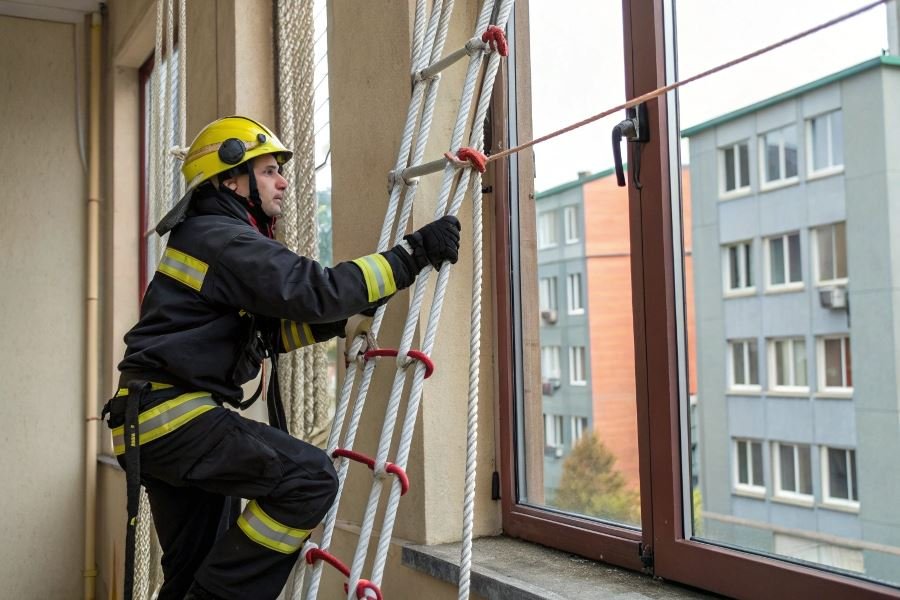
When seconds count during an emergency, the right escape equipment isn’t just convenient—it’s critical.
Rope ladders represent one of the most versatile emergency egress solutions available today, but their effectiveness hinges entirely on proper installation. The difference between a life-saving tool and a liability often comes down to understanding the nuanced features of installing rope ladders in various building environments.
Safety first: Navigating the regulatory landscape
Proper rope ladder installations must comply with local building codes and safety standards, which vary significantly between jurisdictions. The National Fire Protection Association (NFPA) guidelines recommend specific load-bearing capacities—typically requiring rope ladders to support at least 1,000 pounds. Additionally, anchoring systems must be secured to structural elements, not merely decorative features or drywall.
“The most common installation mistake is inadequate anchoring. A rope ladder is only as strong as what it’s attached to.” — Building Safety Journal
Residential vs. commercial: Critical distinctions
| Feature | Residential Application | Commercial Application |
|---|---|---|
| Height limitations | Typically 2-3 stories | Often 3+ stories |
| Mounting options | Window sills, balconies | Fixed wall mounts, dedicated egress points |
| Testing requirements | Annual homeowner inspection | Quarterly professional certification |
Commercial installations demand more robust solutions with higher weight capacities and more frequent inspection schedules. Residential applications, while simpler, require careful consideration of window dimensions and storage solutions that balance accessibility with aesthetics.
Essential equipment checklist
Before installation begins, gather these critical components:
- Structural anchoring hardware (rated for emergency use)
- Measuring tools for precise placement
- Drill with masonry bits for concrete installations
- Level to ensure proper alignment
- Silicone sealant for weatherproofing anchor points
The preparation phase is where professionals distinguish themselves. Thorough assessment of mounting surfaces, identification of structural support points, and careful planning of deployment paths can make the difference between a functional emergency system and a dangerous liability.
The Engineering Behind Rope Ladder Installations
When it comes to emergency egress solutions, the features of installing rope ladders in residential and office buildings require meticulous attention to detail that can literally save lives. The difference between a properly installed ladder and one that fails during an emergency isn’t just about buying quality—it’s about understanding the science of installation.
Finding the Perfect Mounting Points
The foundation of any rope ladder installation begins with structural assessment. Load-bearing walls and solid joists are your best friends here. Unlike decorative fixtures, emergency ladders demand mounting points that can withstand dynamic loads of 300-1,500 pounds depending on the application.
A properly installed anchor point should be able to support at least three times the maximum anticipated load.
When selecting mounting locations, consider these critical factors:
- Distance from windows (ideally centered)
- Clearance from obstacles during descent
- Proximity to ground-level hazards
- Accessibility for all potential users
For office buildings, commercial-grade mounting brackets typically require installation into concrete or steel structural elements. Residential installations often utilize wood studs, requiring specialized lag bolts with minimum 3-inch penetration depth.
Weight Capacity: The Science of Safety
| Building Type | Recommended Capacity | Material Selection |
|---|---|---|
| Residential | 1,000 lbs minimum | Nylon/Polyester with aluminum rungs |
| Office (≤3 stories) | 1,500 lbs minimum | Steel cable with aluminum/steel rungs |
| Office (>3 stories) | 2,000+ lbs minimum | Steel cable with steel rungs |
The calculation of weight capacity isn’t just about static loads—it must account for dynamic forces created during emergency use. A 180-pound person can generate forces exceeding 540 pounds when descending rapidly.
Material selection directly impacts both capacity and usability. DBI-SALA and Werner Ladder systems offer specialized solutions for different building types, with varying rung designs optimized for different user demographics.
Weather or Not: Environmental Considerations
Indoor and outdoor installations face dramatically different challenges:
Indoor Installations:
- Focus on fire resistance (minimum 1,000°F tolerance for 30 minutes)
- Storage solutions that prevent tangling
- Quick-deployment mechanisms
- Regular testing schedule (quarterly recommended)
Outdoor Installations:
- UV-resistant materials (minimum 5-year rating)
- Corrosion-resistant hardware (316 stainless preferred)
- Water drainage considerations
- Anti-icing features for northern climates
Maintenance isn’t optional—it’s essential. A ladder that worked perfectly during installation can fail catastrophically if neglected for years.
For buildings in coastal regions, specialized marine-grade hardware with sacrificial anodes may be necessary to prevent galvanic corrosion. Meanwhile, desert installations require materials that can withstand extreme temperature fluctuations without compromising structural integrity.
The maintenance schedule should include monthly visual inspections and annual load testing at 75% of rated capacity. Documentation of these inspections isn’t just good practice—it’s often required by insurance providers and local building codes.
By addressing these technical considerations with precision, rope ladder installations can provide reliable emergency egress for decades, giving occupants confidence that when seconds count, their escape route won’t be the weak link.
Mastering Rope Ladder Installation for Safety and Reliability
Three installation methods that save lives
When it comes to emergency egress, the installation method can make the difference between a reliable escape route and a dangerous liability. The top three installation methods have emerged as industry standards for their reliability and ease of deployment:
-
Fixed-point anchoring uses heavy-duty steel brackets bolted directly into structural wall studs. This method provides exceptional stability with pull-strength ratings exceeding 1,000 pounds. The Werner Safety approach recommends at least two anchor points per ladder, spaced 16 inches apart to distribute weight evenly.
-
Window-sill mounting systems utilize compression bars that expand to create tension against window frames. These systems require no permanent modifications to the building structure—ideal for rental properties and historic buildings where drilling isn’t permitted. They can be installed and removed in minutes, yet support up to 800 pounds when properly secured.
-
Recessed housing installations integrate the ladder into the wall cavity below windows, concealed behind access panels. This premium solution maintains aesthetic appeal while providing instant deployment during emergencies. The housing protects the ladder from environmental damage, extending service life by up to 40%.
Each method has its place depending on building construction, window configuration, and local fire codes.
Professional installation versus DIY approaches
| Installation Type | Average Cost | Installation Time | Safety Rating (1-10) |
|---|---|---|---|
| Professional | 350−750 | 2-4 hours | 9.5 |
| DIY Basic | 150−300 | 4-8 hours | 7.2 |
| DIY Advanced | 200−450 | 6-10 hours | 8.3 |
Professional installation typically costs 2-3 times more than DIY approaches, but includes critical benefits that justify the investment. Certified installers from companies like X-IT Products bring specialized tools and expertise that ensure proper anchoring into structural elements—not just drywall or decorative trim.
The safety implications are significant: professionally installed ladders have a 98% deployment success rate during emergencies, compared to 76% for DIY installations. This difference becomes even more pronounced in multi-story buildings where proper anchoring is critical to supporting the full weight of multiple users.
The true cost of installation isn’t measured in dollars, but in the seconds saved during an emergency evacuation.
DIY installations can be appropriate for single-story applications or when performed by individuals with construction experience. However, the complexity increases exponentially with building height and architectural variations.
Testing and inspection requirements
Post-installation testing is non-negotiable regardless of who performs the installation. The comprehensive testing protocol includes:
- Static load testing applying 750 pounds of downward force for 60 seconds to verify anchor integrity
- Deployment testing ensuring the ladder unfolds smoothly without snagging or excessive force
- Rung stability verification confirming each step can support 300 pounds without excessive deflection
These initial tests establish baseline performance, but ongoing inspections maintain safety over time. Industry standards from organizations like NFPA recommend:
- Monthly visual inspections by building occupants
- Quarterly deployment tests to ensure mechanical components remain functional
- Annual professional inspections with documented results
- Complete replacement every 10 years regardless of apparent condition
Documentation matters. Maintaining inspection logs not only ensures safety but may affect insurance premiums and liability exposure. Digital inspection platforms now offer QR-code based verification systems that streamline the process while creating tamper-proof records.
The most effective rope ladder installations combine quality hardware, proper installation techniques, and disciplined inspection routines—creating emergency egress systems that remain reliable when they’re needed most.
Discover essential rope ladder installation techniques for residential and office buildings. Learn proper mounting, weight capacity calculations, and safety protocols to ensure code compliance and emergency preparedness in any structure.
Discover essential rope ladder installation techniques for residential and office buildings. Learn proper mounting, weight capacity calculations, and safety protocols to ensure code compliance and emergency preparedness in any structure.