Ever wondered why some protective gear feels like it was custom-made for your body while other pieces leave you wincing in pain after just an hour? The difference often comes down to one crucial factor: proper sizing.
When it comes to lumbar armor—that essential protective equipment safeguarding one of your body’s most vulnerable regions—the consequences of poor sizing extend far beyond mere discomfort. The lumbar region (your lower back) houses critical nerve pathways and supports your entire upper body. This anatomical powerhouse deserves nothing less than perfectly fitted protection.
“The right lumbar armor should feel like a natural extension of your body,” notes leading protective gear specialist Dr. Marcus Thornhill. “It should distribute impact forces evenly across the protected area without restricting natural movement.”
Your lower back features a delicate S-curve design that requires specialized protection. Unlike flat body areas, the lumbar region’s complex curvature means generic, one-size-fits-all solutions often create dangerous protection gaps. These gaps become impact points where force concentrates rather than disperses—precisely what you don’t want in protective gear.
The three most common sizing mistakes include:
- Choosing by waist size alone – Your lumbar region’s width and curvature matter more than waist circumference
- Prioritizing comfort over coverage – Proper protection sometimes requires an adjustment period
- Failing to account for position-specific needs – Different activities demand different coverage areas
Remember: properly sized lumbar armor should feel snug without restricting breathing or movement. When positioned correctly, it should cover from just below your ribcage to the top of your pelvis, with no gaps along your spine.
Getting Your Lumbar Armor Size Right
Finding the perfect fit for lumbar armor isn’t just about comfort—it’s about ensuring maximum protection when you need it most. The difference between properly sized protection and ill-fitting gear can be significant, especially during high-impact activities or in emergency situations. Let’s dive into the essential measurements that will help you properly choose the size of lumbar armor that fits like it was custom-made for your body.
Mastering Waist Measurement Technique
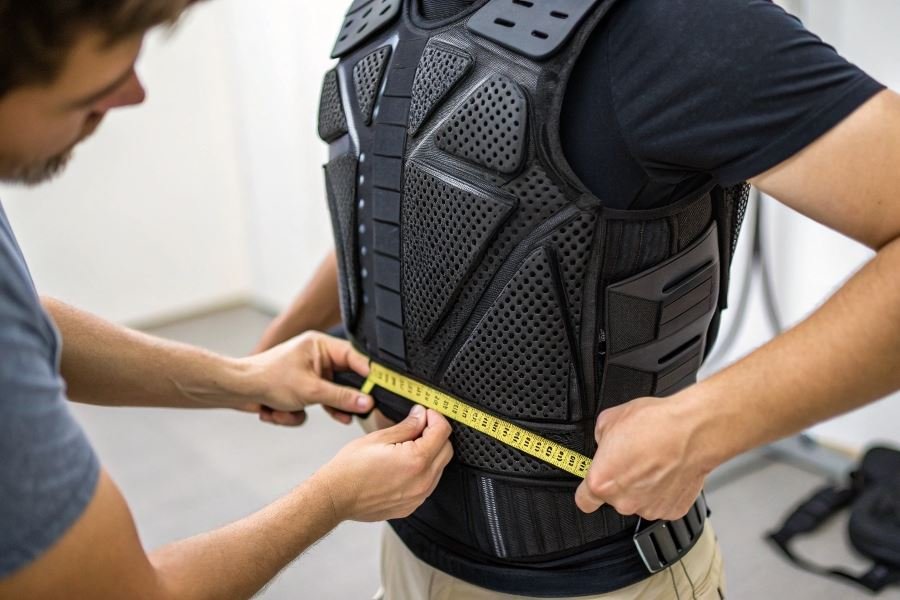
Your waist circumference forms the foundation of lumbar armor sizing. Unlike casual pants measurements, precision matters here:
- Stand naturally with feet shoulder-width apart
- Locate your natural waistline (typically at the narrowest part of your torso)
- Exhale normally—don’t suck in or expand your stomach
- Wrap a flexible measuring tape around your waist, keeping it parallel to the floor
- Allow for approximately 1/2 inch of slack—armor that’s too tight restricts movement
Pro tip: Take this measurement twice to confirm accuracy. Many protection failures stem from incorrect initial measurements.
The ideal measurement should be taken directly against skin or over a thin base layer—never over thick clothing that might compress or add bulk.
Determining Optimal Torso Length
Torso length determines vertical coverage—critical for protecting your entire lumbar region:
- Sit on a flat surface with your back straight
- Measure from the base of your neck (C7 vertebra) to your natural waistline
- Add 2-3 inches to ensure proper coverage of your entire lumbar region
This measurement ensures your armor extends high enough to protect vertebrae while low enough to maintain mobility.
| Body Height | Typical Torso Length | Recommended Armor Length |
|---|---|---|
| Under 5’7″ | 16-18 inches | 19-21 inches |
| 5’7″-6’0″ | 18-20 inches | 21-23 inches |
| Over 6’0″ | 20-22 inches | 23-25 inches |
Accounting for Body Type Variations
Not all bodies are created equal, and your unique physique demands consideration when selecting lumbar protection:
Athletic Builds
If you have a V-shaped torso with broader shoulders and narrower waist, look for armor with:
- Tapered design
- Higher side coverage
- Adjustable tension systems
Rectangular Builds
For those with less difference between shoulder and waist measurements:
- Seek models with additional side adjustability
- Consider armor with extended coverage zones
- Look for designs with multiple adjustment points
Fuller Figures
If you carry more weight around your midsection:
- Prioritize comfort panels at contact points
- Select armor with stretch zones
- Consider custom-fitted options for optimal protection
Remember: The best lumbar armor moves with you, not against you. When trying on protection, perform basic movements like bending, twisting, and reaching to ensure it stays in position without pinching or riding up.
By taking these key measurements and considering your unique body type, you’ll secure lumbar armor that provides maximum protection without compromising mobility or comfort—exactly what you need when facing high-impact situations or daily wear scenarios that demand reliable support.
Making the Final Call on Your Lumbar Armor
The perfect lumbar armor doesn’t just protect—it becomes an extension of your body. After measuring and researching options, you’ve reached the crucial final stage: confirming your selection through real-world testing and practical considerations. Let’s finalize your decision with confidence.
The Movement Test Never Lies
When testing lumbar armor fit, movement tells the complete story. Put on your prospective armor and perform these essential mobility checks:
- Bend forward to touch your toes
- Twist your torso left and right
- Sit in your typical riding position for at least 5 minutes
- Simulate reaching for controls or looking over your shoulder
Pressure points should be non-existent. If you feel pinching, digging, or restriction during these movements, the armor is likely too small. Conversely, if the armor shifts position or feels loose during movement, it’s probably too large.
The ideal fit allows full range of motion while maintaining constant contact with your lumbar region.
Seasonal Strategy for Year-Round Protection
Your armor needs change with the seasons and layering requirements:
| Season | Typical Layers | Sizing Consideration |
|---|---|---|
| Summer | Single thin layer | Standard size or slightly smaller |
| Spring/Fall | Medium base layer | Standard size |
| Winter | Thick base layers | Consider sizing up |
Many riders maintain two different sizes of lumbar protection—one for warm weather and one for cold. This approach ensures optimal protection regardless of conditions.
When to Deliberately Size Up
There are specific scenarios where choosing a slightly larger size makes strategic sense:
- High-impact activities: Mountain biking, motocross, and downhill racing often benefit from more substantial protection that may require sizing up.
- Extended wear periods: If you’re planning all-day adventures, a slightly roomier fit can prevent fatigue and discomfort.
- Recovery from injury: When returning to activity after a back injury, a larger armor piece can provide additional psychological and physical security.
When to Size Down
Conversely, certain situations call for a more compact fit:
- Speed-focused disciplines: Road racing and activities where aerodynamics matter may benefit from a sleeker profile.
- Technical maneuvers: Activities requiring extreme flexibility and body control often work better with minimalist protection.
- Hot weather performance: When heat management is critical, a smaller, more ventilated option prevents overheating.
The Final Comfort Check
After selecting your size, wear the armor for at least 30 minutes in a controlled environment. Pay attention to:
- Heat buildup
- Pressure points that develop over time
- How it interfaces with other protective gear
- Ease of adjustment while wearing gloves
Remember that minor discomfort during the first few wears is normal as the armor breaks in, but actual pain is never acceptable.
The perfect lumbar armor becomes invisible during use—you should forget you’re wearing it until the moment it saves you from injury. Take your time with this final selection process, as the right choice delivers both confidence and crucial protection when you need it most.
Discover how to measure correctly for lumbar armor that fits perfectly. Learn essential sizing techniques, avoid common mistakes, and find protective gear that offers both comfort and optimal protection for your lower back.
Discover how to measure correctly for lumbar armor that fits perfectly. Learn essential sizing techniques, avoid common mistakes, and find protective gear that offers both comfort and optimal protection for your lower back.