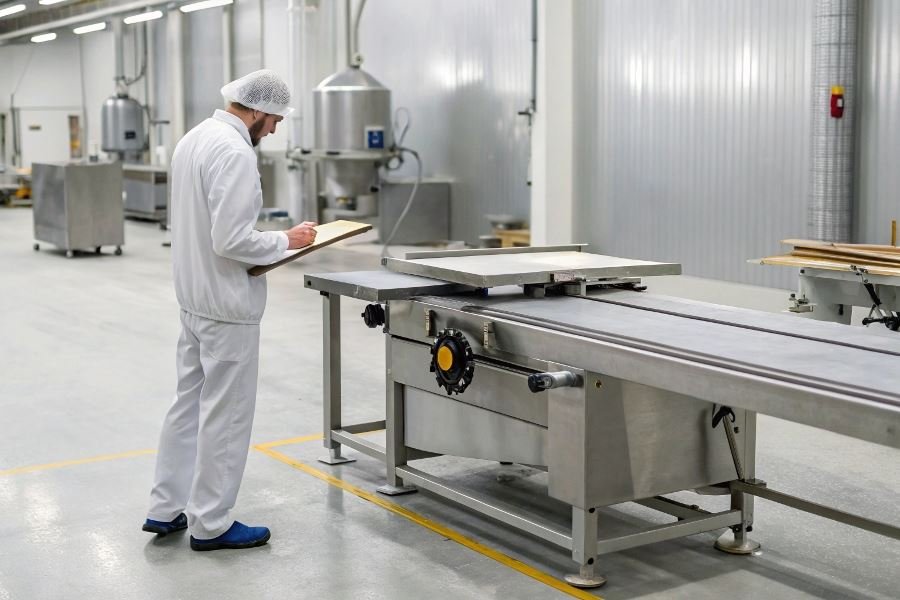
Did you know that 78% of food safety recalls could be prevented with proper equipment maintenance? Behind every slice of deli meat and every cut of commercial fish lies an unsung hero: the properly maintained food processing saw.
The blades that touch our food create a critical control point where safety meets efficiency. Food processing saws—from band saws slicing through frozen meats to circular blades dicing vegetables—represent both opportunity and risk. When maintained with precision, these tools ensure consistent product quality and worker safety. When neglected, they become potential harbingers of contamination and compliance nightmares.
The safety imperative
Food processing facilities operate under intense scrutiny from regulatory bodies like the FDA and USDA. A single contamination incident can trigger costly recalls, damage brand reputation, and even lead to facility shutdowns. Proper saw maintenance isn’t just good practice—it’s a fundamental requirement for regulatory compliance.
The saw ecosystem
The modern food processing facility employs a diverse arsenal of cutting tools:
- Band saws: Workhorses for portioning meats and frozen products
- Circular saws: Precision tools for uniform cuts
- Slicers: Specialized for consistent thickness in deli products
- Bone saws: Heavy-duty equipment for primary processing
Each requires specific maintenance protocols tailored to its unique design and application.
When maintenance fails
The consequences of inadequate saw maintenance extend far beyond dull blades:
“A poorly maintained saw doesn’t just cut inefficiently—it creates microscopic harborage points for bacteria that standard cleaning can’t reach,” explains food safety expert Dr. James Harrington.
Metal fragments, bacterial biofilms, and cross-contamination become real threats when maintenance schedules slip. The result? Compromised product quality, increased operational costs, and potentially devastating food safety incidents.
Keeping Food Production Saws in Prime Condition
Food processing facilities demand the highest standards of equipment maintenance. The specialized saws that slice through meat, fish, poultry, and other food products require meticulous care to ensure both food safety and operational efficiency. Proper maintenance of saws for food production isn’t just about extending equipment life—it’s about protecting consumers and maintaining compliance with stringent food safety regulations.
The daily maintenance routine for food-grade saws forms the foundation of any serious food processing operation. USDA and FDA guidelines mandate thorough cleaning and sanitization after each production shift, with no exceptions. This typically involves a multi-step process: first, removing large debris with scrapers (avoiding wire brushes that might leave metal fragments), then applying food-grade detergent with the correct concentration (usually 2-3% solution), followed by thorough rinsing with potable water at 140°F minimum. The final sanitization step requires food-safe quaternary ammonium compounds or peracetic acid solutions applied according to manufacturer specifications.
Blade inspection protocols deserve particular attention. Operators should examine blades before each use for signs of wear, chips, cracks, or warping. Even microscopic damage can harbor bacteria or potentially introduce metal fragments into food products. Most food processing facilities implement a three-tier inspection system:
- Visual inspection before each use
- Weekly measurement checks using calibrated tools
- Monthly comprehensive assessment by maintenance specialists
The frequency of blade sharpening depends largely on usage patterns and materials being cut. However, most facilities follow this general schedule:
| Material Cut | Sharpening Frequency | Replacement Timeline |
|---|---|---|
| Soft meats | Every 4-8 hours | 3-6 months |
| Poultry | Every 6-10 hours | 4-8 months |
| Fish | Every 2-4 hours | 2-4 months |
| Frozen foods | Every 1-2 hours | 1-3 months |
When sharpening becomes necessary, only food-grade sharpening compounds from manufacturers like Norton Abrasives or DMT Diamond Whetstones should be used. These specialized products ensure no harmful residues remain on cutting surfaces.
Food-Safe Lubrication Requirements
The lubrication of food production saws presents unique challenges. Unlike industrial equipment, these machines require specialized food-grade lubricants that won’t contaminate products even in case of incidental contact. The NSF International classifies these lubricants into distinct categories:
- H1 lubricants: Permitted for incidental food contact
- H2 lubricants: For equipment where no contact with food is possible
- 3H lubricants: Release agents that may have direct food contact
Never substitute standard industrial lubricants for these specialized products. Leading manufacturers like Kluber Lubrication and Petro-Canada offer comprehensive lines of food-grade options specifically formulated for different components of food processing equipment.
For bearings and moving parts, application frequency typically ranges from weekly to monthly depending on usage intensity. Chain-driven saws generally require more frequent lubrication than belt-driven models. Always follow manufacturer guidelines for quantity—over-lubrication can be as problematic as under-lubrication, potentially leading to product contamination.
Maintaining detailed logs of all maintenance procedures provides both operational benefits and regulatory compliance. These records should document cleaning protocols, blade inspections, sharpening dates, and lubrication applications—creating an unbroken chain of documentation that demonstrates your commitment to food safety and equipment integrity.
Mastering Your Saw Maintenance Program
Food production facilities that prioritize saw maintenance don’t just comply with regulations—they outperform their competition. A well-structured maintenance program transforms your cutting equipment from a potential liability into a strategic asset. Let’s explore how to build a maintenance system that delivers consistency, safety, and operational excellence.
Documentation that drives performance
The foundation of exceptional saw maintenance begins with comprehensive documentation. Forward-thinking food processors develop maintenance manuals that include:
- Equipment-specific maintenance protocols for each saw model
- Step-by-step procedures for disassembly, inspection, and reassembly
- Critical control points with acceptable performance parameters
- Troubleshooting decision trees for common issues
Documentation shouldn’t gather dust on a shelf. The most effective programs integrate digital maintenance schedules that automatically generate work orders based on usage metrics rather than arbitrary calendar dates. This approach has helped companies like Tyson Foods reduce emergency maintenance by up to 37% while extending equipment life.
A maintenance schedule matrix should include:
| Maintenance Type | Frequency | Responsible Party | Verification Method |
|---|---|---|---|
| Visual inspection | Pre-shift | Operator | Digital checklist |
| Blade replacement | Based on cutting hours | Maintenance tech | QR code scan |
| Full disassembly | Monthly | Senior technician | Photo documentation |
| Calibration | Quarterly | Certified specialist | Calibration certificate |
The difference between good and great maintenance programs often comes down to documentation quality and accessibility.
Training that transforms technicians
Maintenance personnel in food production facilities face unique challenges that require specialized training. Beyond mechanical aptitude, they need:
- Food safety certification (HACCP principles)
- Cross-contamination prevention protocols
- Sanitary equipment handling techniques
- Material compatibility knowledge for food-contact surfaces
Training shouldn’t be a one-time event. Leading processors implement tiered certification programs where technicians progress through levels of expertise. Companies using this approach, like JBS, report 42% fewer food safety incidents related to equipment maintenance.
The most effective training programs combine:
- Hands-on workshops with actual production equipment
- Video-based instruction showing proper techniques
- Augmented reality simulations for complex procedures
- Peer mentoring systems pairing veterans with newcomers
Technology that transforms compliance
Digital transformation has revolutionized maintenance tracking in food production. Smart systems now integrate:
- IoT sensors that monitor blade vibration patterns to predict failures
- RFID-tagged components that track sanitization history
- Blockchain verification of maintenance records for auditors
- AI-powered analytics that identify maintenance optimization opportunities
Marel and other equipment manufacturers now offer cloud-based maintenance platforms that integrate with production scheduling systems, automatically adjusting maintenance timing to minimize disruption while maintaining compliance.
The most sophisticated programs use predictive analytics to identify potential failures before they occur, transforming maintenance from reactive to proactive.
By implementing these best practices, food processors don’t just maintain their saws—they maintain their competitive edge. The investment in documentation, training, and technology pays dividends through extended equipment life, reduced downtime, and enhanced food safety. Your maintenance program isn’t just about keeping blades sharp—it’s about keeping your business sharp in an increasingly competitive marketplace.
Discover essential food-grade saw maintenance protocols to ensure safety compliance and operational efficiency. Learn proper cleaning, inspection, and lubrication techniques that protect product integrity while extending equipment lifespan.
Discover essential food-grade saw maintenance protocols to ensure safety compliance and operational efficiency. Learn proper cleaning, inspection, and lubrication techniques that protect product integrity while extending equipment lifespan.