What if the perfect burger patty wasn’t about the recipe, but the machine that made it?
Behind every mouthwatering burger lies a critical decision that restaurant owners and food manufacturers face daily: choosing between automatic and manual patty making systems. This choice impacts everything from production capacity to the consistency of your signature burgers.
The journey of patty formation equipment tells a fascinating story of culinary evolution. What began as simple hand-pressing techniques in the early 20th century transformed dramatically when the first commercial patty presses emerged in the 1940s. By the 1970s, rudimentary automatic systems appeared, but the true revolution came in the early 2000s with fully computerized systems offering precision down to the gram.
Efficiency in patty production isn’t one-dimensional. Industry professionals evaluate systems across three critical metrics:
- Throughput capacity: Modern automatic systems can produce up to 4,000 patties hourly, while manual operations typically max out at 500-800
- Consistency factors: Variation in weight, diameter, and thickness
- Labor requirements: Hours needed for operation, cleaning, and maintenance
The market now offers remarkable diversity in both categories:
“The difference between entry-level and premium equipment isn’t just price—it’s the difference between surviving and thriving in a competitive food business.”
For manual systems, options range from basic hand presses (200 − 500)tolever − operatedcommercialmodels(1,200-2,500). Automatic alternatives span from semi-automatic tabletop units (5, 000 − 12, 000)toindustrial − gradesystemswithmulti − formingcapabilities(30,000-75,000).
The efficiency equation isn’t simply about speed—it’s about finding the perfect balance between production needs, budget constraints, and quality standards.
The Efficiency Showdown: Automatic vs Manual Patty Makers
Production Volume: The Numbers Game
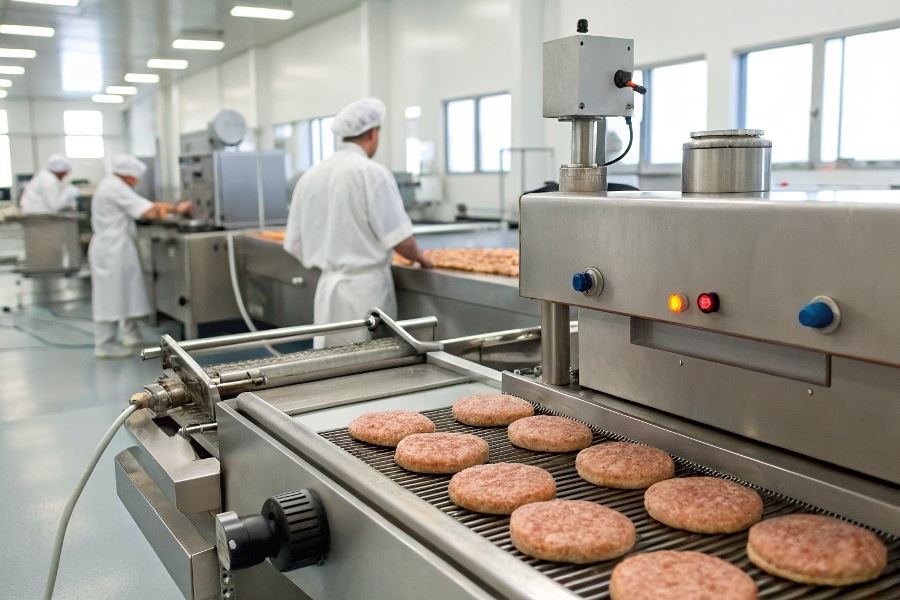
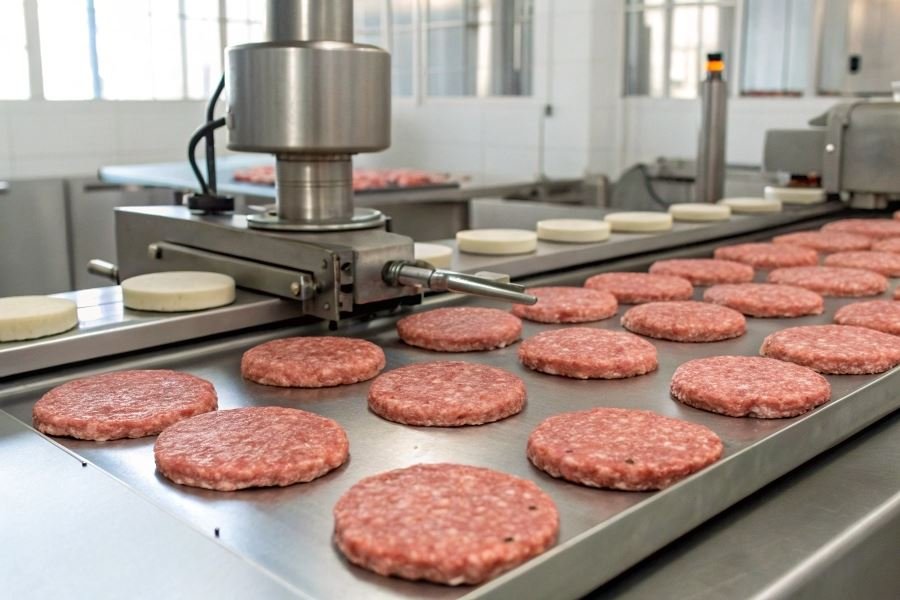
When comparing automatic and manual patty makers, production volume stands as the most striking differentiator. Automatic patty formers typically produce 1,000-3,000 patties per hour, with industrial models reaching up to 8,000 units hourly. Meanwhile, manual operations average 100-300 patties per hour, depending on operator skill and stamina.
The question of automatic vs manual patty makers: which is more efficient becomes particularly relevant when scaling operations. A mid-range Hollymatic automatic former can produce in 15 minutes what would take a skilled manual operator an entire shift to complete. This exponential difference transforms production capabilities, especially during high-demand periods.
Labor Economics That Impact Your Bottom Line
Labor efficiency creates perhaps the most compelling case for automation. Manual patty production requires constant operator attention, with labor costs averaging $15-25 per hour plus benefits. Automatic systems typically require only periodic oversight—one employee can simultaneously monitor production while performing other tasks.
| System Type | Labor Hours per 1,000 Patties | Approximate Labor Cost per 1,000 Patties |
|---|---|---|
| Manual | 3.5-10 hours | $52-250 |
| Automatic | 0.3-0.5 hours | $4.50-12.50 |
The ROI calculation becomes straightforward for operations producing more than 500 patties daily, with most Formax or Patty-O-Matic systems paying for themselves within 12-18 months through labor savings alone.
Consistency: The Customer Experience Factor
Automatic formers deliver remarkable consistency—each patty emerges with identical weight (±1g variance), diameter, and thickness. Manual production, even with portion control tools, typically shows 5-15% weight variation and inconsistent dimensions.
This precision extends beyond aesthetics. Consistent patties cook uniformly, reducing waste from undercooked or overcooked products. The Ross Industries TC-700 demonstrates this principle with its ability to maintain exact protein-to-fat ratios throughout production runs, ensuring flavor and cooking performance remain constant.
The Hidden Costs: Setup, Cleaning and Maintenance
Setup and changeover times reveal surprising efficiency factors:
- Manual systems: 5-10 minutes for setup, minimal changeover time
- Automatic systems: 15-30 minutes initial setup, 10-15 minutes for product changeovers
Cleaning requirements favor manual operations for small batches. Automatic systems require 30-45 minutes of daily cleaning, plus periodic deep cleaning. However, newer models like the Vemag HP series incorporate tool-free disassembly and washdown-ready components, reducing cleaning time by up to 40%.
Maintenance costs average 3-5% of the machine purchase price annually for automatic systems—a consideration that must factor into long-term efficiency calculations.
Space Utilization and Workflow Integration
Modern automatic patty makers have dramatically reduced their footprint. A commercial Bizerba automatic former requires just 12-15 square feet of floor space while producing thousands of patties hourly. Manual operations need less dedicated equipment space but more staging area for operators.
The integration factor often gets overlooked—automatic systems can connect directly to upstream grinding operations and downstream packaging systems, creating continuous production flow. This integration eliminates transfer steps, reducing handling, improving food safety, and further enhancing labor efficiency.
For operations producing varied products, modular automatic systems with quick-change forming plates offer the flexibility of manual production with the speed of automation—a compelling middle ground for growing businesses seeking scalable efficiency.
Making the Right Choice for Your Patty Production
Business Scale Determines Equipment Needs
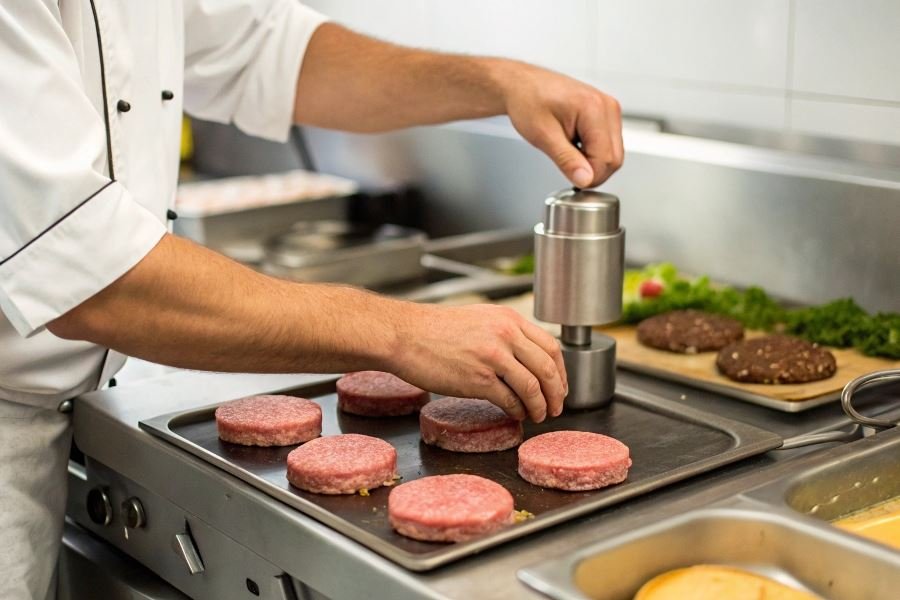
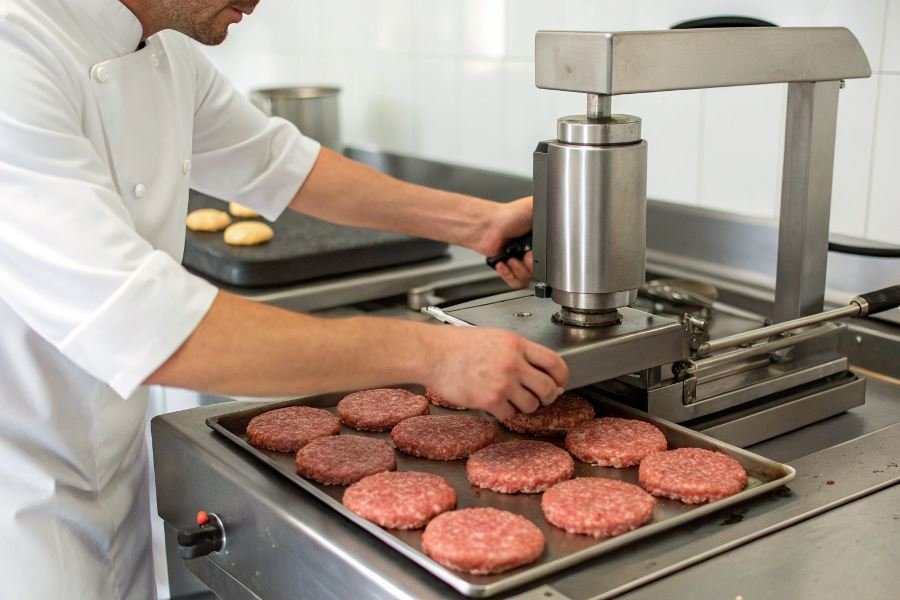
The decision between automatic and manual patty makers fundamentally hinges on your operation’s scale. Small artisan burger shops producing 100-200 patties daily thrive with manual equipment that preserves the handcrafted quality customers expect. The Weston Burger Express and similar manual presses allow artisans to maintain signature irregular edges and texture variations that signal “homemade” to discerning customers.
Conversely, operations exceeding 500 patties daily face a critical inflection point. High-volume restaurants, food trucks with multiple locations, and wholesale suppliers require the consistency and output of automatic systems like the Hollymatic Super Patty Machine, which can produce up to 2,000 uniform patties hourly with minimal labor.
The scale threshold isn’t just about quantity—it’s about maintaining quality standards while meeting demand.
Mid-sized operations often benefit from semi-automatic solutions that offer increased production without the significant investment of fully automatic systems.
ROI Analysis and Break-Even Calculations
The financial equation of patty maker selection requires careful analysis:
| Equipment Type | Initial Investment | Labor Cost (Hourly) | Production Rate | Break-Even Point |
|---|---|---|---|---|
| Manual Press | 300−1,200 | 15−20 | 40-60/hour | Almost immediate |
| Semi-Automatic | 3, 000−8,000 | 15−20 | 300-500/hour | 3-6 months |
| Fully Automatic | 15, 000−40,000 | 15−20 | 1,000-2,000/hour | 12-18 months |
The break-even calculation must factor in:
- Labor savings: Automatic machines typically reduce labor costs by 60-75%
- Consistency benefits: Reduced waste from inconsistent sizing
- Maintenance costs: Automatic systems require professional servicing
- Utility consumption: Power requirements increase with automation
For high-volume operations, the ROI often materializes within 12-18 months through labor savings alone. A restaurant producing 1,000 patties daily can reallocate approximately 20 labor hours weekly—translating to 15, 000−20,000 annual savings that offset equipment investment.
Adaptability to Product Variations
Product diversity requirements significantly impact equipment selection. Manual systems excel at flexibility, allowing operators to:
- Adjust thickness and diameter on demand
- Incorporate mix-ins and fillings
- Create irregular shapes for signature products
- Switch between meat types without extensive cleaning
Automatic systems have historically struggled with versatility, but newer models like the Ross Industries Tenderform offer programmable settings for multiple product specifications. These advanced systems can store 50+ product profiles and switch between them in minutes rather than hours.
The adaptability question extends to special dietary requirements. Manual systems handle delicate alternative proteins (plant-based, seafood blends) more gently, while automatic systems may require specialized attachments for non-traditional mixtures.
For operations with seasonal menu changes or frequent specials, semi-automatic equipment often provides the optimal balance—offering production efficiency while maintaining the flexibility to create signature variations that distinguish your brand in a competitive market.
Discover which patty maker maximizes efficiency for your business. Compare automatic vs manual systems based on production volume, labor costs, consistency, and ROI. Make an informed equipment investment for your food operation.
Discover which patty maker maximizes efficiency for your business. Compare automatic vs manual systems based on production volume, labor costs, consistency, and ROI. Make an informed equipment investment for your food operation.