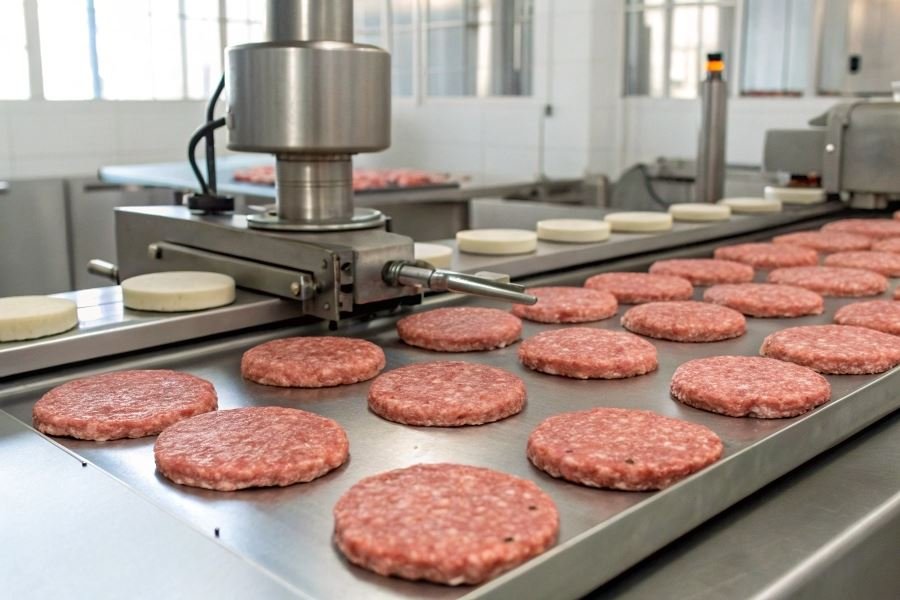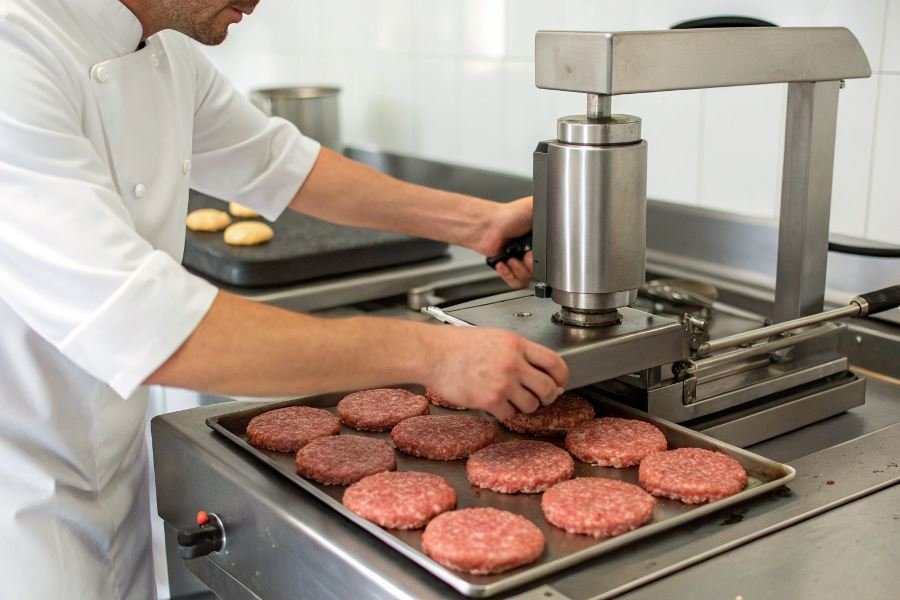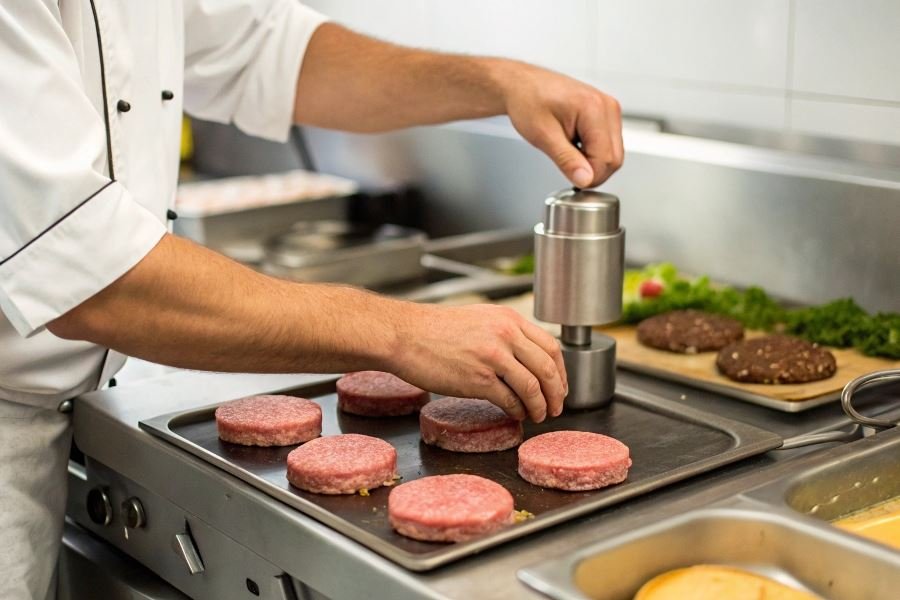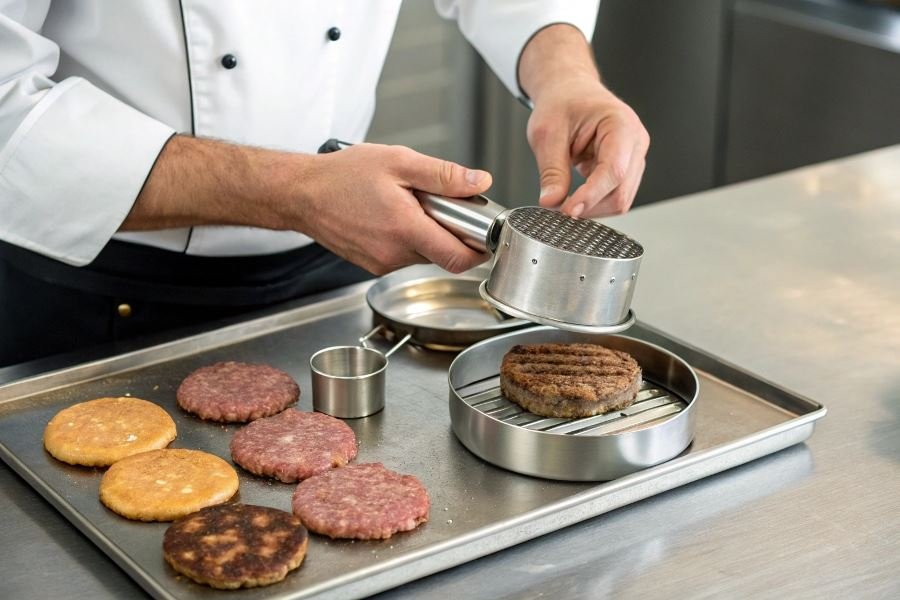
Ever watched a $30,000 patty forming machine grind to a halt during peak production? That’s the nightmare scenario that keeps food production managers up at night. Behind every perfectly shaped burger patty lies a complex machine that demands attention—not just occasionally, but systematically.
Proper maintenance of patty forming machines isn’t just about avoiding breakdowns; it’s about protecting your investment and your reputation. These precision instruments transform raw meat into uniform products that define your brand’s consistency. When maintenance falls short, the consequences cascade through your entire operation.
“The difference between a five-year and fifteen-year equipment lifespan often comes down to maintenance protocols,” notes industry research from the Food Processing Equipment Association. Their studies reveal that well-maintained patty formers retain 92% of their original precision even after a decade of use, while neglected machines show significant degradation after just three years.
Food safety stands as the non-negotiable priority in any food production facility. Inadequate cleaning protocols create harborage points for bacteria, potentially transforming your production line into a foodborne illness vector. The FDA reports that equipment-related contamination contributes to approximately 14% of food recalls—an entirely preventable statistic.
When evaluating potential patty forming machines, savvy buyers look beyond the sticker price to assess:
- Accessibility of components for thorough cleaning
- Disassembly requirements and time investment
- Compatibility with standard sanitizing agents
- Availability of replacement parts and service support
The most sophisticated patty former becomes worthless if it can’t be maintained properly. Choose wisely—your production efficiency and food safety reputation depend on it.
Smart Maintenance: The Hidden Value in Patty Forming Machines
When evaluating industrial food processing equipment, the spotlight typically falls on production capacity and forming precision. Yet the true workhorses of any meat processing operation reveal their value during the daily maintenance cycle. The accessibility of components and ease of cleaning directly impact operational efficiency, food safety compliance, and equipment longevity.
Maintenance and cleaning of patty forming machines represent critical factors that savvy buyers must evaluate before making a purchasing decision. While manufacturers highlight throughput specifications, the minutes saved during daily sanitation procedures compound into substantial labor savings over the equipment’s lifespan.
Tool-free Disassembly: Minutes Matter
The most advanced patty formers now feature comprehensive tool-free disassembly systems that dramatically reduce cleaning time. Consider the difference:
| Feature | Traditional Systems | Modern Tool-free Systems |
|---|---|---|
| Disassembly Time | 25-40 minutes | 5-10 minutes |
| Tools Required | Multiple wrenches, screwdrivers | None |
| Training Complexity | Moderate to High | Minimal |
| Risk of Lost Parts | High | Low |
Quick-release mechanisms on forming plates, feed screws, and hoppers have revolutionized the maintenance process. The Formax PF-6 exemplifies this evolution with color-coded components that can be removed, cleaned, and reinstalled in under 15 minutes—without a single tool touching the machine.
The efficiency gains multiply when considering that these procedures typically occur daily, sometimes multiple times during shift changes.
Component Accessibility: Design That Thinks Ahead
Smart engineering reveals itself in how easily operators can access critical components for inspection and servicing.
Key accessibility features to evaluate include:
- Hinged panels that open fully without obstruction
- Removable conveyor belts designed for single-operator handling
- Visible inspection points for hydraulic systems and drive mechanisms
- Ergonomic access heights that reduce operator strain
The best machines incorporate preventative maintenance indicators that alert operators to potential issues before they cause downtime. These early warning systems—ranging from simple wear indicators to sophisticated digital monitoring—can prevent catastrophic failures during production runs.
Parts and Support: The Long Game
The availability of replacement parts represents perhaps the most overlooked aspect of equipment selection. A patty former that sits idle for days awaiting proprietary components creates exponentially greater costs than its initial price difference.
When evaluating manufacturer support programs, consider:
- Parts warehousing locations relative to your facility
- Guaranteed shipping timeframes for critical components
- Cross-compatibility of wear parts across machine generations
- Technical support availability including after-hours emergency service
Leading manufacturers like Marel and JBT maintain comprehensive parts inventories with overnight shipping capabilities throughout North America. Their preventative maintenance programs often include discounted parts packages that reduce overall operating costs by 15-22% compared to as-needed purchasing.
The most forward-thinking manufacturers now offer digital twin technology that allows remote diagnostics and even augmented reality-guided maintenance procedures. These innovations dramatically reduce downtime by enabling rapid troubleshooting without waiting for technician visits.
When selecting patty forming equipment, remember that the purchase price represents only the beginning of your relationship with both the machine and its manufacturer. The true value emerges in the daily maintenance cycle, where minutes saved translate directly to production capacity gained.
Cleaning Your Way to Perfect Patties
When investing in a patty forming machine, the cleaning process might not be the first thing that captures your attention—but it absolutely should be. The difference between a machine that’s a dream to sanitize and one that becomes your maintenance nightmare can impact everything from food safety to operational efficiency.
Food-grade materials that shine
The foundation of any sanitary patty forming system starts with its construction materials. Top-tier machines feature food-grade stainless steel (typically 304 or 316 grade) that resists corrosion even with daily cleaning. But material selection goes beyond just the frame:
- Non-porous surfaces prevent bacteria from finding hiding spots
- Seamless welding eliminates crevices where food particles can accumulate
- Removable components made from FDA-approved polymers that won’t degrade
The best manufacturers incorporate sanitary design principles from the ground up. Marel and Formax patty formers, for example, feature rounded corners and sloped surfaces that prevent standing water—a breeding ground for microorganisms.
Industry wisdom: The most expensive cleaning time isn’t spent scrubbing—it’s spent disassembling and reassembling poorly designed equipment.
Cleaning compatibility that makes sense
Not all cleaning solutions play nicely with all materials. Modern patty forming machines should be designed with this reality in mind.
| Cleaning Method | Compatibility Considerations | Time Investment |
|---|---|---|
| High-pressure washing | Requires IP65 or higher electrical components | 15-30 minutes |
| Foam cleaning | Needs non-reactive surfaces for alkaline/acidic cleaners | 30-45 minutes |
| Clean-in-place systems | Requires specialized design and circulation pathways | 20-40 minutes |
The best machines come with detailed cleaning protocols that specify compatible detergents and sanitizers. JBT FoodTech patty formers, for instance, provide comprehensive cleaning guides that list approved cleaning agents that won’t compromise gaskets or seals.
Time is money when cleaning
Labor costs for cleaning can quickly add up, making the ease of disassembly a critical factor when selecting equipment:
- Tool-free disassembly can reduce cleaning time by up to 50%
- Color-coded components eliminate guesswork during reassembly
- Quick-release mechanisms for high-wear parts like forming plates
The most advanced machines from manufacturers like Handtmann feature modular designs where entire sections can be removed, cleaned, and replaced in minutes rather than hours.
Consider this: if daily cleaning takes an extra 30 minutes due to poor design, that’s 182.5 hours of labor annually—essentially a month of full-time work just spent on unnecessary cleaning time.
The cleaning efficiency of your patty former directly impacts your production capacity. Machines designed with sanitation in mind might command a premium upfront but deliver substantial savings through reduced downtime and labor costs. When evaluating options, ask for a demonstration of the complete cleaning process—not just the production capabilities—to truly understand what you’re investing in.
Discover essential maintenance features and cleaning protocols for patty forming machines that ensure food safety, extend equipment lifespan, and maintain product quality. Key buyer considerations for efficient commercial food processing operations.
Discover essential maintenance features and cleaning protocols for patty forming machines that ensure food safety, extend equipment lifespan, and maintain product quality. Key buyer considerations for efficient commercial food processing operations.