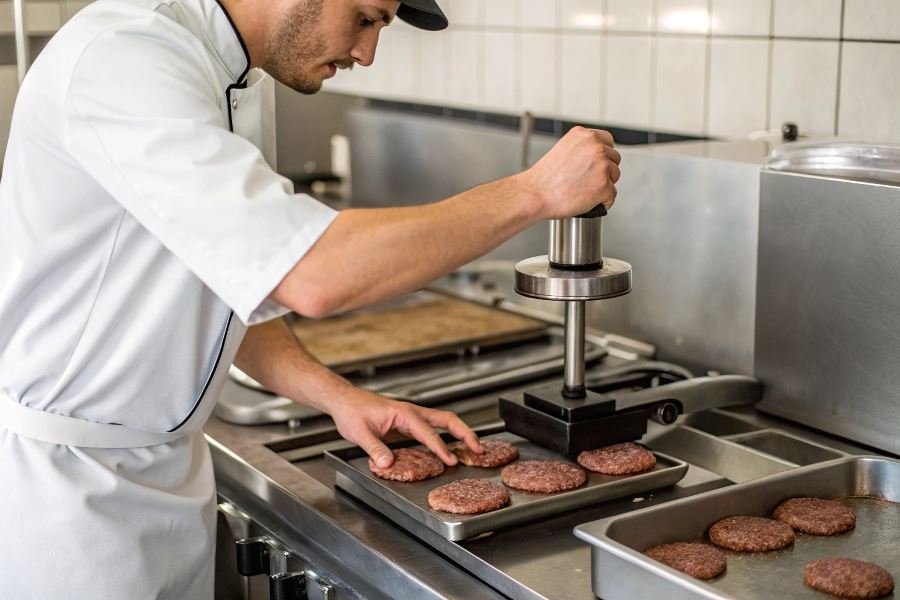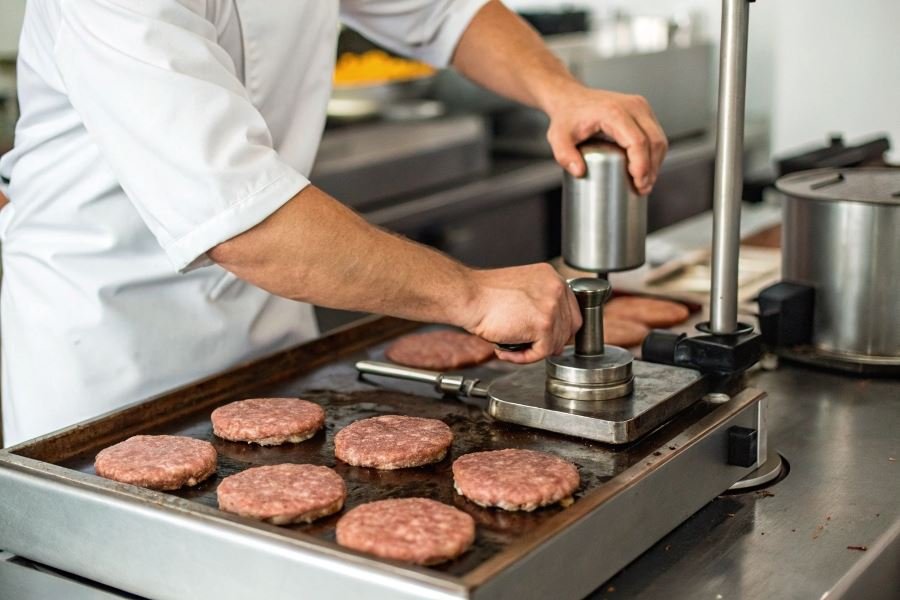
Ever wonder why some burger joints consistently serve perfect patties while others struggle with misshapen meat discs? The secret often lies not in the beef blend or seasoning, but in something far more fundamental: the hamburger mold.
For small food businesses, hamburger molds aren’t just kitchen gadgets—they’re precision instruments that directly impact your bottom line. When customers bite into a perfectly formed burger with ideal thickness and diameter, they’re experiencing the invisible craftsmanship of a well-chosen mold. This consistency builds trust and keeps them coming back.
The consistency connection
The right hamburger mold transforms your burger production from an art (unpredictable) to a science (reliable). Consider this: a variance of just 0.25 inches in patty thickness can mean the difference between a perfectly cooked medium-rare and a disappointing well-done burger. When every patty matches exactly, your cooking times become predictable, waste decreases, and your staff can focus on other aspects of food preparation.
Beyond the basics: What truly matters
When selecting a hamburger mold for your small business, several factors deserve careful consideration:
- Material durability: Commercial-grade stainless steel might cost more initially but outlasts aluminum alternatives by years
- Production capacity: How many patties can you form per hour during peak demand?
- Cleaning efficiency: Complex mechanisms might save time forming patties but cost you precious minutes during cleanup
- Size versatility: Can your mold accommodate different portion sizes for menu flexibility?
The hamburger mold you select today will shape thousands of customer experiences tomorrow. Choose wisely, and your investment will pay dividends with every perfectly formed patty.
Making the Perfect Patty: Essential Hamburger Mold Selection Criteria
When scaling up burger production for your food business, the humble hamburger mold transforms from a nice-to-have into mission-critical equipment. The right mold doesn’t just shape meat—it shapes your operation’s efficiency, product consistency, and ultimately, your bottom line.
Selecting appropriate criteria for choosing a hamburger mold for small business operations requires balancing immediate needs against long-term growth plans. The decision impacts everything from food safety to production speed, making it far more consequential than many entrepreneurs initially realize.
Material matters: The foundation of quality
The material of your hamburger mold fundamentally determines its performance, longevity, and food safety profile:
Food-grade stainless steel stands as the gold standard in commercial settings. These molds offer unmatched durability, resist corrosion, and maintain structural integrity through thousands of pressing cycles. The 304-grade stainless steel variants provide exceptional resistance to acidic ingredients while withstanding high-volume washing.
Aluminum alternatives present a more budget-friendly option while still delivering professional results. Typically 30-40% lighter than steel counterparts, aluminum molds reduce operator fatigue during extended production runs. However, they may develop surface pitting over time when exposed to acidic ingredients.
Plastic molds, while inexpensive, generally underperform in commercial settings. Even high-density polypropylene options tend to warp after repeated use and cleaning cycles, compromising patty consistency.
| Material | Durability | Weight | Price Range | Best For |
|---|---|---|---|---|
| Stainless Steel | 5-10+ years | Heavy | $80-200 | High-volume operations |
| Aluminum | 2-4 years | Medium | $40-90 | Mid-volume operations |
| Plastic | 6-12 months | Light | $15-30 | Occasional use only |
Sizing up success: Capacity considerations
Your mold’s size and capacity requirements should align precisely with your business volume and menu diversity:
Single-press molds work well for artisanal operations producing fewer than 100 burgers daily. These allow for careful quality control but limit throughput.
Multi-cavity presses that form 4-6 patties simultaneously become essential when daily production exceeds 200 units. The Vollrath 47234 and similar commercial models offer adjustable thickness settings from ¼” to 1″, accommodating everything from smash burgers to gourmet thick patties.
For menu versatility, consider investing in interchangeable ring sets that allow for different diameter patties (typically 3″, 4″, and 5″) without purchasing multiple complete mold systems.
Built to last: The durability equation
The true value of a hamburger mold emerges through its maintenance requirements and longevity:
Construction quality reveals itself in the details—seamless welding, reinforced hinges, and precision-machined surfaces indicate professional-grade equipment built for commercial demands.
Cleaning complexity dramatically affects operational efficiency. Molds with removable parts and dishwasher-safe components save valuable labor hours. Non-stick surfaces like those found on Winco MPBP-4 models reduce cleaning time while minimizing food waste from sticking.
Replacement part availability often separates truly commercial-grade equipment from consumer-grade alternatives. Before purchasing, verify that wear items like springs, handles, and non-stick surfaces can be replaced without scrapping the entire unit.
The ideal hamburger mold balances material quality, appropriate capacity, and maintenance simplicity—creating the foundation for consistent, efficient burger production that scales with your business growth.
Maximizing Your Burger Business with Advanced Mold Selection
Ergonomic design that transforms workflow
The difference between a profitable burger operation and one that struggles often comes down to kitchen efficiency. Ergonomic hamburger molds aren’t just fancy equipment—they’re workflow revolutionaries. The Cuisinart Stuffed Burger Press exemplifies this with its non-slip grip and pressure-distributing handle design that reduces wrist strain during high-volume service periods.
Staff fatigue translates directly to decreased output. Tests conducted by commercial kitchen consultants show that ergonomically designed molds can increase production speed by 15-20% during rush periods while reducing repetitive strain injuries.
Efficiency insight: Position your burger mold station at elbow height (approximately 36-38 inches) to maximize ergonomic benefit and minimize back strain during extended prep sessions.
The best molds feature quick-release mechanisms that eliminate the frustrating “burger sticking” problem. The Weston Burger Express incorporates a spring-loaded design that ejects perfectly formed patties with minimal effort, saving precious seconds per burger that accumulate into hours saved monthly.
Versatility for menu expansion
Single-purpose equipment limits your menu potential. Today’s most successful burger businesses leverage versatile molds that adapt to changing customer preferences.
Multi-size capability has become non-negotiable for competitive burger operations. The Weber Burger Press offers adjustable thickness settings from ¼-inch sliders to 1-inch gourmet burgers, allowing menu flexibility without additional equipment investment.
Specialty burger options drive premium pricing. Consider these adaptability features:
| Feature | Business Benefit | Example Application |
|---|---|---|
| Stuffing capability | $2-4 price premium per burger | Blue cheese-stuffed black Angus patties |
| Interchangeable inserts | Menu diversification | Lamb kofta patties with Mediterranean spices |
| Non-circular shapes | Brand differentiation | Signature square patties with crisp edges |
The Cuisinart 3-in-1 Stuffed Burger Press allows for standard, stuffed, and slider burgers from a single device, eliminating the need for multiple tools and reducing kitchen clutter—critical for small operations with limited prep space.
ROI considerations beyond the price tag
Initial purchase price represents only a fraction of a mold’s true business cost. Savvy operators calculate comprehensive ROI based on multiple factors:
Production capacity directly impacts revenue potential. A commercial-grade Vollrath Burger Press might cost $120 compared to a $40 consumer model, but its ability to produce 500+ consistent patties daily versus 100-150 from budget alternatives makes the premium investment mathematically sound for operations serving more than 50 burgers daily.
Durability metrics reveal the true cost over time. Cast aluminum molds from American Metalcraft typically last 3-5 years in high-volume settings, while budget plastic alternatives often require replacement within 6-8 months. Calculate your cost-per-patty over the equipment’s lifespan rather than focusing solely on acquisition cost.
Material quality affects both food safety and maintenance expenses. Commercial-grade stainless steel molds from Winco might command a 30% premium but offer dishwasher-safe convenience and eliminate the cross-contamination risks associated with scratched non-stick surfaces—potentially saving thousands in prevented foodborne illness incidents.
The most successful burger operations understand that mold selection isn’t merely about forming meat—it’s about forming a sustainable business advantage through thoughtful equipment investment that optimizes both production efficiency and menu creativity.
Discover the 7 critical criteria for selecting the perfect hamburger mold for your small business. Learn how material quality, size, durability, and ergonomic design impact efficiency, consistency, and ultimately your bottom line.
Discover the 7 critical criteria for selecting the perfect hamburger mold for your small business. Learn how material quality, size, durability, and ergonomic design impact efficiency, consistency, and ultimately your bottom line.