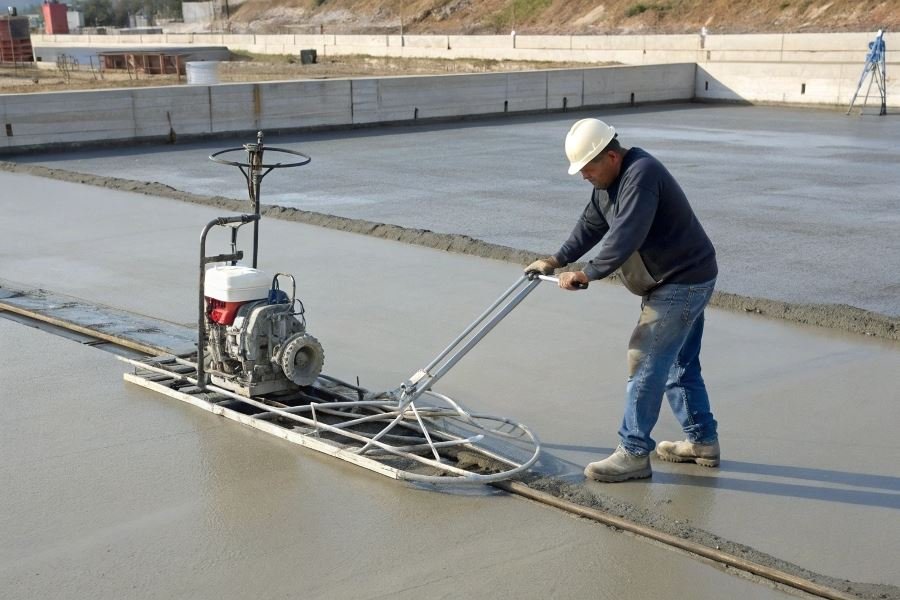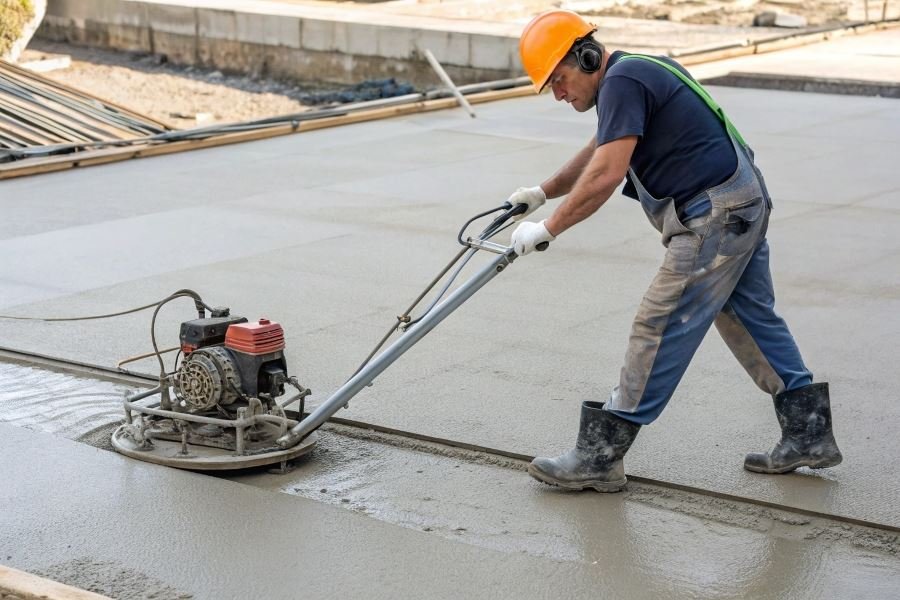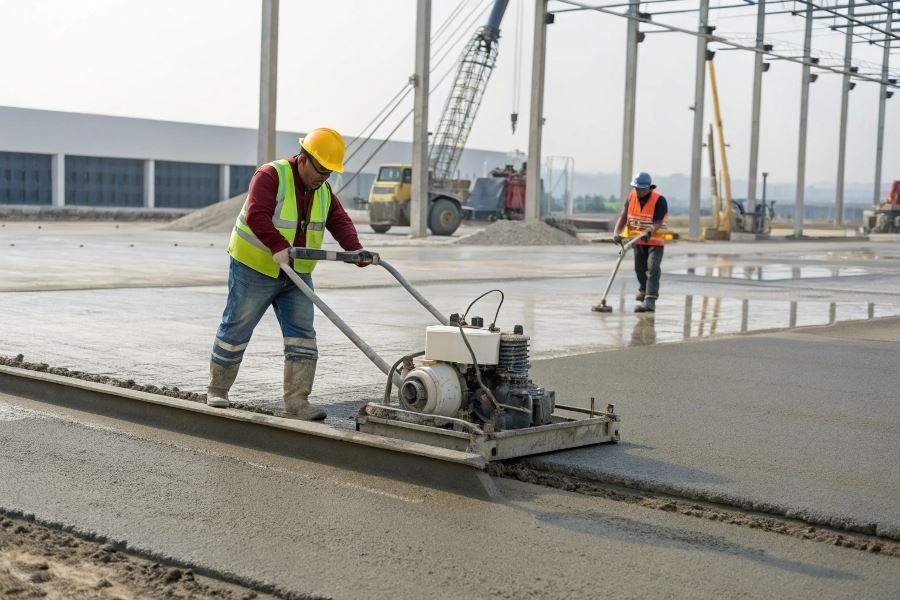
Ever wondered why some concrete surfaces feel perfectly smooth while others seem like they were poured during an earthquake? The secret often lies in a piece of equipment that doesn’t get nearly enough credit: vibrating rails.
At construction sites across America, these powerful tools are transforming how we approach industrial flooring and pavement projects. Vibrating rails—essentially motorized straightedges that simultaneously level and consolidate concrete—represent the critical intersection between engineering precision and practical application. They create surfaces that not only look professional but maintain structural integrity for decades.
The selection of the right vibrating rail can mean the difference between a project that stands the test of time and one that requires costly repairs within months. When concrete isn’t properly consolidated, air voids form, creating weak points that eventually lead to cracking and deterioration. A properly selected vibrating rail eliminates these voids through controlled vibration frequency and amplitude, ensuring optimal concrete density.
Key selection factors for project success
Choosing the appropriate vibrating rail involves evaluating several critical parameters:
- Engine power and reliability: The heart of any vibrating rail system
- Vibration frequency range: Different mixes require different frequencies
- Rail length and material: Must match your specific project dimensions
- Weight and maneuverability: Affects operator fatigue and productivity
The concrete industry has evolved dramatically since the first mechanical vibrating systems were introduced in the 1930s. Today’s equipment offers precision that early builders could only dream of, with digital controls that allow for fine-tuning vibration parameters to match specific concrete formulations.
The Engineering Behind Vibrating Rails
When selecting vibrating rails for industrial construction projects, the technical specifications make all the difference between project success and costly delays. These powerful concrete finishing tools transform freshly poured surfaces into perfectly level foundations through precisely controlled vibration.
Choosing the right vibrating rails for industrial construction projects requires careful consideration of multiple factors including power requirements, dimensional specifications, and vibration characteristics. The selection process becomes significantly easier when you understand how each feature impacts performance across different applications and concrete mixes. Professional contractors recognize that matching equipment capabilities to specific job requirements not only improves finish quality but also enhances crew productivity and extends equipment lifespan.
Power That Drives Performance
The heart of any vibrating rail system is its power unit. Most professional-grade models operate with:
- Gas-powered engines: Typically 5.5-13 HP for maximum mobility
- Electric motors: Usually 2-5 HP, ideal for indoor applications
- Hydraulic systems: Common in larger industrial settings where consistent power is critical
The power source directly affects not only operational capability but also runtime between refueling or recharging. Gas engines offer excellent portability but require ventilation, while electric models eliminate emissions but need reliable power sources.
| Power Type | Typical HP Range | Best Application |
|---|---|---|
| Gas | 5.5-13 HP | Outdoor projects |
| Electric | 2-5 HP | Indoor work |
| Hydraulic | Variable | Large industrial |
Dimensional Considerations Matter
The physical specifications of vibrating rails dramatically impact their suitability for different projects:
Length options typically range from 6 to 24 feet, with modular systems allowing for custom configurations. Longer rails require more power but cover more area per pass.
Width factors generally fall between 6 and 24 inches. Wider rails finish more surface area but demand more operator strength and power.
Weight considerations are crucial—heavier rails (80-200 lbs) provide better compaction but require more operators or mechanical assistance. The weight-to-power ratio must be balanced for optimal performance without operator fatigue.
Vibration Parameters Define Results
The vibration characteristics ultimately determine finish quality:
- Frequency range: Professional models operate between 3,000-5,000 vibrations per minute (VPM)
- Amplitude settings: Typically 0.5-2.5 mm of movement
- Adjustability: Premium models offer variable settings for different concrete mixes
Higher frequencies work better for low-slump concrete with smaller aggregate, while greater amplitude proves more effective for thicker pours with larger aggregate sizes.
For industrial applications, look for systems from Wacker Neuson or Multiquip that offer frequency adjustability—this allows fine-tuning for specific mix designs and environmental conditions.
The most versatile systems provide digital controls that maintain consistent vibration regardless of load variations, ensuring uniform compaction across the entire pour. This precision becomes particularly valuable when working with specialized concrete formulations or when project specifications demand exceptionally tight tolerances.
Mastering Vibrating Rail Selection for Industrial Excellence
Durability That Outlasts Your Project Timeline
When investing in vibrating rails for industrial construction, durability isn’t just a feature—it’s the foundation of your ROI calculation. The most robust systems on the market utilize aircraft-grade aluminum alloys combined with hardened steel components that resist the punishing conditions of construction sites.
Maintenance requirements vary dramatically between models. Premium systems from manufacturers like Wacker Neuson feature sealed bearings and self-lubricating components that require inspection only every 500 operating hours. Compare this to budget alternatives demanding weekly maintenance, and the labor savings become immediately apparent.
The difference between a 3-year and 7-year service life translates to approximately $12,000 in replacement costs for a mid-sized operation.
Environmental factors dramatically impact durability. Rails operating in coastal environments face accelerated corrosion unless they feature marine-grade protective coatings. For projects in extreme temperature environments, look for systems with thermal-resistant components rated for your specific conditions.
Concrete Compatibility Creates Perfect Finishes
The relationship between vibrating rails and concrete mix design is crucial yet frequently overlooked. Different concrete formulations respond uniquely to vibration frequencies and amplitudes.
| Concrete Type | Optimal Frequency | Recommended Rail Type |
|---|---|---|
| High-slump | 3000-4000 VPM | Lightweight profile |
| Standard mix | 4000-5000 VPM | Medium-duty profile |
| Low-slump | 5000+ VPM | Heavy-duty profile |
For projects utilizing fiber-reinforced concrete, rails with higher amplitude settings prevent fiber clustering and ensure even distribution. When working with self-consolidating concrete (SCC), select rails with variable frequency controls to avoid over-vibration and aggregate separation.
Compatibility extends beyond vibration characteristics to include rail profile design. Wider profiles excel with larger aggregate mixes, while narrower profiles deliver superior results with fine-aggregate formulations.
Investment Analysis Beyond Initial Price Tags
The true cost of vibrating rail systems emerges only through comprehensive ROI analysis. Initial acquisition costs typically represent just 30-40% of lifetime ownership expenses.
The most expensive vibrating rail is the one that fails mid-project or delivers substandard results requiring rework.
When calculating ROI, factor these critical elements:
- Energy efficiency – Modern electric models from Husqvarna consume up to 35% less power than previous generations
- Labor productivity – Advanced ergonomic designs reduce operator fatigue, increasing daily square footage by 15-20%
- Maintenance downtime – Premium systems average 98% uptime versus 85% for budget alternatives
- Concrete finish quality – Higher quality rails reduce finishing labor by up to 40%
For operations completing more than 50,000 square feet annually, the premium for top-tier equipment typically pays for itself within 14 months through reduced labor costs alone.
Consider rental-to-own programs for specialized projects or lease options that include maintenance packages. These alternatives can preserve capital while providing access to higher-quality equipment than outright purchase might allow within the same budget constraints.
The most successful contractors view vibrating rails not as disposable tools but as precision instruments that directly impact project timelines, concrete quality, and ultimately, profitability.
Discover how to select optimal vibrating rails for industrial construction projects. Learn key specifications including power requirements, dimensions, vibration parameters, durability factors, and cost considerations to maximize efficiency and concrete quality.
Discover how to select optimal vibrating rails for industrial construction projects. Learn key specifications including power requirements, dimensions, vibration parameters, durability factors, and cost considerations to maximize efficiency and concrete quality.