
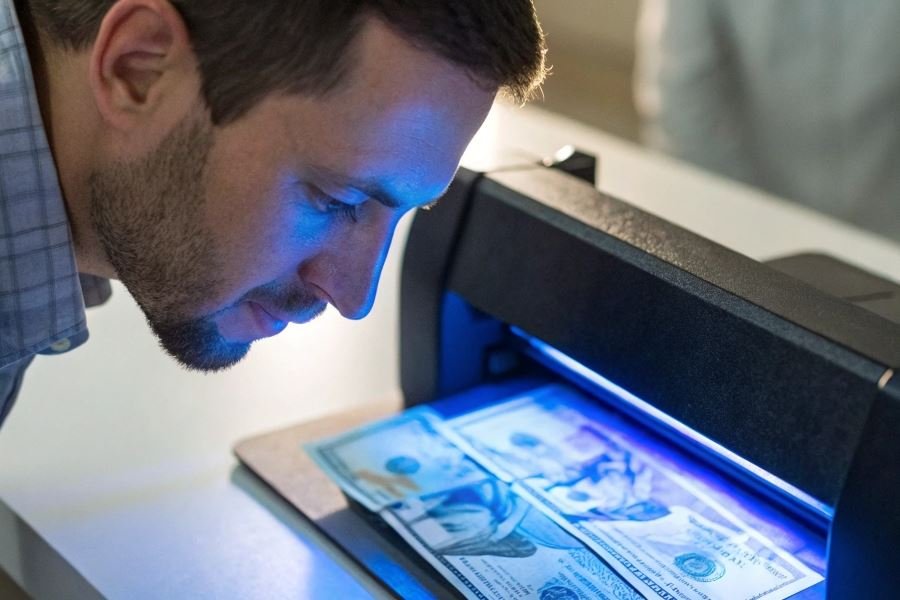
Ever wonder how much counterfeit money might be passing through your business undetected? The Federal Reserve estimates that approximately $70 million in counterfeit bills remain in circulation – a silent threat to your bottom line.
For small business owners, every dollar counts. When counterfeit bills slip through your fingers, they don’t just represent lost merchandise – they create a cascade of financial damage. Accepting even a single fake $50 bill can erase the profit margin on multiple sales. Banknote detectors serve as your first line of defense against this persistent threat.
The financial security imperative
Counterfeit detection isn’t just about avoiding losses – it’s about maintaining financial integrity. Modern counterfeiters use increasingly sophisticated techniques, making visual detection nearly impossible. A quality detector provides:
- Immediate verification of currency authenticity
- Protection against sophisticated forgeries that fool the naked eye
- Peace of mind during high-volume transactions
Detector types for every business need
Today’s market offers several detector categories, each with distinct advantages:
| Type | Best for | Key benefit |
|---|---|---|
| UV detectors | Low-volume retail | Affordable entry point |
| Multi-feature detectors | Medium businesses | Balance of speed and security |
| Automated counters | High cash volume | Efficiency with built-in verification |
Choosing the right detector: Critical factors
When selecting your counterfeit detection solution, consider these essential elements:
- Transaction volume – How many bills do you process daily?
- Staff expertise – Will multiple employees use the device?
- Currency types – Do you accept foreign currencies?
The ideal detector balances accuracy, speed, and ease of use while fitting seamlessly into your existing operations. Remember that the most expensive option isn’t always necessary – the right detector is the one that addresses your specific business vulnerabilities.
Essential Features That Make or Break Your Banknote Detector
When cash transactions are part of your daily operations, the right counterfeit detection equipment becomes as crucial as your point-of-sale system. Selecting the appropriate banknote detector for small business operations requires understanding several critical features that separate adequate tools from exceptional ones.
Detection Technology: Your First Line of Defense
The foundation of any quality banknote detector lies in its verification technologies. Modern detectors employ multiple authentication methods simultaneously:
- Ultraviolet (UV) detection identifies the fluorescent security features embedded in genuine notes that remain invisible to the naked eye
- Magnetic sensors verify the magnetic ink used in legitimate currency, particularly effective for USD detection
- Infrared scanning detects the specialized inks that reflect or absorb infrared light in specific patterns
- Watermark verification confirms the presence of authentic watermarks through specialized lighting
The most reliable detectors combine at least three of these technologies. For example, the Safescan 185-S employs UV, magnetic, and watermark detection, creating a robust verification system that catches sophisticated counterfeits that single-technology devices might miss.
Processing Speed: Time Is Money
Transaction efficiency directly impacts customer satisfaction and operational productivity. When evaluating how to choose a banknote detector for small business needs, processing speed becomes particularly important during peak hours.
The difference between a 0.5-second and 1.5-second verification might seem negligible until you’re facing a line of impatient customers.
Processing capabilities vary dramatically between models:
| Detector Type | Processing Speed | Recommended Transaction Volume |
|---|---|---|
| Basic Manual | 2-3 seconds/bill | <50 transactions daily |
| Mid-Range Automated | 0.5-1 second/bill | 50-200 transactions daily |
| Advanced Multi-Feed | 100+ bills/minute | 200+ transactions daily |
Businesses handling significant cash volumes should consider multi-feed detectors like the AccuBANKER D580 that can process stacks of bills automatically, dramatically reducing verification time while maintaining accuracy.
Currency Compatibility and Future-Proofing
Currency designs evolve constantly to incorporate advanced security features. A detector that can’t be updated becomes obsolete when new banknotes enter circulation.
Key considerations for compatibility include:
- Multi-currency support for businesses in tourist areas or near international borders
- Update mechanisms (USB, Wi-Fi, or manufacturer service)
- Update frequency offered by the manufacturer
- Cost of updates over the detector’s lifetime
The Cassida Quattro exemplifies adaptability with its automatic updates via internet connection, ensuring your investment remains viable as currency designs change.
Practical Integration Factors
Beyond core detection capabilities, consider how the device fits into your operational workflow:
- Size and footprint on your counter space
- Power options (battery operation for mobile businesses)
- Ease of use for all staff members
- Durability for high-volume environments
Remember that the most sophisticated detector provides no value if your team finds it too cumbersome to use consistently.
By prioritizing detection technology, processing efficiency, and adaptability to currency changes, you’ll select a counterfeit detector that provides both immediate protection and long-term value for your business operations. The right detector doesn’t just save you from accepting counterfeit bills—it streamlines your cash handling process and builds customer confidence in your operations.
Making the Final Decision: Banknote Detector Selection That Makes Sense
Choosing the right counterfeit detector isn’t just about security—it’s about making a smart business investment that aligns with your operational needs. Let’s cut through the noise and focus on what truly matters when finalizing your decision.
Budget Considerations That Actually Pay Off
The price range for banknote detectors spans from $50 basic models to sophisticated $2,000+ systems. But thinking purely in terms of upfront cost misses the bigger picture.
Calculate your risk exposure first: A business handling $5,000 in cash daily faces significantly different risks than one processing $500. Your potential loss from accepting counterfeit bills should guide your investment level.
The smartest approach isn’t buying the most expensive detector—it’s finding the right protection-to-price ratio for your specific situation.
Consider this ROI calculation:
| Detector Type | Initial Cost | Annual Maintenance | Counterfeit Detection Rate | Estimated Annual Savings |
|---|---|---|---|---|
| Basic UV | $80-150 | $0 | 65% | $300-500 |
| Multi-detection | $300-600 | $50-100 | 85% | $800-1,200 |
| Advanced | $800-2,000 | $100-300 | 98% | $1,500-3,000 |
The savings estimate assumes preventing acceptance of counterfeit bills that would otherwise be losses. Many businesses find their detector pays for itself within 3-6 months.
Space and System Integration That Works
Your physical environment dictates practical considerations that can make or break your counterfeit detection strategy.
Footprint matters: Counter space is precious in retail. Modern compact detectors like the Safescan 155-S occupy just 6×3 inches—roughly the size of a stapler—while delivering multi-point verification.
When evaluating portability, consider:
- Weight (under 2 pounds for truly portable options)
- Battery operation capability (essential for mobile businesses)
- Setup time (under 30 seconds is ideal)
Integration with your existing POS system eliminates double-handling and speeds up transactions.
Most modern detectors offer USB connectivity, but compatibility varies widely. Before purchasing, verify:
- Whether the detector can interface with your specific POS software
- If it requires additional drivers or middleware
- Whether it can log verification results automatically
Some advanced systems like the Cassida Quattro can even be programmed to automatically record denomination information directly into your sales system.
Support Systems That Don’t Leave You Hanging
The best detector becomes worthless if it malfunctions during a busy period with no backup plan.
Warranty coverage varies dramatically: Standard warranties range from 90 days to 3 years. The AccuBANKER D580 offers an industry-leading 5-year warranty that includes parts and labor.
Maintenance requirements differ by technology:
- UV detectors: Minimal maintenance, bulb replacement every 2-3 years
- Magnetic detectors: Regular cleaning of sensors every 1-2 months
- Multi-sensor systems: Annual professional calibration recommended
Technical support availability becomes crucial during peak business periods when equipment failure isn’t an option.
Before finalizing your purchase, test the manufacturer’s support responsiveness:
- Call their technical support line to gauge response time
- Check if they offer weekend support hours
- Verify if replacement units are available during repairs
The best manufacturers offer overnight shipping on replacement units and maintain detailed troubleshooting databases accessible 24/7.
Discover how to protect your small business from counterfeit currency with the right banknote detector. Learn about essential detection technologies, processing speeds, and budget considerations to make a smart investment in your financial security.
Discover how to protect your small business from counterfeit currency with the right banknote detector. Learn about essential detection technologies, processing speeds, and budget considerations to make a smart investment in your financial security.
