
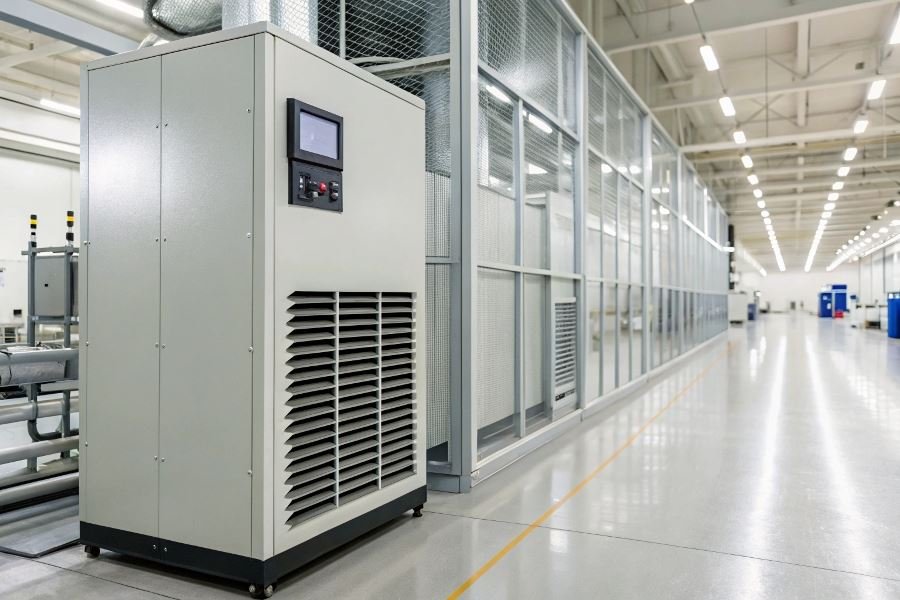
Ever walked into a manufacturing plant and felt that unmistakable heaviness in the air? Industrial environments face unique air quality challenges that standard filtration simply can’t handle. Air ionization technology offers a powerful solution—but choosing the right system requires understanding both the science and the strategy.
Air ionizers work by releasing charged particles (ions) that attach to airborne contaminants, causing them to become too heavy to remain suspended. These particles then fall to surfaces or are attracted to collection plates, effectively removing them from breathing zones. Unlike traditional filters that passively wait for air to pass through, ionizers actively seek out pollutants throughout the entire space.
The benefits for industrial settings are substantial:
- Dramatic reduction in airborne particulates including dust, smoke, and allergens
- Enhanced employee health with fewer respiratory complaints and reduced sick days
- Decreased equipment maintenance costs as less dust means less mechanical wear
- Improved product quality in sensitive manufacturing processes
- Compliance support for stringent air quality regulations
“The return on investment for properly implemented ionization systems typically occurs within 12-18 months through reduced maintenance costs alone.” — American Industrial Hygiene Association
Before selecting an industrial air ionizer, consider these critical factors:
- Space dimensions and airflow patterns in your facility
- Specific contaminant challenges unique to your industry
- Integration capabilities with existing HVAC systems
- Maintenance requirements and associated long-term costs
- Ozone production levels (ideally zero or negligible)
The right ionization system transforms not just air quality, but operational efficiency—making this technology an investment in both workplace health and bottom-line performance.
Essential Factors for Choosing Industrial Air Ionizers
When selecting air ionization systems for manufacturing facilities, warehouses, or other industrial environments, the technical specifications matter significantly more than marketing claims. The process of evaluating how to choose an air ionizer for industrial premises requires careful analysis of several critical factors that directly impact performance, efficiency, and return on investment.
Coverage Area and Ionization Capacity
The first consideration when evaluating industrial ionizers is matching the device’s capacity to your specific space requirements.
Square footage isn’t the only metric that matters. Industrial spaces present unique challenges:
- Ceiling heights often exceed 20 feet
- Open floor plans may create air circulation patterns
- Equipment and storage racks create “dead zones”
For optimal performance, calculate the cubic footage (length × width × height) rather than just floor area. Most manufacturers specify coverage in cubic feet, with industrial models ranging from 1,000 to 50,000+ cubic feet.
Ion density requirements vary by application:
| Industry Type | Recommended Ion Density (ions/cm³) | Typical Applications |
|---|---|---|
| Electronics Manufacturing | 25,000-50,000 | Static discharge prevention |
| Food Processing | 10,000-20,000 | Airborne pathogen reduction |
| Warehousing | 5,000-15,000 | Dust control, general air quality |
| Chemical Processing | 20,000-40,000 | Odor neutralization, VOC reduction |
Ion Generation Technologies
The method used to generate ions dramatically affects performance, maintenance requirements, and suitability for specific industrial applications.
Needle-point ionization creates ions through corona discharge from metal emitters. These systems:
- Require minimal power
- Generate both positive and negative ions
- Need regular cleaning to maintain performance
- Work well in moderate humidity environments
Carbon brush technology offers:
- Higher ion output
- More consistent performance in varying humidity
- Lower maintenance requirements
- Higher initial cost but longer operational life
Bipolar ionization systems represent the newest technology, using specialized tubes to create equal amounts of positive and negative ions without producing ozone. The AtmosAir systems exemplify this approach with their tubular design that integrates directly into existing HVAC infrastructure.
Energy Efficiency and Operational Costs
The true cost of industrial ionization extends far beyond the purchase price.
Power consumption varies dramatically between technologies:
- Needle-point systems: 5-20 watts
- Carbon brush systems: 15-40 watts
- Bipolar systems: 10-30 watts
For continuous operation, even small efficiency differences translate to significant annual costs. A 20-watt difference in a 24/7 operation represents approximately $175 in annual electricity costs per unit at average industrial electricity rates.
Maintenance requirements create additional operational expenses:
- Needle-point systems require cleaning every 30-90 days
- Carbon brush emitters need replacement every 1-2 years
- Bipolar tubes typically last 2-3 years before replacement
When calculating total cost of ownership, factor in both scheduled maintenance and the labor costs associated with system monitoring. The Plasma Air industrial series offers remote monitoring capabilities that reduce inspection requirements while ensuring optimal performance.
By thoroughly evaluating these three critical factors—coverage capacity, generation technology, and operational costs—facility managers can select ionization systems that deliver consistent performance while minimizing long-term expenses.
Advanced Selection Criteria for Industrial Air Ionizers
Maintenance Requirements That Won’t Break Your Operation
When selecting an industrial air ionizer, maintenance requirements can make or break your operational efficiency. The most advanced models from manufacturers like Blueair and AtmosAir have extended maintenance intervals of 12-18 months, dramatically reducing downtime compared to older units requiring quarterly service.
Filter replacement schedules vary significantly between technologies. Bipolar ionization systems typically require electrode cleaning or replacement every 24,000 hours of operation, while needlepoint ionization systems may extend to 30,000+ hours. This translates to real dollars:
| Ionizer Type | Replacement Interval | Annual Maintenance Cost | Downtime Hours/Year |
|---|---|---|---|
| Traditional Plate | 3-6 months | $1,200-2,400 | 8-16 |
| Needlepoint | 12-24 months | $400-800 | 2-4 |
| Bipolar | 12-18 months | $600-1,200 | 3-6 |
The true cost of maintenance isn’t just parts—it’s the operational disruption during servicing.
Look for self-diagnostic capabilities that alert maintenance teams before performance degrades. The Plasma Air systems feature LED indicators that shift from green to yellow when approaching maintenance thresholds—a simple feature that prevents unexpected downtime.
Seamless HVAC Integration Is Non-Negotiable
Industrial air ionizers must work harmoniously with existing HVAC infrastructure. The integration approach dramatically affects installation costs, efficiency, and overall performance.
Duct-mounted systems offer the most straightforward integration path, requiring minimal modifications to existing infrastructure. These units, like those from GPS Air, install directly into supply ducts and typically require only:
- A 4-8 inch access cutout
- 24V AC/DC power connection
- Minimal airflow adjustments
Standalone units provide flexibility but may create airflow conflicts with existing systems. If choosing this route, ensure the ionizer’s airflow patterns complement rather than compete with your HVAC system.
The most overlooked integration factor? Ensuring your ionizer’s performance isn’t compromised by high humidity environments common in industrial settings.
For facilities with variable air volume (VAV) systems, select ionizers with proportional output control that adjusts ionization levels based on airflow rates. This prevents over-ionization during low-flow periods and under-ionization during peak demand.
Certification Standards That Actually Matter
The industrial air ionizer market is flooded with products making extraordinary claims. Legitimate certification is your shield against underperformance.
UL 2998 certification (zero ozone emission) has become the gold standard for industrial applications. This certification ensures the ionizer produces less than 0.005 ppm of ozone—well below the OSHA permissible exposure limit of 0.1 ppm.
Beyond ozone, look for these critical certifications:
- UL 867: Safety standard for electrostatic air cleaners
- CE Marking: Compliance with European health, safety, and environmental standards
- CARB Certification: California Air Resources Board compliance for VOC reduction
The absence of these certifications isn’t just a technical concern—it’s a liability risk for your operation.
For food processing and pharmaceutical facilities, additional compliance with FDA 21 CFR Part 11 may be necessary. Aerisa offers specialized systems designed specifically for these highly regulated environments.
When evaluating compliance documentation, demand test results from independent laboratories rather than manufacturer-conducted testing. Third-party validation from organizations like Intertek or TÜV provides credibility that internal testing simply cannot match.
Discover how to select the optimal industrial air ionizer with our comprehensive guide. Learn about coverage requirements, ion generation technologies, energy efficiency, maintenance needs, and certification standards for cleaner workplace air.
Discover how to select the optimal industrial air ionizer with our comprehensive guide. Learn about coverage requirements, ion generation technologies, energy efficiency, maintenance needs, and certification standards for cleaner workplace air.


