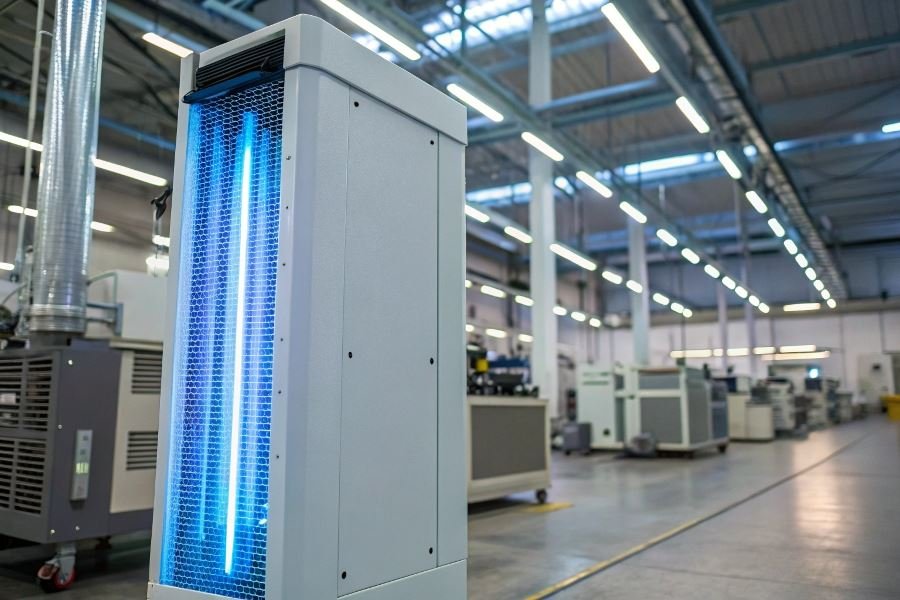
Ever walked into a warehouse after a thunderstorm and felt that distinctive “clean air” sensation? That’s nature’s ionization at work—and it’s exactly what modern warehouse ionizers replicate, but with precision that would make Mother Nature jealous.
Ionizers are specialized devices that release charged particles (ions) into the air, neutralizing static electricity and removing airborne contaminants. In warehouse environments, these technological sentinels serve as the first line of defense against invisible threats that can damage sensitive inventory, compromise product integrity, and even create safety hazards for personnel.
The stakes couldn’t be higher for warehouse operators. Static electricity—often imperceptible until it’s too late—can destroy sensitive electronics, attract dust to packaging, trigger unexpected fires, and even cause product components to stick together inappropriately. A properly selected ionization system doesn’t just protect products; it safeguards your entire operation’s reputation and bottom line.
When evaluating ionizers for your warehouse facility, three critical factors demand your attention: coverage capacity (can it handle your square footage?), ionization balance (does it produce appropriate positive and negative ion ratios?), and monitoring capabilities (can you verify it’s working correctly?). The difference between adequate and optimal ionization often translates directly to thousands of dollars in prevented damage.
The right ionizer doesn’t just eliminate problems—it creates opportunities for operational excellence that your competitors might be missing entirely.
Technical Essentials for Warehouse Ionizer Selection
Selecting the right ionizer for warehouse facilities demands attention to technical specifications that directly impact performance. When evaluating ionization systems for large-scale storage environments, three critical factors stand out: coverage capabilities, ion balance precision, and system integration options. These criteria for selecting an ionizer for warehouse facilities will determine whether your investment delivers the contamination control and static elimination your operation requires.
Coverage Area and Output Power
The effectiveness of an ionizer begins with its ability to blanket your entire workspace with sufficient ion density. Coverage requirements vary dramatically based on warehouse dimensions and storage configurations:
Small warehouses (under 10,000 sq ft) typically require 2-4 strategically placed overhead ionizers, while large distribution centers may need comprehensive ionization networks with 15+ units.
The ionization output, measured in ions/cm³, must match your specific contamination control needs:
| Warehouse Type | Recommended Ion Density | Typical Coverage Per Unit |
|---|---|---|
| Electronics Storage | 10⁷-10⁸ ions/cm³ | 1,000-1,500 sq ft |
| General Merchandise | 10⁶-10⁷ ions/cm³ | 1,500-2,500 sq ft |
| Food/Pharma | 10⁷-10⁸ ions/cm³ | 1,200-2,000 sq ft |
When evaluating Simco-Ion or Static Clean systems, verify their output specifications at various distances. Remember that ion density decreases exponentially with distance from the emitter—a unit claiming “20-foot range” may provide inadequate ionization at that maximum distance.
Ion Balance and Discharge Time
The technical heart of any ionizer is its ability to maintain precise ion balance while rapidly neutralizing static charges. This balance, measured in volts, represents the difference between positive and negative ion production.
Premium warehouse ionizers maintain balance within ±10V, while budget options may drift to ±50V or worse.
Discharge time—how quickly an ionizer can neutralize static charges—directly impacts operational efficiency:
Fast discharge times (1-10 seconds to reduce 1000V to 100V) protect sensitive inventory and reduce production delays.
Consistent performance across varying humidity levels (20-80% RH) ensures year-round protection regardless of seasonal changes.
Look for systems with self-monitoring capabilities that automatically adjust ion output to maintain optimal balance as environmental conditions fluctuate.
Monitoring and System Integration
Modern warehouse management demands intelligent systems that communicate with your existing infrastructure. Advanced ionization networks offer:
- Real-time monitoring of ion output, balance, and emitter cleanliness
- Alarm capabilities that alert maintenance when performance falls below thresholds
- Data logging for compliance documentation and performance optimization
Integration options have expanded significantly, with leading systems from Fraser Anti-Static and NRD Static Control offering:
- Ethernet/IP connectivity for direct integration with warehouse management systems
- Modbus protocols for industrial control system compatibility
- API access for custom application development
The most sophisticated systems allow for zone-based control, enabling targeted ionization only where needed to reduce energy consumption and extend emitter life.
When evaluating monitoring capabilities, prioritize systems with intuitive dashboards that provide actionable insights rather than overwhelming data streams. The best ionization networks transform complex electrostatic measurements into clear maintenance recommendations and performance metrics that warehouse managers can actually use.
Mastering the Operational Side of Warehouse Ionizers
Seamless integration with your warehouse layout
The most sophisticated ionizer technology falls flat if it can’t properly integrate with your existing warehouse infrastructure. Installation requirements vary dramatically between models, with ceiling-mounted units requiring adequate overhead clearance and structural support, while portable systems need strategic placement to maximize airflow patterns.
Clearance considerations become critical when selecting your ionizer system. High-bay warehouses typically accommodate ceiling units without issue, but facilities with lower clearances or extensive overhead conveyor systems may require wall-mounted or free-standing alternatives.
Power availability represents another installation hurdle. Most industrial ionizers require dedicated electrical circuits—typically 110V for smaller units and 220V for warehouse-scale systems. Older facilities may need electrical upgrades before installation, adding unexpected costs to your implementation budget.
The most overlooked installation factor? Airflow patterns. An ionizer placed near loading docks or high-traffic areas will constantly battle against external air intrusion, dramatically reducing effectiveness.
Many warehouse managers find success with modular ionization systems that can be expanded as needs grow. The Airversa ProZone and AtmosAir SG-500 offer scalable configurations that allow phased implementation across large facilities.
True cost analysis beyond the price tag
Initial purchase price represents just the tip of the financial iceberg when selecting warehouse ionization systems. The total cost of ownership includes:
| Cost Component | Typical Range | Frequency |
|---|---|---|
| Filter Replacement | 200−800 | Quarterly |
| Electrode Cleaning | 150−300 | Bi-annually |
| Power Consumption | 0.10−0.25/sq ft | Monthly |
| Professional Maintenance | 500−1,500 | Annually |
Maintenance requirements vary significantly between bipolar ionization and needlepoint systems. Bipolar units typically require electrode replacement every 2-3 years, while needlepoint systems need more frequent cleaning but less component replacement.
Energy efficiency deserves careful consideration in your selection process. Modern ionizers like the Plasma Air 600 consume up to 70% less electricity than older models while delivering comparable air quality improvements.
Self-cleaning systems command premium prices but dramatically reduce maintenance labor costs. These systems use automated brush mechanisms or thermal cleaning cycles to maintain optimal performance without frequent manual intervention.
Meeting regulatory requirements and industry standards
Warehouse ionization systems must comply with a complex web of safety and performance standards. At minimum, ensure your selected system carries UL 2998 certification, which verifies the unit produces no harmful ozone byproducts—a critical consideration for facilities storing sensitive inventory.
For food storage facilities, additional FDA compliance may be necessary. Medical supply warehouses should verify that ionization systems meet ISO 14644 standards for cleanroom environments if applicable to their operations.
ASHRAE Standard 62.1 compliance ensures your ionization system contributes positively to indoor air quality without compromising ventilation effectiveness. Systems from Global Plasma Solutions and Phenomenal Aire prominently feature this compliance in their specifications.
The most forward-thinking warehouse operators also consider third-party performance verification. Independent testing from organizations like the Air Quality Sciences Laboratory provides unbiased confirmation that your ionization system delivers its promised benefits under real-world conditions.
When properly selected and implemented, warehouse ionization systems deliver exceptional returns through improved inventory preservation, enhanced worker health, and reduced contamination risks—but only when operational considerations receive the same careful attention as technical specifications.
Discover the 7 critical factors for choosing the right warehouse ionizer in 2025. Learn how to evaluate coverage area, ion balance, monitoring capabilities, and maintenance requirements to protect inventory and ensure operational efficiency.
Discover the 7 critical factors for choosing the right warehouse ionizer in 2025. Learn how to evaluate coverage area, ion balance, monitoring capabilities, and maintenance requirements to protect inventory and ensure operational efficiency.