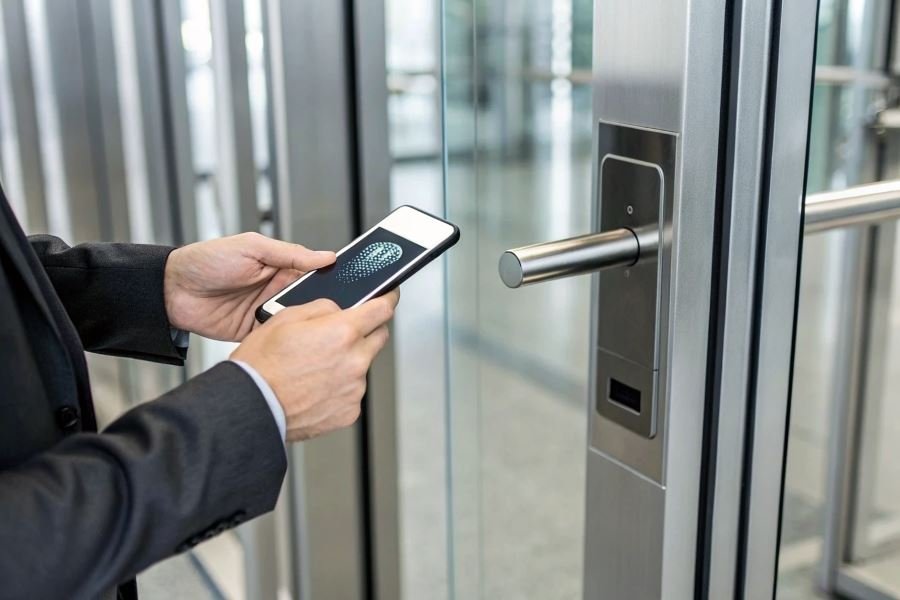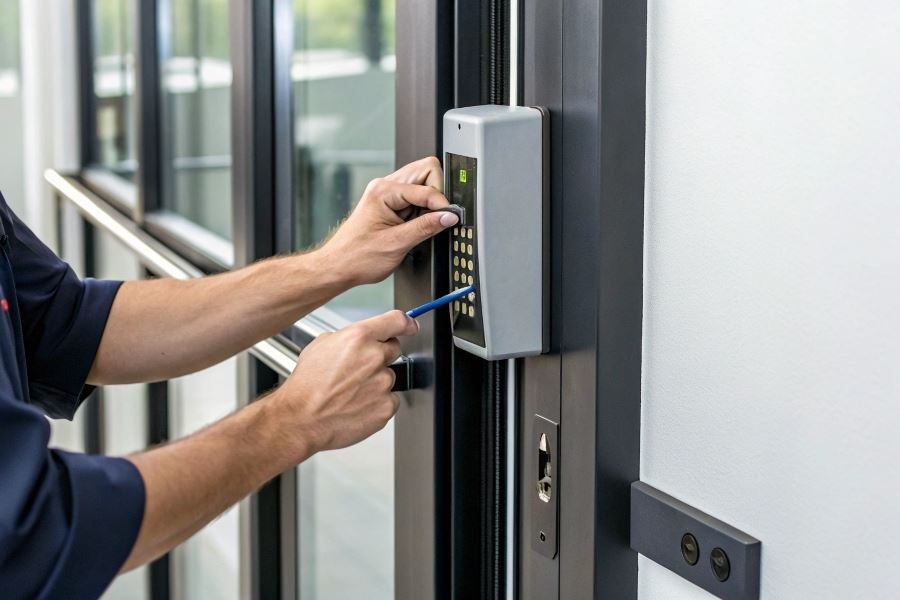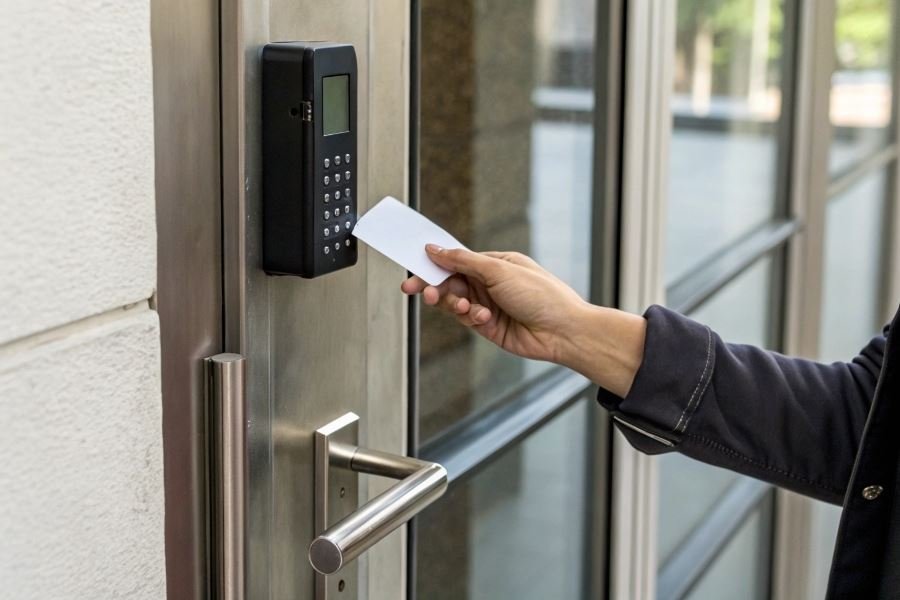
Ever stood too far from a door sensor and wondered why it didn’t detect your card? That frustrating moment reveals everything about the critical yet often overlooked aspect of access control systems: range.
The distance at which an access control reader can detect credentials determines not just convenience but security itself. Think of range as the invisible boundary between accessibility and restriction—too short and users fumble at entrances; too long and unauthorized access becomes possible from concerning distances. The physics behind this seemingly simple measurement shapes the entire security ecosystem of modern facilities.
Range variations between reader technologies aren’t just technical specifications—they’re strategic decisions. RFID readers might operate effectively from 2-4 inches while long-range UHF readers can detect credentials from up to 30 feet away. This dramatic difference transforms how buildings flow, how quickly people move through secure areas, and ultimately, how protected assets remain.
Several factors critically influence reader range performance:
- Environmental conditions: Metal surfaces, electromagnetic interference, and even weather can dramatically reduce effective range
- Power supply quality: Voltage fluctuations often cause inconsistent detection distances
- Antenna design: The physical configuration determines read patterns and maximum distances
- Frequency bands: Higher frequencies generally enable longer ranges but with different penetration characteristics
Industry standards like ISO/IEC 14443 and ISO/IEC 15693 provide frameworks for measuring and comparing ranges, though real-world performance often differs from laboratory conditions. The most reliable measurements combine controlled testing with practical field evaluations under actual installation conditions.
The Reading Range Revolution: Access Control Readers Compared
Ever wondered why some access cards need to be practically pressed against the reader while others work from across the room? The secret lies in the frequencies and technologies powering these seemingly identical devices. When examining the comparison of the range of various types of access control readers, three distinct categories emerge, each with unique capabilities that dramatically impact security system design and user experience.
Proximity Card Readers: The Close-Contact Veterans
Proximity card readers operating at 125 kHz represent the old guard of access control—reliable, straightforward, and deliberately limited in range. These systems typically offer:
- Reading distances of 2-4 inches (5-10 cm)
- Consistent performance around metal surfaces
- Lower cost implementation
The intentionally restricted range of proximity readers serves as a security feature rather than a limitation. HID ProxPoint Plus readers, for instance, maintain tight read ranges to prevent unauthorized access through “signal sniffing” from a distance.
While proximity technology remains widespread in legacy installations, its reading range rarely exceeds 6 inches even in optimal conditions. This technology excels in applications where physical presence verification is paramount, though the trade-off comes in user convenience.
Smart Card Readers: The Balanced Performers
The 13.56 MHz frequency band used by smart card readers delivers a sophisticated balance between security and convenience. These systems offer:
- Reading distances of 2-6 inches (5-15 cm)
- Enhanced data encryption capabilities
- Multi-application functionality
Smart card readers like the MIFARE DESFire systems provide marginally improved range over proximity technology while maintaining robust security. The slight range improvement might seem minimal, but represents a significant usability enhancement in high-traffic environments.
| Reader Type | Typical Range | Maximum Range | Security Level |
|---|---|---|---|
| Proximity (125 kHz) | 2-4 inches | 6 inches | Basic |
| Smart Card (13.56 MHz) | 2-6 inches | 8 inches | High |
| Long-range RFID | 5-30 feet | 100+ feet | Varies |
The mid-range performance of smart card readers makes them ideal for most commercial applications, offering the perfect compromise between security and convenience. Their slightly extended range compared to proximity readers reduces the “card fumbling” effect in busy entrances.
Long-Range RFID: Distance Champions
For applications where convenience trumps close-contact verification, long-range RFID readers deliver impressive performance:
- Reading distances from 5 feet to 30+ feet (1.5-10+ meters)
- Hands-free operation capabilities
- Vehicle access and asset tracking optimization
The Nedap TRANSIT readers exemplify this category, capable of identifying credentials at distances exceeding 30 feet in optimal conditions. These systems typically operate in the UHF (Ultra High Frequency) range of 865-928 MHz, enabling the dramatic range extension.
The extended range capabilities transform how access control functions in specific environments, particularly parking facilities and logistics centers where stopping to present credentials creates bottlenecks.
Long-range systems do require careful implementation, as their extended read range can create security vulnerabilities if not properly configured. Environmental factors like metal objects and electronic interference can significantly impact actual performance, sometimes reducing theoretical ranges by 30-50% in real-world installations.
The dramatic range differences between these technologies highlight why system designers must carefully match reader capabilities to specific security requirements and operational needs.
Optimizing Your Access Control Reader Selection
When environment shapes performance
Access control reader range doesn’t exist in a vacuum—it’s dramatically influenced by the environment where you deploy it. Metal surfaces near RFID readers can create interference that reduces read range by up to 50%. Weather conditions affect performance too: extreme temperatures can degrade read distances for certain technologies. HID Global readers maintain 85% of their optimal range even at -30°F, while budget alternatives often drop to below 40% efficiency.
Electromagnetic interference presents another challenge. Installing readers near electrical panels, motors, or even LED lighting can create signal noise that compromises performance. Proper shielding and strategic placement make the difference between consistent 30-foot reads and frustrating 5-foot limitations.
Indoor vs. outdoor installation creates distinct range profiles. UHF readers that deliver impressive 30-foot ranges in warehouse settings might struggle to maintain 15 feet when battling rain, humidity, and temperature fluctuations. The Suprema BioStation 3 demonstrates how modern readers address this with adaptive power management that automatically compensates for environmental variables.
Range vs security economics
The relationship between range and cost follows a predictable pattern—until it doesn’t. Basic proximity readers offering 2-4 inch ranges typically cost $100-200 per unit, while mid-range solutions extending to 12-24 inches jump to $250-400. The surprising value inflection occurs with UHF long-range readers, where the $600-1200 investment delivers exponentially greater coverage per dollar spent.
Security considerations create interesting cost dynamics:
| Reader Type | Typical Range | Security Level | Approximate Cost | Cost per Foot of Range |
|---|---|---|---|---|
| Proximity | 2-4 inches | Medium | $150 | $600/foot |
| Smart Card | 2-6 inches | High | $300 | $600/foot |
| Mid-Range | 12-24 inches | Medium-High | $350 | $21/foot |
| UHF Long-Range | 15-30 feet | Medium | $800 | $32/foot |
| Biometric | 4-8 inches | Very High | $1,200 | $2,400/foot |
The security-range tradeoff becomes evident: the most secure technologies typically require closer proximity. This creates an inverse relationship between convenience and security that must be carefully balanced.
Total cost of ownership extends beyond purchase price. Long-range readers may require less infrastructure (fewer units covering more entry points) but demand more sophisticated backend systems. The Genetec Security Center platform demonstrates how unified management can offset hardware premiums through operational efficiency.
Tomorrow’s range innovations
The access control landscape is evolving rapidly with several emerging technologies poised to redefine range capabilities:
Bluetooth Low Energy (BLE) and Ultra-Wideband (UWB) technologies are revolutionizing mobile credentials. UWB offers precision ranging within centimeters while maintaining ranges up to 200 feet. This enables presence-based authentication that automatically adjusts security requirements based on approach vectors and user behavior patterns.
Artificial intelligence is enhancing traditional technologies through adaptive power management. Readers from Gallagher Security now incorporate machine learning algorithms that continuously optimize transmission power based on environmental conditions, extending battery life while maintaining consistent read ranges.
The most transformative development may be the shift from discrete readers to distributed sensor networks. Rather than relying on single-point authentication, facilities are implementing overlapping coverage zones that create continuous authentication environments. This approach eliminates the traditional concept of “range” altogether, replacing it with persistent identity verification throughout protected spaces.
The future clearly favors flexible, adaptive systems that can adjust their range characteristics based on security contexts, environmental conditions, and user behavior patterns—creating smarter, more responsive access control ecosystems.
Discover the definitive comparison of access control reader ranges, from proximity cards to long-range RFID. Learn how environmental factors impact performance and make informed decisions based on your security needs and installation requirements.
Discover the definitive comparison of access control reader ranges, from proximity cards to long-range RFID. Learn how environmental factors impact performance and make informed decisions based on your security needs and installation requirements.