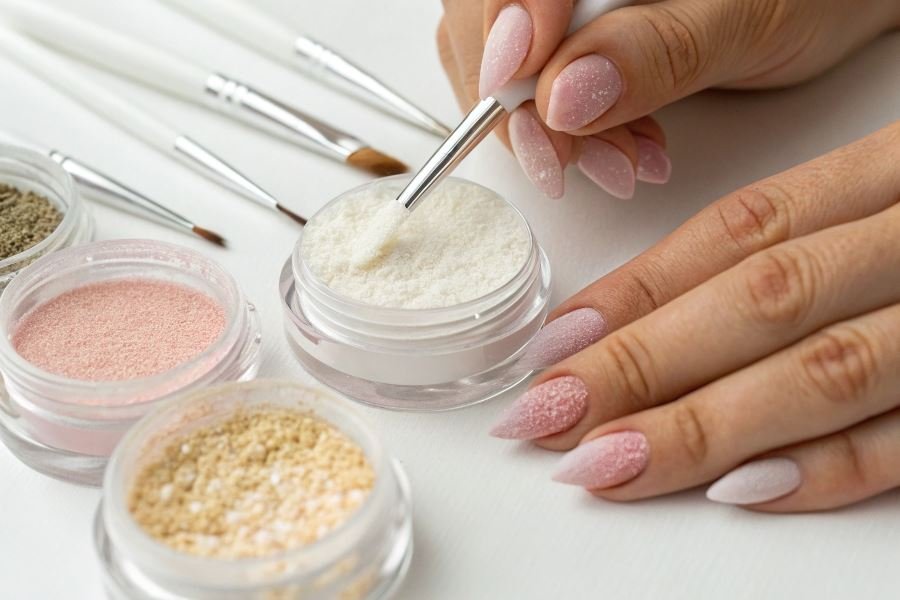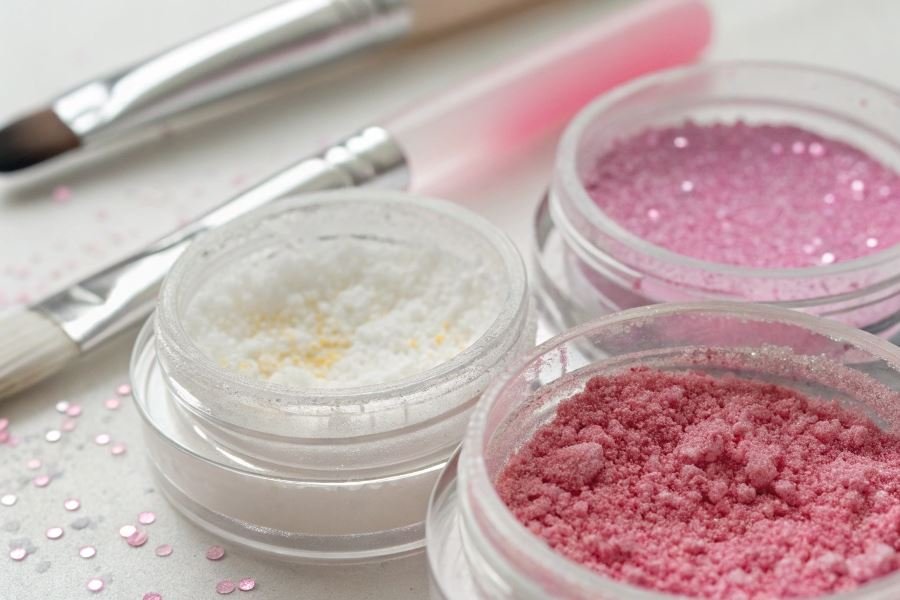
Behind every stunning acrylic nail set lies a decision that separates professionals from amateurs: the quality of acrylic powder they choose.
When a client sits in your chair expecting flawless, durable nails, your acrylic powder becomes your most crucial ally—or your greatest liability. For nail technicians and home enthusiasts alike, understanding how to evaluate acrylic powder quality isn’t just about aesthetics; it’s about reputation, client safety, and business success.
Poor-quality acrylic powders reveal themselves quickly. They create uneven applications with bubbles, yellow prematurely, or crack within days of application. Many technicians have watched in horror as their carefully crafted sets lift at the edges just days after application—a telltale sign of substandard materials.
“The difference between a $15 acrylic powder and a $40 one becomes evident not on day one, but on day fourteen.” — Professional nail educator
Quality indicators that separate premium from problematic
The truly discerning nail professional evaluates acrylic powder through multiple lenses:
- Consistency and particle size: Premium powders feature uniform, fine particles that create smooth, bubble-free applications
- Polymerization time: Quality products offer predictable setting times without sudden hardening or excessive waiting
- Color stability: Superior formulations resist yellowing even after weeks of wear
- Adhesion properties: The best powders create a strong bond with properly prepared nail plates
Recognizing these quality markers transforms your selection process from guesswork to expertise, ensuring your clients receive nothing less than excellence with every application.
Physical Characteristics That Define Premium Acrylic Powder
When professional nail technicians evaluate acrylic nail powder, they don’t just glance at the packaging—they scrutinize the material itself with almost scientific precision. The physical characteristics of acrylic powder directly influence application ease, durability, and final appearance of nail enhancements. Learning how to determine the quality of acrylic nail powder through careful examination of its physical properties can save you from disappointing results and wasted investment.
Consistency and texture: The foundation of performance
High-quality acrylic powder exhibits a specific consistency that experienced technicians can identify almost immediately. Premium products feel silky-smooth between the fingers without clumping or feeling gritty. When testing texture, place a small amount between your thumb and forefinger—quality powder should feel lightweight and fine, similar to confectioner’s sugar rather than granulated sugar.
The flow test reveals volumes about powder quality. Place a small amount on a flat surface and tilt it gently. Superior products will flow evenly without clumping or creating dust clouds. Lower-quality options often demonstrate inconsistent movement or excessive airborne particles.
The difference becomes even more apparent during application, where premium powders create a smooth, workable bead when combined with monomer, while inferior products may create lumpy, difficult-to-manage mixtures.
Color uniformity and pigmentation assessment
| Quality Indicator | Premium Powder | Low-Quality Powder |
|---|---|---|
| Color Distribution | Completely uniform | Visible speckling or marbling |
| Pigment Intensity | Rich, consistent color | Faded or uneven coloration |
| Light Test | Even appearance under bright light | Shows inconsistencies when illuminated |
The pigmentation quality in acrylic powder directly impacts the final aesthetic result. Examine the powder under natural light—premium products display consistent coloration throughout the entire container. For clear powders, look for true transparency without yellowing or cloudiness. For colored powders, check for rich, uniform pigmentation without streaking.
The light test provides valuable insights: spread a thin layer of powder on a dark surface for light colors (or light surface for dark colors) and examine under bright light. Quality products maintain consistent color intensity across the entire sample.
Particle size: The invisible performance factor
Perhaps the most technical yet crucial aspect of acrylic powder quality assessment lies in its particle size and uniformity. While you can’t measure microns with the naked eye, you can observe the effects of particle characteristics.
Premium acrylic powders feature particles that are:
- Uniform in size (typically 40-50 microns)
- Spherical rather than jagged
- Consistent throughout the product
The application test reveals particle quality instantly. Mix a small amount with monomer and observe how it forms a bead. Quality powders with optimal particle size create a smooth, manageable bead that maintains its shape without running or drying too quickly. The working time should feel comfortable—not rushed due to rapid setting or frustratingly slow.
Self-leveling capability directly correlates with particle quality. After application, superior products will settle into a smooth surface with minimal manual manipulation, while inferior powders require excessive filing and buffing to achieve an even finish.
When investing in professional-grade acrylic systems like CND or OPI, you’re paying for precisely engineered particle technology that delivers predictable performance every time—a worthwhile investment for consistent, high-quality nail enhancements that satisfy discerning clients.
Testing Acrylic Nail Powder Performance Like a Pro
When it comes to acrylic nail systems, performance is everything. The difference between professional-grade results and amateur hour often comes down to how thoroughly you’ve tested your powder before committing to a full set. Let’s dive into the scientific methods professionals use to evaluate acrylic powder quality that go beyond just looking at the packaging.
Mastering the Mix Ratio
The relationship between your acrylic powder and liquid is the foundation of a perfect application. Professional nail technicians know that quality powder responds predictably when mixed.
The bead test: Place a small amount of liquid in a dappen dish and dip your brush. Touch the brush to your powder and observe how it forms a bead. High-quality powder creates a smooth, rounded bead that’s neither too wet nor too dry.
A properly formed bead should maintain its shape for 10-15 seconds before beginning to flatten slightly.
Testing different ratios reveals the powder’s versatility:
| Ratio (Powder:Liquid) | Expected Result | Quality Indicator |
|---|---|---|
| 1.5:1 (dry bead) | Faster setting, thicker consistency | Should remain workable for 30-45 seconds |
| 1:1 (medium bead) | Balanced working time, ideal coverage | Should remain workable for 45-60 seconds |
| 1:1.5 (wet bead) | Slower setting, self-leveling | Should remain workable for 60-90 seconds |
Quality powders maintain consistent performance across these ratios, while inferior products become unmanageable at certain extremes.
Decoding Setting Time and Curing Behavior
The setting process tells you everything about powder quality. Premium acrylic powders polymerize predictably and consistently.
Polymerization test: Apply a medium-sized bead to a nail form and time how long it takes to reach these stages:
- Initial set (loses glossiness) – typically 30-45 seconds
- Workable stage (can be shaped) – typically 1-2 minutes
- Full cure (completely hardened) – typically 5-7 minutes
Temperature and humidity affect curing times, so conduct tests in your typical working environment for accurate results.
Quality powders exhibit a gradual, even color change during curing. Watch for:
- Uniform hardening from center to edges
- Consistent color development throughout the curing process
- Minimal heat production during polymerization (excessive heat indicates unstable formulations)
Durability Testing for Client-Worthy Results
The true test of acrylic powder quality comes after application. Professional-grade products create structures that withstand daily wear.
Impact resistance test: Apply the acrylic to a nail form, cure completely, then test resilience by:
- Tapping gently with a metal implement to test for brittleness
- Applying pressure to test flexibility without breaking
- Checking for yellowing after 24 hours of UV exposure
Chemical resistance evaluation: Expose cured samples to common substances:
| Substance | Quality Indicator |
|---|---|
| Acetone | Should resist complete dissolution for at least 10 minutes |
| Alcohol | Should show no surface changes after 5 minutes of exposure |
| Hot water | Should maintain structural integrity after 3-minute immersion |
Premium acrylic powders maintain their clarity, strength, and color even after these challenges. Inferior products will show immediate signs of degradation, saving you from disappointed clients down the road.
By methodically testing your acrylic powder before committing to client work, you’re not just evaluating a product—you’re protecting your reputation and ensuring consistent, professional results every time.
Discover professional techniques for evaluating acrylic nail powder quality through texture, color uniformity, and performance testing. Learn key indicators that separate premium products from substandard options for flawless, long-lasting nail enhancements.
Discover professional techniques for evaluating acrylic nail powder quality through texture, color uniformity, and performance testing. Learn key indicators that separate premium products from substandard options for flawless, long-lasting nail enhancements.