
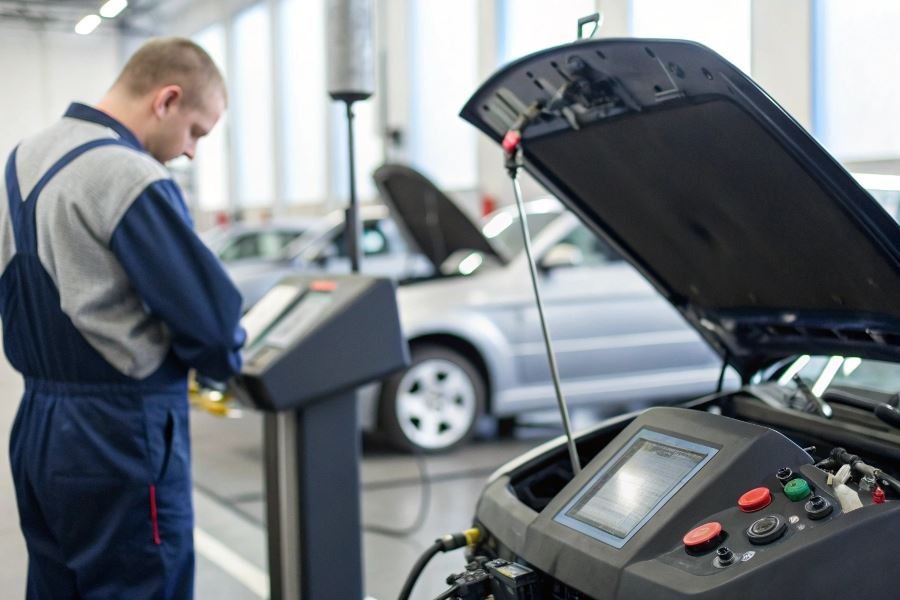
What separates a thriving auto service from one that barely survives? Often, it’s the equipment behind the garage doors.
When a vehicle rolls into your service bay for an oil change, the tools and equipment you use aren’t just mechanical devices—they’re the backbone of your reputation. Selecting the right oil change equipment transforms what could be a basic maintenance task into a precision service that customers return for repeatedly.
The profit-efficiency connection
The right oil change equipment doesn’t just make the job easier—it fundamentally changes your business equation. High-quality extraction systems can reduce service time by up to 40%, allowing your technicians to handle more vehicles daily. This isn’t just about speed; it’s about creating capacity for additional revenue without expanding physical space.
“Equipment selection is the single most overlooked factor in service profitability. The right tools don’t just save time—they create it.”
Quality signals customers notice
Customers may not understand the technical specifications of your oil extraction system, but they absolutely recognize the results. Clean, efficient oil changes with minimal wait times build trust. Modern equipment with digital monitoring capabilities also provides transparency that today’s informed customers increasingly expect.
Selection factors that matter most
When evaluating oil change equipment, three factors should guide your decision:
- Volume capacity – Will it handle your daily vehicle count without bottlenecks?
- Precision capabilities – Does it extract the exact amount needed, reducing waste?
- Adaptability – Can it service various vehicle types from compact cars to commercial trucks?
The equipment you select today will define your service quality for years to come. Choose wisely.
Essential Oil Change Equipment for Professional Auto Service
Oil Extraction Systems: The Foundation of Efficiency
When setting up a professional auto service operation, selecting the right equipment for oil changes becomes a critical decision that impacts workflow efficiency, service quality, and ultimately, customer satisfaction. The market offers two primary approaches to oil extraction: vacuum-based systems and gravity drainage solutions, each with distinct advantages for different service environments.
Vacuum extraction systems operate by creating negative pressure to pull oil directly through the dipstick tube. The BestVac Pro-3000 exemplifies this category with its 8-gallon capacity tank and ability to extract hot oil in under 8 minutes. These systems excel in situations where access to drain plugs is restricted or when dealing with awkwardly positioned oil pans. The primary advantage? No need to lift the vehicle, which translates to faster service times and reduced bay occupancy.
Gravity drainage systems, by contrast, rely on natural flow after removing the drain plug. The OilSafe Drain System features a low-profile design that captures oil with minimal splashing while incorporating filtration screens to catch debris. How to choose a device for oil change in an auto service often depends on your facility layout and service volume—gravity systems typically cost 30-40% less than vacuum alternatives but require vehicle elevation.
Filter Removal Tools: Precision Instruments
Oil filter removal represents another critical component of the oil change process, with specialized tools designed to address various filter configurations:
| Tool Type | Best Application | Average Price Range |
|---|---|---|
| Strap wrenches | Universal use, minimal clearance | $15-45 |
| Cap wrenches | Specific filter sizes, high torque | $8-30 per size |
| Spider wrenches | Restricted access situations | $20-60 |
| End cap tools | Cartridge-style filters | $30-80 |
The Lisle 63600 universal filter wrench deserves special mention for its ability to handle filters ranging from 2.5 to 4 inches in diameter, accommodating approximately 85% of passenger vehicles on American roads. For high-volume shops, investing in a comprehensive set of filter removal tools prevents those frustrating moments when a stubborn filter threatens your service schedule.
Oil Dispensing Equipment: Precision Meets Efficiency
The final piece of the oil change equipment trinity involves the systems used to dispense fresh oil into engines—a process where accuracy directly impacts engine performance and longevity.
Manual dispensing options include:
- Calibrated containers with flexible spouts
- Hand-operated barrel pumps
- Metered dispensing guns
For shops handling fewer than 15 oil changes daily, the Lumax LX-1632 8-quart manual dispenser offers an excellent balance of precision and affordability at approximately $75.
Pneumatic systems represent the gold standard for high-volume operations, with advantages including:
- Preset volume dispensing (accuracy to within 0.1 quarts)
- Faster service completion
- Reduced physical strain on technicians
- Integrated inventory tracking capabilities
The Lincoln Industrial 3670 pneumatic oil pump system can reduce oil dispensing time by up to 65% compared to manual methods, though the initial investment typically exceeds $1,200 for a complete setup.
When selecting dispensing equipment, consider not just current volume but anticipated growth—upgrading mid-stream often costs more than making the right initial investment in equipment that can scale with your business.
Making the Smart Oil Change Equipment Decision
Service Volume Drives Equipment Needs
The heartbeat of any auto service operation is throughput. High-volume shops handling 20+ oil changes daily need fundamentally different equipment than boutique operations servicing 5-8 vehicles.
Volume-based equipment selection isn’t just smart—it’s survival. High-capacity shops thrive with pneumatic oil extractors capable of processing 10-15 gallons per cycle. The Graco Husky systems, for instance, can evacuate oil from multiple vehicles simultaneously, reducing service bay occupation time by up to 40%.
For mid-volume operations, consider balanced solutions like the Mityvac MV7400, which combines reasonable throughput with manageable investment. These systems typically handle 8-10 gallons per cycle—perfect for shops servicing 10-15 vehicles daily.
The equipment-to-throughput ratio directly impacts your ability to meet customer expectations while maintaining profitability.
Workshop Layout Considerations
Your physical space dictates equipment possibilities more than most realize. The average service bay in North America measures approximately 12’ × 24’, leaving precious little room for inefficient equipment footprints.
| Equipment Type | Footprint (sq ft) | Ceiling Clearance | Mobility |
|---|---|---|---|
| In-ground lifts | 35-45 | 12’+ | Fixed |
| Mobile extractors | 3-5 | N/A | High |
| Overhead systems | 2-3 | 14’+ | Fixed |
Workshop layout efficiency multiplies with strategic equipment placement. Mobile extraction units offer flexibility for shops with variable configurations, while centralized vacuum systems with multiple access points work brilliantly for facilities with consistent layouts.
The BendPak P-2900 series exemplifies space-efficient design with vertical storage capabilities, reducing floor space requirements by nearly 60% compared to traditional models.
ROI Calculations That Actually Matter
Equipment investment decisions should be driven by hard numbers, not gut feelings. The calculation is straightforward but often overlooked:
Annual oil changes × Time saved per service × Labor rate = Annual savings potential
A $7,500 investment in premium extraction equipment might seem steep until you calculate the throughput improvement. Consider this real-world math:
- Standard drain plug method: 25 minutes per vehicle
- Advanced extraction system: 12 minutes per vehicle
- Time saved: 13 minutes per service
- At 15 oil changes daily (3,900 annually) and $125/hour labor rate
- Annual savings: 3,900 × (13/60) × $125 = $105,625
Equipment lifespan matters enormously in ROI calculations. The Samoa Industrial systems typically offer 8-10 year operational lifespans with minimal maintenance, dramatically improving long-term ROI compared to budget options with 2-3 year practical lifespans.
Budget-conscious operations should consider financing options that allow equipment costs to be offset by immediate efficiency gains. Many manufacturers offer financing at 4-6% interest rates, allowing positive cash flow from day one when efficiency gains exceed monthly payments.
The wisest investment isn’t necessarily the cheapest upfront—it’s the one that delivers the strongest performance relative to your specific service volume, space constraints, and financial parameters. Equipment that perfectly matches your operational reality transforms from a cost center into a profit driver.
Discover the best oil change equipment for your auto service business. Learn how to select efficient extraction systems, filter tools, and dispensing options that maximize productivity and profitability in your shop.
Discover the best oil change equipment for your auto service business. Learn how to select efficient extraction systems, filter tools, and dispensing options that maximize productivity and profitability in your shop.