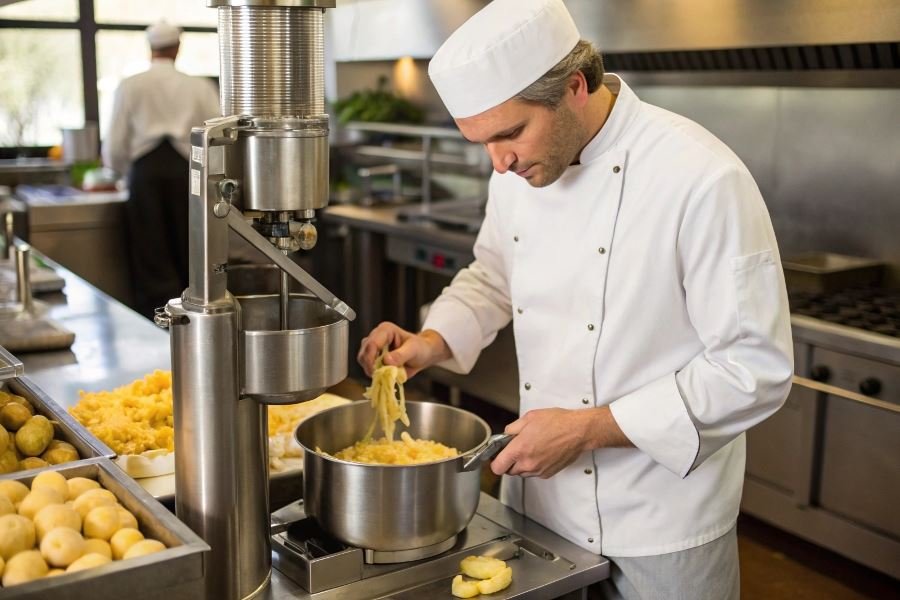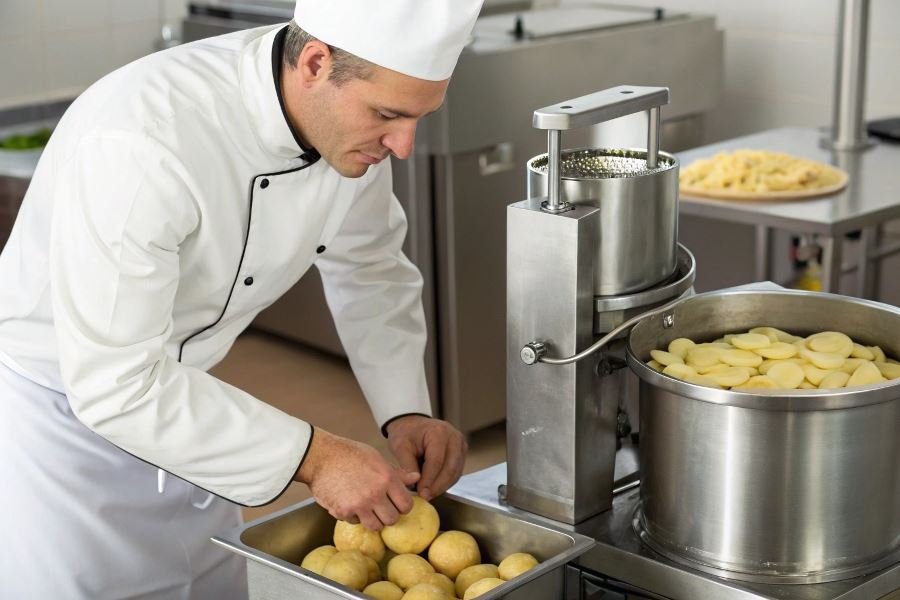
Ever wondered why professional kitchens can process 50 pounds of potatoes in the time it takes you to peel just one? The secret lies in their equipment choices—specifically, whether they’re using automatic or semi-automatic potato peelers.
When it comes to transforming those dirty, skin-covered spuds into gleaming culinary canvases, the technology you choose makes all the difference. Commercial kitchens, restaurants, and food processing facilities face this decision regularly: should they invest in fully automatic systems or opt for the more hands-on semi-automatic alternatives?
Understanding the fundamental differences
Automatic peelers operate with minimal human intervention—load potatoes, press start, and walk away. These machines typically use abrasive surfaces inside rotating drums, removing peels through continuous friction.
Semi-automatic peelers, by contrast, require operator oversight throughout the process. They often feature manual loading/unloading and may need adjustments during operation.
Key decision factors to consider
- Volume requirements: Processing 200+ pounds daily? Automatic systems shine here.
- Labor costs: Semi-automatic models require dedicated staff time.
- Precision needs: For specialty potatoes or when peel thickness matters, semi-automatic options offer greater control.
- Space constraints: Automatic systems generally demand more kitchen real estate.
Market landscape and investment ranges
The current market offers solutions ranging from compact countertop semi-automatic units (300 − 800)toindustrial − gradeautomaticsystems(3,000-15,000). Mid-range options like the BatchPro 5000 provide automation with smaller footprints at approximately $2,500.
The choice ultimately depends on your specific operational demands, budget constraints, and quality expectations. The perfect potato peeler isn’t universal—it’s the one that best aligns with your kitchen’s unique workflow.
Performance Showdown: Automatic vs Semi-Automatic Potato Peelers
Speed and Efficiency That Transforms Your Kitchen
When kitchen productivity matters, the difference between automatic and semi-automatic potato peelers becomes immediately apparent. Automatic models typically process 15-20 pounds of potatoes in under 3 minutes, while semi-automatic units handle 5-7 pounds in the same timeframe. The Hobart PEE-001 commercial automatic peeler, for instance, can process a staggering 50 pounds per cycle, making it ideal for high-volume operations.
Deciding between automatic vs semi-automatic potato peelers: what to choose often comes down to throughput requirements. Restaurant kitchens preparing hundreds of servings daily benefit tremendously from the hands-off operation of automatic systems, while smaller operations might find the semi-automatic balance of control and efficiency more appropriate.
Time-saving comparison:
| Peeler Type | Processing Capacity | Operator Attention Required | Power Consumption |
|---|---|---|---|
| Automatic | 15-20 lbs/3 min | Minimal (loading/unloading) | 300-500W |
| Semi-automatic | 5-7 lbs/3 min | Moderate (monitoring/adjusting) | 150-250W |
Peeling Quality and Food Waste Metrics
The precision of peeling directly impacts both food quality and operational costs. Automatic peelers like the Waring WFP15SC utilize abrasive discs that remove thin, consistent layers, typically wasting only 8-12% of potato mass. Semi-automatic models, requiring more human judgment, result in waste variations between 10-18% depending on operator skill.
The difference becomes particularly significant when processing thousands of pounds annually, where even a 3% reduction in waste translates to substantial savings.
Modern automatic systems incorporate pressure sensors and timing controls that adapt to potato size and skin thickness. The Sammic PP-12 automatic peeler adjusts its abrasive intensity based on load weight, ensuring consistent results regardless of batch size.
Versatility Across Produce Types
The adaptability to handle different potato varieties and other vegetables represents a critical performance factor.
Automatic peelers excel with:
- Uniform, round potatoes (Russets, Yukon Golds)
- High-volume, consistent batches
- Commercial kitchen environments
Semi-automatic models demonstrate advantages with:
- Irregular shapes (fingerlings, new potatoes)
- Mixed vegetable batches
- Delicate produce requiring careful handling
The Vollrath 40956 semi-automatic peeler offers interchangeable abrasive plates specifically designed for different vegetables, from carrots to beets. Meanwhile, the Metcalfe EP20 automatic system provides programmable cycles for different produce types.
The true measure of a peeler’s performance isn’t just speed—it’s the balance between efficiency, waste reduction, and versatility across different ingredients.
For operations processing multiple vegetable types, semi-automatic models typically offer greater flexibility, allowing operators to adjust pressure and duration based on visual feedback. Automatic systems prioritize consistency and throughput, making them ideal for operations with standardized menu items requiring large quantities of the same vegetable type.
When evaluating overall performance, consider your specific production needs, labor availability, and the diversity of your menu offerings to determine which peeler technology aligns best with your kitchen’s workflow.
Making the Perfect Choice: Automatic vs Semi-Automatic Potato Peelers
When it comes to potato peeling equipment, the decision between automatic and semi-automatic models isn’t just about preference—it’s about aligning technology with your specific operational needs. Let’s dive into the factors that should guide your decision and explore the standout models in each category.
Volume Requirements Matter
The scale of your potato processing needs should be your primary consideration when choosing between automatic and semi-automatic peelers.
Commercial kitchens processing 50+ pounds of potatoes daily will find automatic peelers indispensable. These workhorses can handle 15-30 pounds per cycle, with continuous-feed models processing up to 1,000 pounds per hour. Restaurants, catering companies, and food production facilities benefit from this efficiency, especially during peak service periods.
Semi-automatic peelers shine in smaller operations—home kitchens, small cafés, and specialty restaurants where potato dishes aren’t the primary focus. These machines typically process 2-10 pounds per cycle, striking the perfect balance between manual peeling and industrial automation.
The difference between an automatic and semi-automatic peeler becomes most apparent when time equals money—especially in high-volume operations where labor costs add up quickly.
Maintenance, Durability and Long-Term Value
The true cost of a potato peeler extends far beyond the initial purchase price.
Automatic peelers typically represent a larger upfront investment (1, 200−5,000) but offer impressive durability with proper maintenance. Commercial-grade models feature:
- Stainless steel construction resistant to corrosion
- Replaceable abrasive discs or cylinders
- Serviceable motors rated for 5,000+ hours of operation
Semi-automatic models (150−800) require more frequent maintenance but with simpler components. Their smaller motors and plastic components may need replacement every 2-3 years with regular use.
When calculating long-term value, consider these factors:
- Water usage (automatic models use 2-5 gallons per cycle)
- Electricity consumption (0.5-2 kWh for automatic vs. 0.1-0.3 kWh for semi-automatic)
- Replacement parts availability and cost
- Labor savings over manual peeling (approximately $15-25 per hour)
Top Performers in Each Category
Leading Automatic Potato Peelers
- Hobart 6460 ($3,200)
- Pros: Processes 60 lbs per load, all-stainless construction, 10-year motor warranty
- Cons: Requires dedicated water line, significant floor space, higher energy consumption
- Sammic PP-12 ($2,400)
- Pros: Compact footprint, adjustable peeling times, removable abrasive plate
- Cons: Limited to 26 lbs per cycle, louder operation, parts less readily available
- Metcalfe EP20 ($1,800)
- Pros: Excellent peel-to-waste ratio, easy-clean design, reliable performance
- Cons: Smaller capacity (20 lbs), less durable abrasive disk, limited warranty
Semi-Automatic Standouts
- Vollrath 40956 ($650)
- Pros: 15 lb capacity, continuous operation capability, dishwasher-safe components
- Cons: Plastic housing prone to cracking, noisy operation, limited warranty
- Waring WFP16S ($450)
- Pros: Compact design, versatile functionality beyond potatoes, easy maintenance
- Cons: Limited to 10 lbs per batch, less effective with irregular potatoes, plastic components
- KitchenAid KSMVSA ($180)
- Pros: Attachment for existing KitchenAid mixers, space-efficient, good for small batches
- Cons: Only processes 2-3 lbs at once, requires manual feeding, slower operation
The ideal potato peeler balances your volume requirements, budget constraints, and operational needs. For high-volume operations, automatic peelers deliver unmatched efficiency. For smaller kitchens where flexibility matters more than throughput, semi-automatic models offer the perfect middle ground between manual peeling and industrial automation.
Discover the key differences between automatic and semi-automatic potato peelers to make the right choice for your kitchen. Compare speed, efficiency, and value while exploring top models for both commercial and home use in 2025.
Discover the key differences between automatic and semi-automatic potato peelers to make the right choice for your kitchen. Compare speed, efficiency, and value while exploring top models for both commercial and home use in 2025.