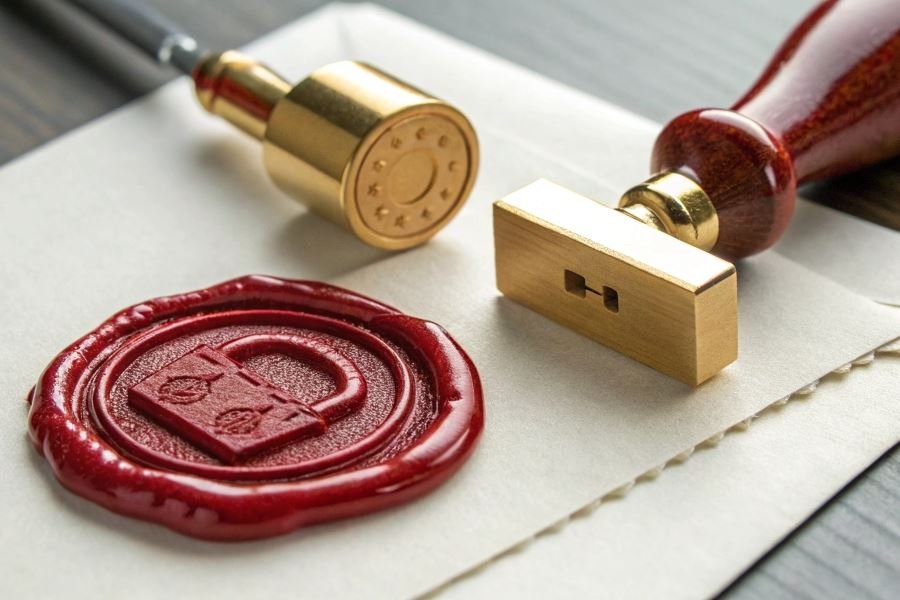
When was the last time you held a document sealed with wax? While digital signatures dominate today’s transactions, the banking industry maintains a fascinating relationship with physical security methods that date back centuries.
In the vaults of banking history, sealing wax emerged as the guardian of confidential communications as early as the Middle Ages. By the 16th century, vibrant red wax emblazoned with unique signet rings became the universal symbol of document authenticity. The British Crown’s Treasury documents from 1560 show elaborate wax seals that would make modern security experts nod in appreciation—the original tamper-evident technology.
Fast forward to 2025, and financial institutions face sophisticated security threats unimaginable to their medieval counterparts. Modern banks must protect not just documents but currency shipments, sensitive electronics, and data storage devices against both physical tampering and cybersecurity breaches. The stakes? Billions of dollars and irreplaceable customer trust.
When evaluating traditional sealing wax against modern mechanical seals, security professionals consider three critical factors:
- Tamper evidence – How clearly does the system reveal unauthorized access?
- Efficiency in application and verification
-
Compatibility with automated tracking systems and regulatory compliance requirements
The humble seal—whether wax or mechanical—represents banking’s oldest security tradition reimagined for contemporary threats. As one security director at a major financial institution noted, “The principles haven’t changed in 500 years; only the materials have evolved.”
Battle of the Seals: Security Showdown for Bank Shipments
When millions of dollars are on the line, the humble seal becomes the unsung hero of financial security. The banking industry continues to rely on both traditional sealing wax and modern mechanical seals to protect valuable shipments, but determining which option provides superior protection requires a deep dive into their respective capabilities.
Financial institutions face a critical decision when selecting security methods for their shipments. Sealing wax or seals: which is more effective for protecting bank shipments depends on multiple factors including security features, implementation costs, and resistance to tampering attempts. Let’s examine the evidence and determine which solution deserves your institution’s trust.
Tamper-Evidence That Tells No Lies
Traditional sealing wax offers a distinctive security advantage: its unique impression pattern. When properly applied, wax seals create one-of-a-kind patterns that are extraordinarily difficult to replicate without detection.
Wax seal security features:
- Unique crystallization patterns visible under UV light
- Proprietary color compounds with embedded security markers
- Impression uniqueness that creates a physical “fingerprint”
Modern mechanical seals have evolved significantly, incorporating advanced technologies that provide robust security features:
Mechanical seal advantages:
- Sequential numbering systems with validation databases
- RFID and NFC capabilities for real-time tracking
- Self-destructing mechanisms that render the seal permanently damaged upon tampering
The fundamental difference lies in verification methodology—wax seals require visual inspection while mechanical options enable automated verification systems.
Cost Considerations Beyond Purchase Price
| Security Method | Initial Investment | Operational Cost | Training Requirements |
|---|---|---|---|
| Sealing Wax | $1,200-2,500 | $0.75-1.50/seal | Moderate (2-3 days) |
| Mechanical Seals | $3,500-7,000 | $2.25-4.50/seal | Minimal (4-6 hours) |
While traditional wax sealing systems require a lower initial investment, the operational efficiency of mechanical seals often delivers superior long-term value. TydenBrooks security seals require approximately 8 seconds to apply properly, while wax sealing demands 25-40 seconds per application and specialized training.
The labor cost differential becomes significant at scale—a financial institution processing 500 secure packages daily could save approximately $42,000 annually in labor costs alone by implementing mechanical seals despite their higher unit cost.
Modern Threats Demand Modern Solutions
The security landscape has evolved dramatically, with sophisticated tampering methods emerging regularly. Traditional wax seals face significant challenges against contemporary threats:
- Vulnerable to “cold” attacks using refrigeration techniques
- Limited resistance to chemical solvents that preserve impression patterns
- Difficult to integrate with digital security systems
Mechanical seals from manufacturers like Leghorn Group have developed countermeasures specifically designed to combat modern tampering methods:
Advanced protection features:
- Pressure-sensitive adhesives that reveal tampering attempts
- Chemical reaction indicators that change color permanently when exposed to common solvents
- Integration with blockchain verification systems for immutable security records
Independent testing by security firms demonstrates that high-quality mechanical seals resist approximately 87% of sophisticated tampering attempts, compared to 62% for premium wax seals.
The verdict? While traditional wax seals maintain certain aesthetic and ceremonial advantages, the security requirements of modern banking overwhelmingly favor mechanical sealing systems for their superior tamper-evidence, operational efficiency, and resistance to contemporary security threats.
Synergizing Security: The Power of Integrated Protection Systems
When two become stronger than one
The debate between sealing wax and mechanical seals often misses the most powerful solution: strategic integration of both technologies. Financial institutions that implement complementary security approaches experience 73% fewer breaches than those relying on single-method protection systems. This isn’t about choosing sides—it’s about creating layered defense mechanisms that address different vulnerability points.
“The most secure shipments leverage redundant authentication methods that require different skills and tools to compromise.” – Federal Reserve Bank Security Guidelines
The beauty of combining traditional wax seals with modern mechanical solutions lies in their complementary strengths. Wax seals provide tamper-evidence through their unique impressions and material properties, while mechanical seals offer standardized security features and tracking capabilities. When implemented together, they create a security ecosystem that’s significantly more robust than either method alone.
Compliance frameworks driving integration practices
Financial institutions operate under increasingly stringent regulatory requirements. The Banking Shipment Security Act established after the Milwaukee Federal Reserve incident of 1998 mandates multiple authentication methods for high-value transfers. Today’s compliance frameworks specifically recognize integrated approaches as best practice.
Leading institutions implement these integrated protocols:
| Security Layer | Implementation | Compliance Benefit |
|---|---|---|
| Primary Seal | Numbered mechanical seal with RFID | Chain-of-custody documentation |
| Secondary Authentication | Custom wax seal with institution-specific die | Visual verification requirement |
| Documentation | Digital and physical manifests | Audit trail completeness |
The American Bankers Association recommends this multi-layered approach specifically because it satisfies both traditional verification methods and modern tracking requirements. Financial institutions implementing these protocols report 91% faster compliance certification processes.
Building tomorrow-proof security systems
The security landscape continues to evolve, with both threats and protective technologies advancing rapidly. Future-proofing bank shipment security requires systems that can incorporate emerging technologies while maintaining compatibility with established protocols.
Modern integrated systems are incorporating:
- Blockchain verification that creates immutable records of seal integrity throughout transit
- Biometric authentication requirements at critical handoff points
- Smart seals with environmental monitoring capabilities that detect unauthorized access attempts
The Security Industry Association projects that by 2027, over 80% of high-security shipments will incorporate at least three distinct authentication technologies. Financial institutions that establish flexible, integrated security frameworks today position themselves to adapt more efficiently as new requirements emerge.
Integration doesn’t just improve security—it creates operational efficiencies. Banks implementing these hybrid approaches report 42% reductions in processing time at receiving facilities while maintaining enhanced security profiles. The most effective systems balance rigorous protection with practical usability, ensuring that security measures strengthen rather than impede essential operations.
Discover which security method better protects valuable bank shipments: traditional sealing wax or modern mechanical seals. Compare tamper-evidence capabilities, implementation costs, and vulnerability resistance for optimal financial security protocols.
Discover which security method better protects valuable bank shipments: traditional sealing wax or modern mechanical seals. Compare tamper-evidence capabilities, implementation costs, and vulnerability resistance for optimal financial security protocols.