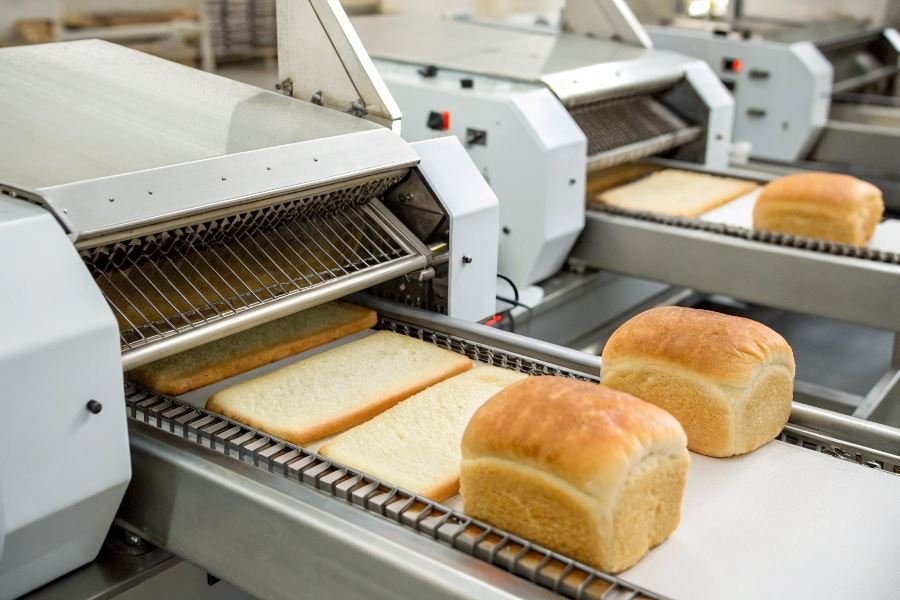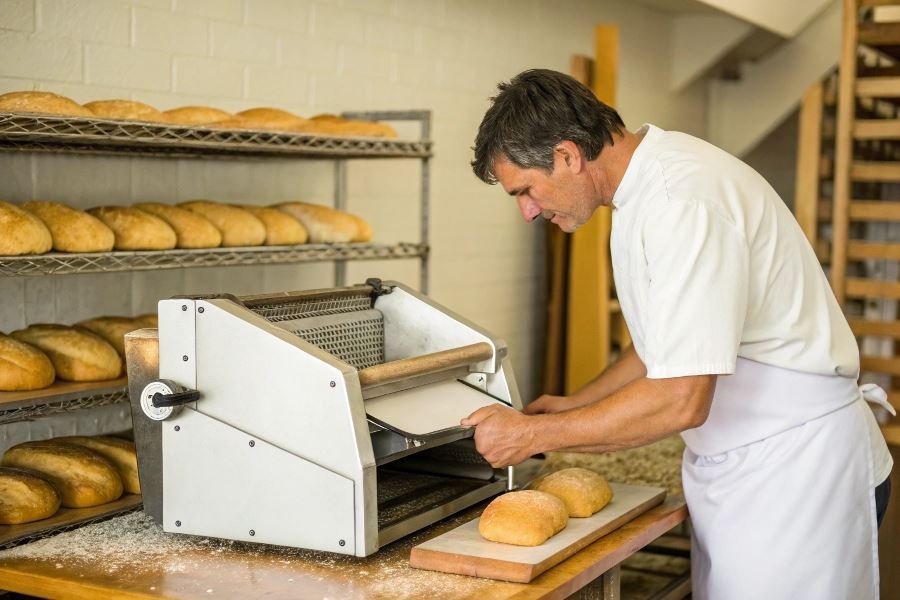
Ever watched a customer’s face light up when they receive a perfectly sliced loaf? That moment of satisfaction doesn’t happen by accident. Behind every precisely cut sandwich loaf and uniformly sliced artisanal bread is a critical piece of equipment that deserves far more attention than it typically receives.
For mini bakery owners, a bread slicer isn’t just another piece of equipment—it’s the final touchpoint between your craft and your customer. The difference between a professional-looking product and an amateur one often comes down to those clean, consistent slices that showcase your baking expertise. When customers see uniformly sliced bread, they perceive higher quality, even before the first bite.
“The final 30 seconds of your bread’s journey to the customer can undo 3 hours of careful baking.”
Efficiency matters more than you think. A quality bread slicer can process up to 200 loaves per hour with minimal waste, while manual cutting might manage just 20-30 with significant product loss. This translates directly to your bottom line.
The triple impact of proper slicing
- Productivity – Reduce labor costs and increase output
- Consistency – Deliver the same experience with every purchase
- Customer satisfaction – Meet exact specifications that keep clients coming back
Choosing the right bread slicer requires understanding your specific operation’s needs. From blade thickness to maintenance requirements, each factor plays a crucial role in determining whether your investment will boost profits or become an expensive disappointment.
Essential Features of Bread Slicers That Drive Bakery Success
When selecting equipment for a mini bakery operation, bread slicers represent a critical investment that directly impacts production efficiency, product quality, and customer satisfaction. Bread slicers for mini bakeries: what to pay attention to when buying involves careful consideration of several key factors that can make the difference between struggling with inconsistent results and achieving professional-grade slicing day after day.
Production Capacity Meets Business Reality
The slicing capacity of your machine should align perfectly with your production volume needs. Mini bakeries typically fall into distinct production tiers:
- Light production (50-100 loaves daily): Entry-level slicers processing 1-2 loaves per minute
- Medium production (100-300 loaves daily): Mid-range slicers handling 3-5 loaves per minute
- High-volume mini bakeries (300+ loaves daily): Commercial slicers managing 6+ loaves per minute
“Investing in a slicer with 20% more capacity than your current needs provides room for business growth,” notes industry experts at commercial equipment expos.
The Sinmag SM-302 and JAC Duro models exemplify this scaling approach, offering adjustable speed settings that adapt to changing production demands.
Blade Quality Defines Slice Perfection
Blade construction represents perhaps the most critical component of any bread slicer:
| Blade Material | Advantages | Maintenance Needs |
|---|---|---|
| High-carbon steel | Superior sharpness, clean cuts | Regular cleaning, occasional resharpening |
| Stainless steel | Corrosion resistance, food safety | Less frequent resharpening, higher upfront cost |
| Teflon-coated | Reduced sticking with moist breads | Gentle cleaning to preserve coating |
The blade spacing mechanism must maintain consistent tension to prevent blade wandering—a common issue in lower-quality machines that results in uneven slices. Premium models like the Oliver 797 feature individual blade tensioners that can be adjusted without disassembling the entire frame.
Precision Thickness Control
Versatility in slice thickness has become non-negotiable for successful bakeries serving diverse customer preferences. Modern slicers should offer:
- Minimum adjustment increments of 1-2mm
- Range spanning from thin sandwich slices (8mm) to thick artisanal cuts (25mm+)
- Tool-free adjustment mechanisms for quick production changes
Digital controls with preset thickness options, like those found on the Wabama Eco+, eliminate guesswork and ensure consistency across production shifts.
Safety Systems That Protect Your Team
Mini bakeries face the same safety requirements as larger operations but often with less specialized staff. Essential safety features include:
- Automatic blade guards that engage when access doors open
- Emergency stop buttons positioned for immediate access
- Blade cleaning tools designed to prevent direct hand contact
- Lockout systems during maintenance procedures
Equipment meeting UL (Underwriters Laboratories) and NSF (National Sanitation Foundation) certifications ensures compliance with both safety and sanitation standards.
Space-Efficient Design For Limited Footprints
Mini bakeries typically operate in constrained spaces where every square foot matters. Modern space-efficient slicers offer:
- Vertical designs with smaller footprints (some under 4 square feet)
- Integrated crumb collection systems that eliminate separate catch trays
- Caster wheels with locks for mobility and stability
- Fold-away components for temporary space reclamation
The Bakon USA Nano-Series exemplifies this approach with its 30% smaller footprint compared to traditional models while maintaining commercial-grade slicing capabilities.
By carefully evaluating these essential features against your specific production needs, you’ll select a bread slicer that delivers consistent results, operational efficiency, and the slice quality your customers expect.
The True Value Equation of Bakery Slicers
When investing in equipment for your mini bakery, bread slicers represent a critical decision point that impacts your daily operations, product quality, and bottom line. Let’s dive into the three fundamental factors that determine the real value of a bread slicer beyond its price tag.
Beyond the Sticker Price
The initial purchase price of a bread slicer—ranging from $1,200 for basic models to $8,000+ for premium automated systems—tells only part of the financial story. Smart bakery owners calculate the total cost of ownership (TCO) over the equipment’s lifespan.
A Moline industrial slicer priced at $5,000 might seem expensive compared to a $2,500 alternative, but the calculation changes dramatically when you factor in:
- Energy consumption: Premium models often use 15-30% less electricity
- Maintenance requirements: Higher-quality slicers typically need servicing every 100,000 loaves versus every 40,000 for budget models
- Blade replacement frequency: Quality blades might cost more initially but last 2-3 times longer
The difference in operational costs can exceed $1,500 annually, often making the premium model more economical by year three.
Reliability Is Revenue Protection
Nothing halts production like equipment failure. The most affordable slicer becomes incredibly expensive when it’s sitting idle during your busiest production hours.
When evaluating reliability:
- Warranty coverage: Look beyond the standard 1-year coverage. Manufacturers like JAC offering 3-5 year warranties on critical components demonstrate confidence in their equipment
- Service network: Ensure technicians are available within your region with response times under 24 hours
- Parts availability: Confirm critical replacement parts are stocked domestically, not requiring international shipping
| Reliability Factor | Budget Models | Premium Models |
|---|---|---|
| Average downtime | 3-5 days/year | 0-1 days/year |
| Parts lead time | 5-14 days | 1-3 days |
| Service call cost | $200-350 | Often included |
The hidden cost of unreliable equipment extends beyond repairs to lost production capacity and potential customer disappointment.
Versatility Drives Growth Potential
The bread market continues to diversify, with specialty artisan loaves commanding premium prices. Your slicer’s ability to handle different products directly impacts your menu flexibility.
The most valuable slicers offer:
- Adjustable slice thickness: Precision settings from ultra-thin (5mm) to thick-cut (30mm)
- Crust handling capabilities: Technology that prevents crumbling of delicate artisan crusts
- Product size range: Accommodation for everything from baguettes to boules
Oliver slicers with their patented blade technology demonstrate how adaptability translates to business opportunity—bakeries using their adjustable systems report introducing an average of 4-6 new product lines annually without additional equipment investment.
The most valuable slicer isn’t necessarily the cheapest or most expensive—it’s the one that aligns perfectly with your production needs while offering room for growth.
When evaluating bread slicers, remember that value emerges from this three-part equation: initial investment balanced against operational costs, reliability that protects production continuity, and versatility that enables product innovation. The right choice becomes clear when you analyze these factors against your specific bakery’s needs and growth trajectory.
Discover essential features for selecting the perfect bread slicer for your mini bakery. Learn about slicing capacity, blade quality, safety standards, and cost considerations to maximize efficiency and customer satisfaction in your bakery operations.
Discover essential features for selecting the perfect bread slicer for your mini bakery. Learn about slicing capacity, blade quality, safety standards, and cost considerations to maximize efficiency and customer satisfaction in your bakery operations.