A single shoplifting incident costs retailers an average of $559 per event, while office break-ins can result in losses exceeding $35,000. These aren’t just statistics—they represent real threats to your business continuity and peace of mind.
When selecting surveillance equipment for your commercial space, you’re not just buying cameras and recorders—you’re investing in a comprehensive security strategy that protects your assets, employees, and customers. The right video recorder forms the backbone of this system, determining everything from footage quality to storage capacity and remote access capabilities.
The evolving security landscape
Today’s video recorders bear little resemblance to the grainy VHS systems of decades past. Modern Network Video Recorders (NVRs) and Digital Video Recorders (DVRs) offer crystal-clear HD footage, intelligent motion detection, and seamless cloud integration. The technology has democratized access to enterprise-level security, making sophisticated systems accessible to businesses of all sizes.
Critical pre-purchase considerations
Before writing a check for any system, ask yourself:
- What specific threats am I protecting against? Shoplifting requires different coverage than employee monitoring or after-hours security.
- How long do I need to retain footage? Some industries have compliance requirements mandating specific retention periods.
- What’s my growth trajectory? The system you choose should accommodate expansion without requiring a complete overhaul.
Remember that the most expensive option isn’t always the best fit. The ideal system balances robust features with your specific operational needs and budget constraints.
Technical Essentials That Make or Break Your Surveillance System
Selecting the right video recorder for your business surveillance needs isn’t just about picking the shiniest box on the shelf. The technical specifications form the backbone of an effective security system that protects your assets while providing peace of mind. When evaluating criteria for choosing a video recorder for a store or office, you’ll need to navigate through a maze of specifications that directly impact performance, reliability, and future-proofing your investment.
Storage capacity that meets your retention needs
The cornerstone of any surveillance system is adequate storage. Modern Network Video Recorders (NVRs) and Digital Video Recorders (DVRs) offer capacities ranging from 1TB to 20TB and beyond.
Pro insight: Calculate your storage needs based on this formula: (bitrate × hours of recording per day × days of retention × number of cameras) ÷ 8 = required storage in bytes
For a typical retail environment, consider these retention guidelines:
| Business Type | Recommended Retention | Typical Storage Needed |
|---|---|---|
| Small Retail | 14-30 days | 4-8TB |
| Medium Office | 30-60 days | 8-16TB |
| High-security Facility | 90+ days | 16TB+ |
Remember that higher resolution footage consumes significantly more storage. A single 4K camera can devour up to 7GB per hour compared to 1-2GB for 1080p footage.
Resolution capabilities that capture every detail
Video quality determines whether you can identify faces or merely detect movement. Today’s recorders should support at least 1080p (Full HD) resolution, with 4K becoming increasingly standard for critical areas.
The processing power of your recorder directly affects how many high-resolution streams it can handle simultaneously. Look for recorders with dedicated GPUs from manufacturers like NVIDIA for systems with multiple 4K cameras.
Resolution matters most in areas where identification is crucial—entrances, cash registers, and high-value inventory locations.
Seamless compatibility with your camera ecosystem
Nothing derails a security system faster than incompatible components. Modern recorders typically support one of these standards:
- ONVIF compliance – The gold standard for interoperability
- Proprietary ecosystems – Like Hikvision or Dahua
- Hybrid capabilities – Supporting both IP and analog cameras
When upgrading an existing system, verify that your new recorder supports your current camera protocols and compression standards (H.264, H.265, or H.266).
Remote monitoring that keeps you connected
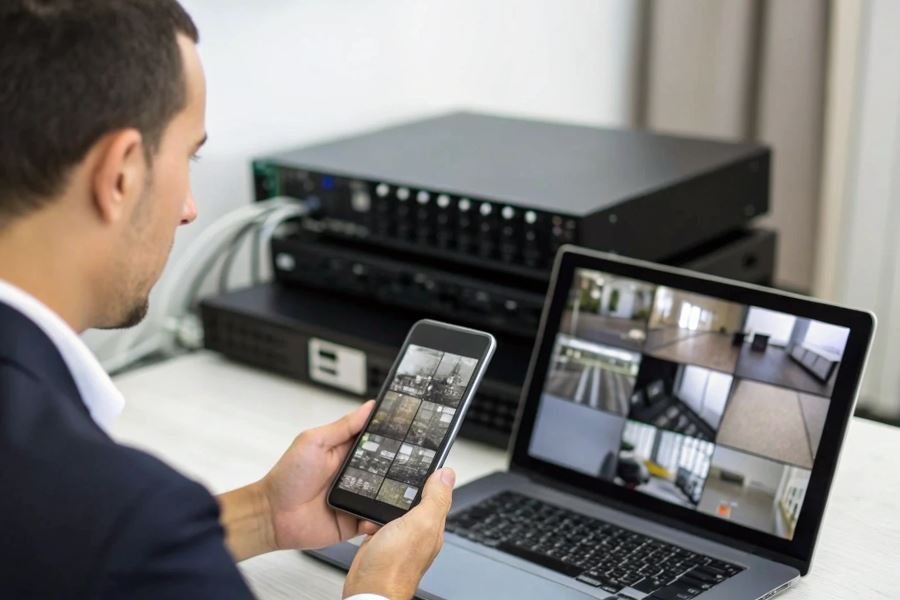
The ability to access your surveillance system from anywhere has transformed from luxury to necessity. Look for recorders offering:
- Mobile apps with push notifications for critical events
- Multi-user access with customizable permission levels
- Bandwidth management for smooth remote viewing
- SSL/TLS encryption for secure connections
Systems from providers like Axis Communications offer enterprise-grade remote access without monthly subscription fees.
Scalability that grows with your business
The surveillance system you install today should accommodate tomorrow’s expansion. Key scalability features include:
- Channel capacity with room to grow (16+ channels recommended)
- Storage expandability through additional bays or external connections
- Bandwidth headroom for additional cameras
- Software upgradability for future features
Invest in modularity rather than maximum capacity upfront. A recorder from Synology or QNAP with expandable bays offers better long-term value than a fixed-capacity unit.
By focusing on these five technical pillars, you’ll select a video recorder that delivers reliable surveillance today while adapting to your evolving security needs tomorrow.
Advanced Security Features That Transform Business Video Recorders
Motion detection that actually works
Gone are the days when security cameras would trigger alerts for passing shadows or falling leaves. Modern video recorders now employ sophisticated motion detection algorithms that can distinguish between a customer browsing shelves and a potential shoplifter exhibiting suspicious behavior.
The best systems offer customizable detection zones where you can highlight specific areas of interest—like cash registers or inventory storage—while ignoring high-traffic areas that would trigger constant false alarms. Some advanced models from companies like Hikvision and Axis Communications can even differentiate between humans, vehicles, and animals, dramatically reducing false alerts.
Smart alerts have evolved beyond simple notifications to become actionable intelligence tools for business owners.
Today’s systems can send real-time alerts through multiple channels simultaneously:
| Alert Type | Delivery Method | Business Benefit |
|---|---|---|
| Intrusion | SMS + Email + Push | Immediate response to potential break-ins |
| Loitering | Mobile app notification | Identify suspicious behavior patterns |
| Line crossing | Email with video clip | Monitor restricted areas effectively |
| Object removal | Dashboard alert | Prevent inventory shrinkage |
Cloud backup that never sleeps
The most sophisticated security breach isn’t a masked intruder—it’s the thief who steals your video recorder itself. This is where cloud backup becomes essential.
Modern video recorders offer redundant storage options that automatically sync footage to secure cloud servers. Systems like Eagle Eye Networks provide continuous backup that ensures your footage remains accessible even if your on-premises equipment is damaged, destroyed, or stolen.
The best cloud solutions offer:
- Automatic encryption of all uploaded footage
- Flexible retention policies based on business needs
- Bandwidth management to prevent network congestion
- Geographically distributed storage for disaster recovery
The true value of cloud backup isn’t just in storage—it’s in accessibility and business continuity.
Business owners can access archived footage from anywhere, making it possible to review incidents while traveling or collaborate with law enforcement without being on-site.
Integration that multiplies effectiveness
The most powerful video recorders today don’t operate in isolation—they function as central hubs in interconnected security ecosystems.
Advanced integration capabilities allow video systems to communicate with:
- Access control systems that cross-reference entry logs with video footage
- Point-of-sale terminals that sync transaction data with video for loss prevention
- Alarm systems that automatically begin recording when triggered
- Business intelligence tools that analyze customer traffic patterns
Milestone Systems and Genetec offer platforms that connect with hundreds of third-party business applications, transforming security footage into actionable business intelligence.
The most forward-thinking retailers are using integrated video systems to:
- Analyze customer dwell time in specific departments
- Optimize staffing based on traffic patterns
- Improve store layouts using heat mapping
- Enhance inventory management through visual verification
When selecting a video recorder, these advanced features—intelligent motion detection, reliable cloud backup, and seamless system integration—create a security solution that does more than just record footage. It becomes an essential business tool that protects assets while providing valuable operational insights.
Discover the essential criteria for selecting the perfect video recorder for your store or office security system. Learn about storage capacity, resolution, remote access, and advanced features to protect your business assets effectively.
Discover the essential criteria for selecting the perfect video recorder for your store or office security system. Learn about storage capacity, resolution, remote access, and advanced features to protect your business assets effectively.