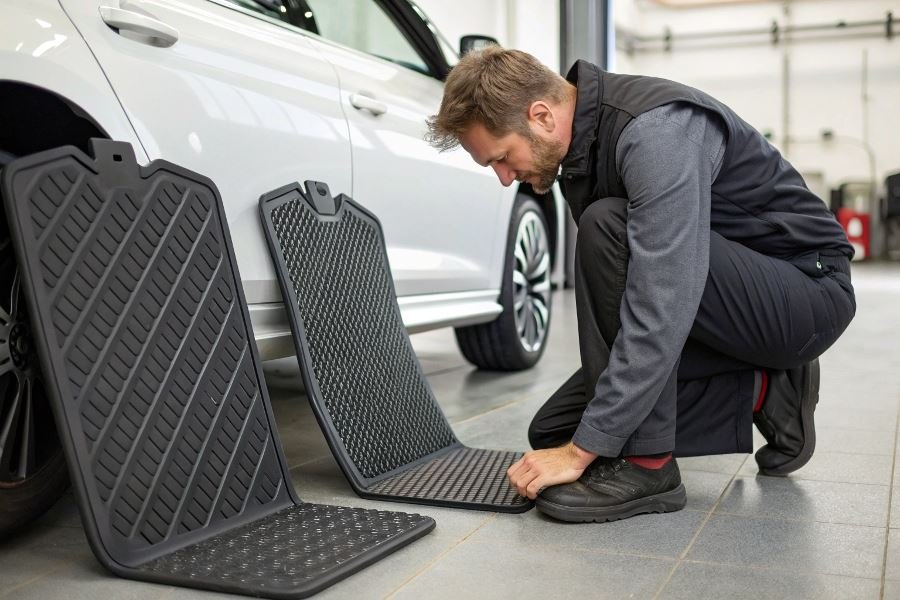
Ever walked into an auto service shop and noticed how the floor mats were either impeccably organized or chaotically strewn about? That first impression speaks volumes about the operation’s professionalism and efficiency. For auto service owners, proper mat organization isn’t just about aesthetics—it’s about workflow optimization, safety compliance, and operational excellence.
When selecting the ideal mat holder system for your facility, size matters—tremendously. A compact urban repair shop with 2-3 bays faces entirely different organizational challenges than a 20-bay dealership service center. The right holder system must align with your spatial constraints while maximizing accessibility and protection of your mat inventory.
The organizational imperative in auto service environments cannot be overstated. Well-organized mats translate to faster service times, reduced contamination between vehicles, and enhanced customer perception. Studies from the Automotive Service Association show that organized shops complete jobs up to 15% faster than their disorganized counterparts.
The size factor plays a critical role in your selection process. Smaller operations might benefit from vertical wall-mounted systems that maximize limited floor space, while larger facilities often require modular, expandable solutions that can grow with their needs.
When evaluating potential mat holder systems, consider these fundamental factors:
- Capacity-to-footprint ratio – How many mats can be stored in the available space?
- Accessibility – Can technicians quickly retrieve and return mats without disrupting workflow?
- Durability – Will the system withstand the rigors of daily use in a high-traffic environment?
The right mat organization system isn’t just an accessory—it’s a strategic investment in your operation’s efficiency and professionalism.
Maximizing Your Mat Holder Strategy: Size-Based Solutions for Auto Services
When setting up an efficient auto service operation, even the smallest details can impact your workflow and bottom line. The humble mat holder—often overlooked—can significantly affect your shop’s organization, efficiency, and professional appearance. Selecting the right holder requires careful consideration of your specific operational needs.
Auto service professionals understand that criteria for choosing a holder for mats depending on the size of the auto service involves balancing space utilization, capacity requirements, and installation flexibility. Let’s dive into how these factors play out across different shop sizes and configurations.
Space Efficiency Across Service Footprints
Small Auto Services (Under 2,000 sq ft)
Small shops face unique space challenges that demand creative solutions. Wall-mounted vertical holders offer maximum floor space preservation while keeping mats visible and accessible. These compact units typically extend only 4-6 inches from the wall while accommodating 10-15 standard floor mats.
Corner installations can transform otherwise unused space into functional storage areas, particularly in reception areas or near service bays.
Medium-Sized Operations (2,000-5,000 sq ft)
Mid-sized facilities benefit from modular systems that can expand with growing inventory. Combination units featuring both vertical and horizontal storage sections provide flexibility without consuming valuable floor space. Look for adjustable designs that can be reconfigured as your service mix evolves.
Large Service Centers (5,000+ sq ft)
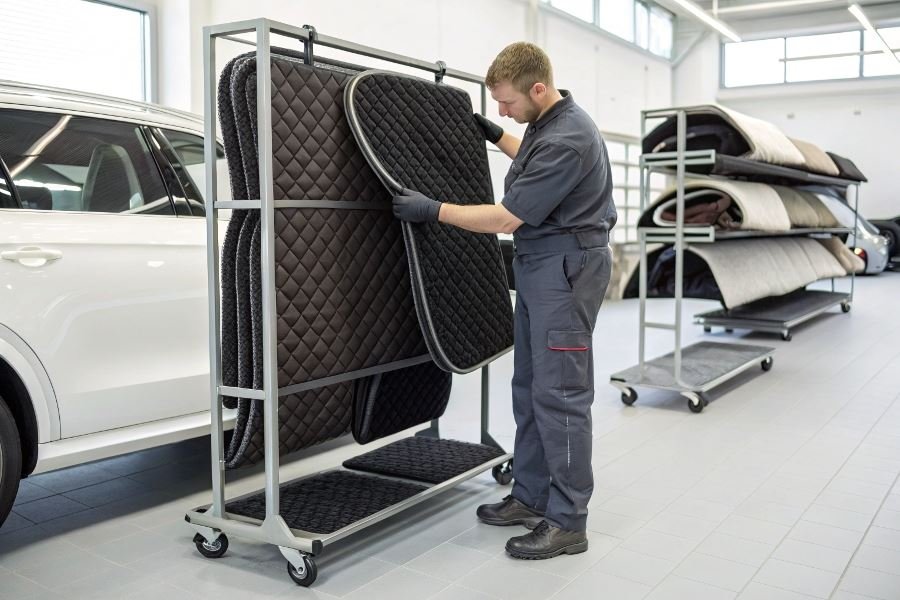
Larger operations should consider industrial-grade, free-standing mat organization systems. These robust units can hold 50+ mats while featuring:
- Multi-tier organization by size or vehicle type
- Built-in drainage systems for wet mats
- Mobility options for repositioning during busy seasons
Capacity Planning Based on Service Volume
Your mat holder capacity should align with your daily service volume and inventory management approach. Consider this capacity planning framework:
| Service Volume (cars/day) | Recommended Capacity | Holder Type |
|---|---|---|
| 5-10 | 20-30 mats | Wall-mounted compact |
| 11-25 | 30-60 mats | Modular/expandable |
| 26+ | 60+ mats | Industrial multi-station |
Remember to account for seasonal fluctuations—winter months typically require 15-20% more capacity due to increased mat usage and longer drying times.
Installation Flexibility for Diverse Layouts
Permanent Mounting Options
For dedicated service areas with consistent workflows, permanently installed holders provide stability and durability. Heavy-duty wall mounts using reinforced brackets can support up to 200 pounds of wet mats without compromising structural integrity.
Mobile Solutions
Service centers with flexible layouts benefit from wheeled mat organization stations. These units can be positioned near wash areas during high-volume periods and tucked away during special events or when floor space is needed for other purposes.
Overhead Systems
Facilities with height advantages can utilize ceiling-mounted pulley systems that raise mats completely off the floor. This innovative approach works particularly well in detail bays where floor space is at a premium.
The right mat holder system transforms a potential organizational headache into a streamlined process that enhances efficiency and projects professionalism to your clients. By matching your selection to your specific spatial constraints, service volume, and layout requirements, you’ll create a solution that serves your operation for years to come.
Advanced Mat Holder Selection for Auto Service Excellence
Durability That Withstands Workshop Demands
The relentless pace of a busy auto service center demands equipment that can take a beating. Mat holders in high-traffic areas face constant abuse from oil spills, tool drops, and the daily shuffle of technicians and vehicles. Premium stainless steel holders have emerged as industry favorites, offering exceptional longevity with minimal maintenance requirements. These units typically withstand 7-10 years of continuous use, compared to just 2-3 years for aluminum alternatives.
A recent material innovation worth noting is the introduction of industrial-grade polymer composites. These advanced materials offer remarkable chemical resistance—particularly important when exposed to brake fluid, transmission fluid, and other automotive chemicals that quickly degrade standard plastics.
The difference between economy and premium holders becomes apparent within months, not years. When factoring replacement costs and downtime, investing in quality becomes the obvious choice.
For shops specializing in heavy equipment service, reinforced mounting brackets are non-negotiable. These specialized brackets distribute weight more effectively, preventing the sagging and eventual failure common with standard mounting systems.
Workflow-Optimized Accessibility
The physical layout of your service bays directly impacts productivity. Mat holders positioned at optimal heights (typically 36-42 inches from the floor) reduce technician strain and improve compliance with proper mat storage protocols.
Workflow patterns should dictate holder placement. Consider these proven configurations:
| Service Area Type | Recommended Holder Placement | Key Benefit |
|---|---|---|
| Quick Service Bay | Wall-mounted near entrance | Minimizes walking distance |
| Diagnostic Area | Mobile cart integration | Follows technician movement |
| Detail Shop | Ceiling-mounted retractable | Preserves floor space |
Ergonomic quick-release mechanisms have revolutionized mat handling efficiency. The best systems allow one-handed operation even with gloved hands, saving precious seconds on each vehicle service. This seemingly small improvement can add up to hours of saved labor monthly in busy shops.
Investment Analysis for Long-Term Value
When evaluating mat holder solutions, looking beyond the initial price tag reveals the true cost picture. Premium systems from Griot’s Garage or Auto Care Pro may command 3-4 times the price of basic options, but deliver exponentially greater value through:
- Reduced replacement frequency – Quality holders typically outlast economy versions by 300-400%
- Improved compliance – Easier-to-use systems result in consistent mat storage, reducing liability risks
- Enhanced professional appearance – Customer perception improvements translate to higher service pricing potential
The math becomes compelling when calculating total ownership costs. A premium holder system priced at $450 that lasts 8 years costs approximately $56 per year. Compare this to replacing 120economyholdersevery2years(60 annually) while accepting lower functionality and increased risk of improper mat storage.
For multi-bay operations, scalable systems that allow for expansion as business grows represent the smartest investment approach. Modular designs permit adding capacity without replacing existing infrastructure.
The most successful auto service operations recognize that mat holders represent more than simple storage—they’re efficiency tools that impact workflow, safety compliance, and professional presentation. By applying these advanced selection criteria, shop owners can make informed decisions that enhance operations while delivering meaningful return on investment.
Discover how to select the perfect mat holder for your auto service based on facility size, workflow, and capacity needs. Learn space-efficient solutions that optimize organization while maximizing durability and ROI for your specific service environment.
Discover how to select the perfect mat holder for your auto service based on facility size, workflow, and capacity needs. Learn space-efficient solutions that optimize organization while maximizing durability and ROI for your specific service environment.