
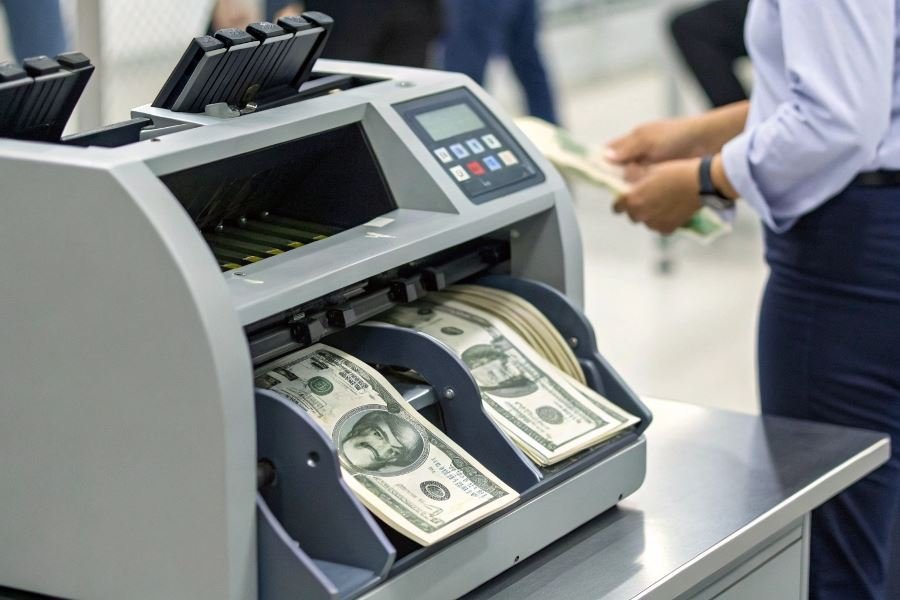
Every 24 hours, over $5 billion in cash flows through America’s financial system—each bill potentially carrying thousands of microorganisms and requiring precise authentication.
Behind the scenes of our economy’s cash flow stands an unsung hero: the professional banknote sorter. These sophisticated machines represent the intersection of precision engineering and financial security, processing thousands of bills per minute while performing multiple critical functions simultaneously.
Professional banknote sorters are specialized devices designed to authenticate, count, sort, and evaluate the physical condition of currency notes with remarkable accuracy. Unlike basic bill counters found in retail environments, these advanced systems employ multiple detection technologies—ultraviolet, magnetic, infrared, and image processing—to verify authenticity while sorting notes by denomination, orientation, and fitness level.
“The evolution of this technology has fundamentally transformed how financial institutions manage physical currency,” notes Federal Reserve cash operations specialist James Harrington. “What once required dozens of trained personnel can now be accomplished with greater accuracy by a single machine.”
The journey from manual counting to today’s AI-powered sorting systems spans decades of innovation. Early mechanical sorters emerged in the 1920s, but the true revolution began in the 1980s with the integration of computer vision. Modern systems can now detect counterfeits with 99.99% accuracy while processing up to 2,000 notes per minute.
Who benefits most?
- Banks and credit unions: Reduced labor costs and enhanced accuracy
- Casinos and gaming establishments: High-volume cash processing with fraud protection
- Retail chains: Streamlined cash management and reduced counting errors
- Central banks: Quality control of currency in circulation
These systems don’t just count money—they protect the integrity of our financial system while driving operational efficiency for businesses that still handle significant cash volumes.
The Technology Behind Modern Cash Processing
Professional banknote sorters represent the backbone of modern cash management systems, combining precision engineering with advanced detection technologies to process currency with remarkable efficiency. These machines have transformed how financial institutions, cash centers, and retail operations handle the daily flow of cash.
When examining the core capabilities of today’s high-end currency processing systems, three critical functions stand out. Professional banknote sorters: functions and capabilities extend far beyond simple cash counting, incorporating sophisticated authentication, multi-dimensional sorting, and processing speeds that would have seemed impossible just a decade ago. Let’s dive into what makes these machines essential tools for any serious cash-handling operation.
Authentication That Leaves Counterfeiters Frustrated
Modern banknote sorters employ multiple authentication technologies simultaneously, creating a verification gauntlet that counterfeit bills simply cannot pass:
- Multi-spectral imaging captures details across visible, UV, and IR light spectrums
- Magnetic ink detection verifies the unique magnetic signatures in genuine currency
- Ultrasonic thickness sensors measure paper density to micron-level precision
The Glory UW-F Series achieves authentication accuracy rates exceeding 99.99%, detecting sophisticated counterfeits that might fool human inspectors. These systems don’t just find fakes—they categorize them by quality, helping authorities track counterfeiting trends.
Sorting Beyond Simple Denominations
Today’s sorters perform multi-dimensional classification in a single pass:
| Sorting Parameter | Capability | Business Benefit |
|---|---|---|
| Denomination | Recognition across multiple currencies | Accurate cash reconciliation |
| Fitness | Detection of tears, soil, graffiti, tape | Compliance with central bank standards |
| Orientation | Face/back and right/left positioning | Presentation-ready cash bundles |
| Serial Number | Optical character recognition | Tracking for investigations and audits |
The Giesecke+Devrient BPS C5 can sort notes into up to 20 different output pockets based on these parameters, allowing cash centers to prepare deposits that meet strict central bank requirements without additional handling.
Processing Efficiency That Transforms Operations
The raw speed metrics of professional sorters have reached astonishing levels:
- Processing velocity: Top-tier machines like the Kisan Newton process up to 1,800 notes per minute
- Continuous operation: Feed hoppers holding 2,000+ notes minimize reloading interruptions
- Throughput optimization: Smart software adjusts processing parameters in real-time based on note quality
These specifications translate directly to operational efficiency. A medium-sized bank branch that once dedicated 3-4 hours daily to cash processing can now complete the same work in under 30 minutes, freeing staff for customer-facing activities.
The integration of these three capability areas—authentication, sorting, and processing efficiency—creates systems that deliver both security and productivity. Financial institutions using these technologies report cash processing cost reductions of 35-40% while simultaneously improving accuracy and compliance.
As cash continues to play a vital role in the global economy, these sophisticated machines ensure that currency can be processed securely, efficiently, and with minimal human intervention.
Making the Smart Investment in Banknote Sorters
Critical evaluation factors that drive ROI
When evaluating professional banknote sorters, three factors consistently emerge as mission-critical for businesses that handle cash at volume. Authentication accuracy stands as the paramount consideration—even a 0.1% improvement in counterfeit detection can translate to thousands of dollars saved annually. The most advanced systems now achieve 99.9% detection rates across multiple currencies using a combination of magnetic, infrared, and ultraviolet scanning technologies.
Processing speed creates the second pillar of evaluation. Modern high-end sorters from manufacturers like Glory and Giesecke+Devrient process between 800-1,200 notes per minute—a dramatic efficiency leap compared to the 400-600 notes typical of entry-level machines. For businesses processing over $10,000 daily, this difference can reduce labor costs by up to 60%.
The third essential factor is adaptability to regulatory changes. Currency designs evolve, and counterfeit techniques grow more sophisticated. Sorters with software update capabilities and modular hardware design provide crucial future-proofing. The best systems offer quarterly security updates and can accommodate new denomination introductions without hardware replacement.
“The right banknote sorter isn’t just equipment—it’s infrastructure that pays dividends through reduced labor costs, fraud prevention, and customer trust.”
The dollars and sense of implementation
The ROI calculation for banknote sorters reveals why they’ve become standard equipment across financial institutions and high-volume retail. A mid-range professional sorter priced at $15,000-25,000 typically reaches breakeven within 12-18 months through multiple value streams:
| ROI Factor | Typical Annual Savings |
|---|---|
| Labor reduction | $8,000-12,000 |
| Counterfeit prevention | $3,000-7,000 |
| Cash handling errors | $2,000-4,000 |
| Audit/compliance costs | $1,500-3,000 |
These figures become even more compelling when considering the hidden costs of manual processing—employee burnout, customer wait times, and reconciliation errors. Businesses processing over $20,000 weekly often see complete ROI within 9-12 months, while even smaller operations typically recover costs within 24 months.
Tomorrow’s technology arriving today
The professional banknote sorter landscape continues its rapid evolution, with three emerging trends reshaping capabilities and expectations:
AI-powered authentication represents the most significant advancement. Machine learning algorithms now analyze subtle printing variations and material compositions with precision exceeding human experts. Systems from Cummins Allison and Kisan Electronics now incorporate neural networks that continuously improve detection capabilities through cloud-based learning.
Integration with cash management ecosystems is transforming sorters from standalone devices into networked nodes. Modern systems now seamlessly connect with cash recyclers, smart safes, and enterprise management software, creating end-to-end visibility. This connectivity enables real-time cash position reporting and predictive analytics for cash flow optimization.
Miniaturization with expanded capabilities marks the third major trend. The footprint of professional-grade sorters has decreased by approximately 30% over the past five years while simultaneously increasing processing speeds and detection capabilities. This evolution makes enterprise-grade technology accessible to businesses with space constraints or moderate volume requirements.
The most forward-thinking businesses are leveraging these advancements not just for operational efficiency, but as strategic assets that transform cash handling from a necessary burden into a competitive advantage.
Discover how professional banknote sorters revolutionize cash processing with advanced authentication, sorting capabilities, and efficiency features. Learn key selection factors and ROI benefits for businesses handling currency transactions.
Discover how professional banknote sorters revolutionize cash processing with advanced authentication, sorting capabilities, and efficiency features. Learn key selection factors and ROI benefits for businesses handling currency transactions.


