Ever wondered why some artisanal cheese operations consistently deliver superior product while others struggle with inconsistent quality? The secret often lies not in the cheese itself, but in how meticulously they maintain their equipment.
Behind every perfectly shredded parmesan or uniformly grated cheddar stands a well-maintained industrial cheese grinder. These powerhouse machines represent significant investments—often $15,000 to $75,000 for commercial-grade equipment—yet their maintenance remains surprisingly overlooked. Proper servicing doesn’t just extend equipment life; it directly impacts food safety, operational efficiency, and ultimately, your bottom line.
The maintenance imperative
Industrial cheese grinders come in several configurations, each with unique maintenance requirements:
- Drum graters: These workhorses require special attention to blade sharpness and drum integrity
- Rotary disc models: Focus maintenance on bearing lubrication and disc alignment
- High-volume shredders: Demand rigorous cleaning protocols for food-contact surfaces
The difference between a properly maintained grinder and a neglected one isn’t subtle—it’s the difference between consistent, high-quality output and costly downtime.
Safety first, always
Maintenance procedures carry inherent risks. Always disconnect power sources before servicing, use cut-resistant gloves when handling blades, and follow lockout/tagout procedures religiously. Remember: the sharpest blades in your facility aren’t in your kitchen—they’re in your grinders.
Proper maintenance isn’t just about protecting your investment; it’s about protecting your product reputation and the people who operate your equipment.
Mastering Industrial Cheese Grinder Maintenance
Industrial cheese grinders represent significant investments for food processing operations, with proper maintenance directly impacting both food safety and operational efficiency. The features of servicing and cleaning industrial cheese grinders encompass systematic procedures that preserve equipment functionality while ensuring compliance with stringent food safety regulations. Implementing a structured maintenance program not only extends equipment lifespan but dramatically reduces costly downtime and contamination risks.
Daily Cleaning Essentials
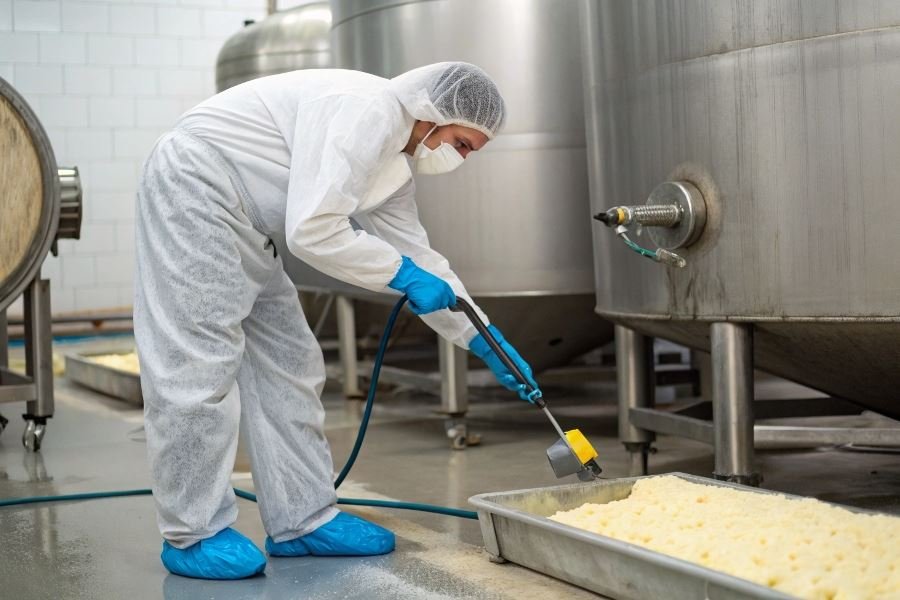
Daily cleaning forms the foundation of effective cheese grinder maintenance. After each production shift:
- Power down and disconnect the grinder completely
- Remove all detachable components including grinding plates, knives, and collection trays
- Scrape away cheese residue using food-grade plastic scrapers
- Rinse components with warm water (120-140°F) to remove loose particles
For the main housing, apply approved food-grade detergent using low-pressure spray systems, focusing on hard-to-reach areas where cheese particles accumulate. The Ecolab Oasis 146 Multi-Quat Sanitizer has proven particularly effective for dairy processing equipment.
Critical insight: Never use high-pressure water directly on motor housings or electrical components—moisture infiltration is the leading cause of premature motor failure in industrial cheese grinders.
Weekly and Monthly Maintenance Rhythms
Weekly maintenance builds upon daily procedures with deeper attention to mechanical components:
| Timeframe | Maintenance Tasks | Tools Required |
|---|---|---|
| Weekly | Bearing inspection, belt tension check, lubrication points | Grease gun, tension gauge |
| Monthly | Motor assessment, electrical connection inspection, calibration verification | Multimeter, calibration weights |
Weekly maintenance should include thorough inspection of grinding plates for signs of wear or damage. Even minor imperfections can significantly impact cheese texture consistency. The Hobart 4146 grinder series requires specific attention to the worm gear assembly, which should be cleaned and lubricated with food-grade lubricant monthly.
Monthly maintenance extends to comprehensive electrical system checks. Inspect all wiring for signs of wear, particularly around areas subject to vibration. Document amperage readings during operation—increases of 15% or more from baseline indicate potential mechanical issues requiring immediate attention.
Disassembly Techniques for Deep Cleaning
Proper disassembly represents the most technical aspect of grinder maintenance:
- Document the assembly sequence with photographs before disassembly
- Use manufacturer-specified tools to prevent damage to threaded components
- Organize parts systematically on clean, designated surfaces
- Soak components in appropriate cleaning solutions based on material composition
For stainless steel components, alkaline cleaners effectively remove protein buildup, while acidic cleaners address mineral deposits. The 3M Quat Disinfectant Cleaner Concentrate provides excellent sanitization for food-contact surfaces after cleaning.
When disassembling cutting assemblies, inspect knife edges under proper lighting. Dull blades increase motor strain and compromise product quality. Most industrial models from manufacturers like Biro recommend blade replacement after approximately 100 hours of operation, though this varies based on product hardness and volume.
After thorough cleaning, allow components to air dry completely before reassembly. Apply food-grade lubricant sparingly to specified points only. Over-lubrication creates potential contamination hazards and attracts debris that accelerates wear.
Implementing these structured maintenance protocols transforms routine cleaning from a mundane task into a critical quality control checkpoint that protects both equipment investment and product integrity.
Mastering Industrial Cheese Grinder Maintenance
Industrial cheese grinders are the unsung heroes of food production facilities, transforming massive blocks of cheese into precisely sized shreds, slices, and crumbles day after day. But like any hardworking equipment, these powerhouses require attentive care to maintain peak performance. Let’s dive into the fascinating world of industrial cheese grinder maintenance—where mechanical precision meets food safety excellence.
Conquering Common Mechanical Failures
When your industrial cheese grinder starts making unusual noises or producing inconsistent output, troubleshooting becomes critical. The most frequent issues include:
Blade dullness and misalignment – After processing thousands of pounds of cheese, even the highest-quality stainless steel blades will eventually lose their edge. Signs include irregular cheese particles and increased motor strain. Most Hobart and Urschel models recommend blade replacement every 3-6 months depending on usage volume.
Motor overheating – This typically stems from:
- Cheese feed rate exceeding capacity
- Inadequate cooling system maintenance
- Electrical connection issues
Temperature monitoring systems are your first line of defense against costly motor burnout.
Feed mechanism jams – Often caused by cheese chunks that exceed the grinder’s specified size or hardness. The solution involves:
- Immediate power disconnection
- Complete disassembly of feed components
- Thorough inspection for damaged parts
- Proper reassembly with correct torque specifications
Cleaning Agents and Tools That Deliver Results
The cleaning protocol for industrial cheese grinders requires specialized products for different components:
| Component | Recommended Cleaning Agent | Ideal Tools | Frequency |
|---|---|---|---|
| Cutting blades | Food-grade alkaline detergent (pH 8-10) | Nylon brushes, compressed air | After each production run |
| Feed mechanisms | Chlorinated sanitizers (200ppm) | Extension brushes, pressure washers | Daily |
| Motor housing | Isopropyl alcohol (70%) | Microfiber cloths | Weekly |
| Electrical panels | Compressed air only | Anti-static brushes | Monthly |
Never use abrasive cleaners on stainless steel components—they create microscopic scratches that become bacterial harbors. Instead, invest in cleaning tools specifically designed for food processing equipment like those from Remco Products.
The difference between adequate and exceptional cleaning protocols often determines equipment lifespan and product quality.
Professional Services vs. In-House Maintenance
The decision between outsourced professional maintenance and developing in-house capabilities hinges on several factors:
Professional service advantages:
- Factory-trained technicians with specialized diagnostic equipment
- Access to proprietary parts and updates
- Comprehensive documentation for regulatory compliance
- Predictive maintenance scheduling
In-house maintenance benefits:
- Immediate response to production interruptions
- Deeper understanding of facility-specific challenges
- Lower long-term costs after initial training investment
- Ability to customize maintenance schedules around production demands
For facilities processing over 10,000 pounds of cheese weekly, a hybrid approach often delivers optimal results: scheduled professional service visits quarterly, supplemented by daily in-house maintenance protocols.
Training investment pays dividends. Manufacturers like Biro Manufacturing offer specialized maintenance certification programs that dramatically improve equipment longevity and reduce downtime incidents by up to 67%.
The most successful cheese processing operations recognize that maintenance isn’t merely a cost center—it’s a strategic investment in production reliability, product consistency, and ultimately, customer satisfaction.
Discover essential maintenance techniques for industrial cheese grinders, including daily cleaning protocols, troubleshooting tips, and professional servicing guidelines to maximize equipment lifespan and ensure food safety compliance.
Discover essential maintenance techniques for industrial cheese grinders, including daily cleaning protocols, troubleshooting tips, and professional servicing guidelines to maximize equipment lifespan and ensure food safety compliance.