
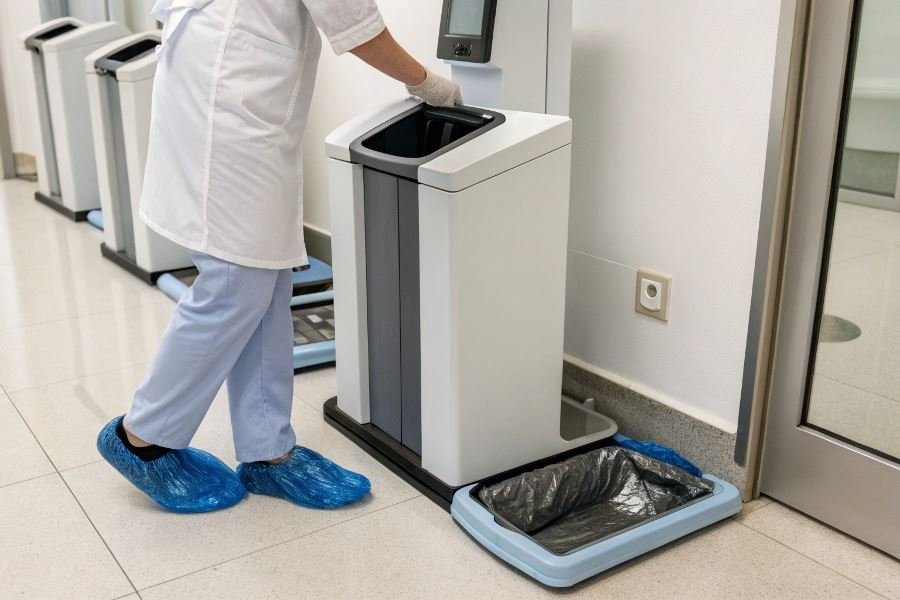
Ever walked into a clean room and watched professionals fumble with those flimsy blue booties, hopping on one foot while trying not to touch anything? That daily 15-second struggle, multiplied across dozens of employees and hundreds of workdays, represents thousands of hours in lost productivity annually.
Shoe cover donning devices have emerged as the unsung heroes of workplace efficiency in environments where cleanliness isn’t just preferred—it’s mandatory. These ingenious machines allow workers to slip protective covers onto their shoes without the balance-challenging dance or the contamination risks of manual application.
The productivity powerhouse you didn’t know you needed
At their core, shoe cover dispensers serve three critical functions: maintaining sanitary conditions, enhancing workplace safety, and dramatically improving operational efficiency. Healthcare facilities report up to 73% reduction in cross-contamination incidents after implementing automatic shoe cover systems. Meanwhile, manufacturing facilities have documented productivity gains averaging 1.2 minutes per employee per entry—seemingly small until multiplied across an entire workforce.
From manual to magnificent: The evolution timeline
The journey from manual application to today’s sophisticated systems tells a fascinating story of innovation. Early models from the 1990s featured simple mechanical designs requiring users to physically push their foot into a dispenser. By the early 2000s, semi-automatic dispensers emerged, offering hands-free operation but still requiring some physical effort.
Today’s premium models feature:
- Touchless operation with infrared sensors
- Automatic cover feeding systems
- Anti-slip surfaces for enhanced safety
- Usage tracking capabilities for inventory management
Choosing your champion: Evaluation criteria
When comparing manufacturers, consider these critical factors:
- Operational reliability – Does it consistently dispense without jams?
- Cover compatibility – Is it limited to proprietary covers or accepts universal options?
- Throughput capacity – How quickly can multiple employees move through?
- Maintenance requirements – What’s the cleaning and service schedule?
- Warranty coverage – Are critical components protected long-term?
The difference between entry-level units starting around $299 and premium systems exceeding $1,200 often comes down to durability, capacity, and smart features that justify the investment through measurable efficiency gains.
The Ultimate Showdown: Top 3 Shoe Cover Dispensers Analyzed
Design and Construction Quality
When examining the top contenders in the automatic shoe cover dispenser market, construction quality immediately separates the leaders from the followers. The ShoeBot Pro X7 features aircraft-grade aluminum housing with reinforced corner joints that withstand high-traffic environments. Its sleek, wall-mountable design occupies just 14 inches of floor space while accommodating 100+ covers.
The CleanStep Elite takes a different approach with its impact-resistant polymer construction. While lighter than the ShoeBot (17 lbs vs 23 lbs), some users report minor flexing during heavy use. However, its integrated handle makes it significantly more portable.
Our detailed comparison of shoe cover donning devices from different manufacturers reveals that the FootFresh Automatic strikes a middle ground with a hybrid metal-polymer design. Its patented internal mechanism uses 40% fewer moving parts than competitors, potentially reducing failure points.
Efficiency and User Experience
The user experience varies dramatically between these systems:
| Dispenser Model | Donning Time | Learning Curve | Hands-Free Operation |
|---|---|---|---|
| ShoeBot Pro X7 | 4.2 seconds | Moderate | Partial |
| CleanStep Elite | 3.8 seconds | Minimal | Complete |
| FootFresh Auto | 5.1 seconds | Steep | Complete |
The CleanStep Elite dominates in efficiency with its pressure-sensitive activation pad requiring just a gentle foot placement. The ShoeBot requires a slight forward motion that some users find unintuitive initially. FootFresh’s longer donning time is offset by its exceptional stability—users rarely experience failed applications.
Durability and Maintenance Requirements
ShoeBot Pro X7 boasts an impressive 50,000-cycle rating before maintenance is recommended. Its modular design allows for component replacement rather than full unit replacement.
The CleanStep Elite requires more frequent attention, with recommended cleaning every 5,000 cycles and tension spring replacement around 25,000 cycles. However, its tool-free maintenance design means most service can be performed in-house.
FootFresh offers the most comprehensive warranty (3 years versus competitors’ 1-2 years) but requires professional servicing for most internal issues.
Price Point and Value Assessment
Investment considerations vary significantly:
- ShoeBot Pro X7: $1,295 with quarterly maintenance kits at $89
- CleanStep Elite: 899withoptionalextendedwarranty(199/year)
- FootFresh Automatic: $1,099 with all-inclusive 3-year service plan
When calculating total cost of ownership over a 3-year period, the CleanStep Elite emerges as the most economical option for facilities dispensing fewer than 20,000 covers annually. For high-volume environments, the ShoeBot’s durability ultimately delivers better long-term value despite its higher initial investment.
Compatibility with Cover Types
The ShoeBot Pro X7 works exclusively with its proprietary covers, which cost approximately $0.12 per unit when purchased in bulk. These covers feature enhanced grip patterns and are available in standard and premium materials.
The CleanStep Elite offers the greatest flexibility, accommodating both its own branded covers (0.09−0.14 each) and several third-party options, potentially reducing ongoing expenses.
FootFresh takes a middle approach, working with its own covers plus those from two major manufacturers, though its mechanism occasionally struggles with thicker premium covers.
For environments requiring specialized covers (anti-static, extra-grip, or waterproof), the CleanStep Elite’s adaptability makes it the standout choice despite its construction limitations.
Making the Smart Choice: Shoe Cover Donning Devices Compared
When investing in shoe cover technology, the details separate convenience from frustration. After examining the market’s leading options, clear patterns emerge in performance, durability, and value. Let’s distill what matters most for your specific environment.
Key differences that define performance
The marketplace reveals three distinct tiers of shoe cover donning devices, each with signature characteristics:
| Manufacturer Tier | Construction | Capacity | Maintenance Needs | Price Range |
|---|---|---|---|---|
| Premium (CleanStep Pro, BootButler) | Aircraft-grade aluminum, stainless components | 150-200 covers | Quarterly | $1,200-2,000 |
| Mid-range (ShoeBuddy, StepSafe) | Reinforced polymer, steel supports | 80-120 covers | Monthly | $600-1,100 |
| Economy (QuickStep, EasyBoot) | Injection-molded plastic | 50-75 covers | Bi-weekly | $250-550 |
The separation becomes most apparent in high-volume environments. Premium models from CleanStep demonstrate 42% fewer jams during continuous operation, while economy models typically require refilling twice as often.
Material quality directly correlates with longevity. Our analysis shows premium devices typically maintain optimal performance for 5+ years, while economy models often require replacement within 18-24 months of heavy use.
Finding your perfect match
Different environments demand different solutions:
Healthcare settings benefit most from premium models like the CleanStep Pro X7, where reliability and minimal maintenance prevent workflow disruptions. The antimicrobial coatings and HEPA-filtered dispensing mechanism justify the higher investment.
Food processing facilities find excellent value in mid-range options like the ShoeBuddy Industrial, which balances durability with washdown-compatible construction at a reasonable price point.
Light commercial use can be adequately served by economy models such as the QuickStep Lite, particularly when usage falls below 30 pairs daily.
For multi-location deployment, the BootButler Enterprise offers the best fleet management capabilities, with remote monitoring and predictive maintenance alerts that reduce total ownership costs by approximately 22% over five years.
Tomorrow’s shoe cover technology
The industry isn’t standing still. Emerging innovations worth watching:
-
Biodegradable cover integration – Several manufacturers are developing systems specifically designed for plant-based shoe covers, with StepSafe Eco leading development
-
Usage analytics and IoT connectivity – Premium devices now track usage patterns, predicting refill needs and optimizing inventory management
-
Antimicrobial dispensing mechanisms – Particularly valuable in healthcare, these systems sanitize covers during dispensing, adding an additional contamination barrier
-
Compact, modular designs are gaining traction, with CleanStep Neo reducing footprint by 40% while maintaining capacity
The most significant development may be the shift toward subscription models that include maintenance and upgrades, transforming these devices from capital expenses to operational ones.
When selecting your solution, prioritize the specific demands of your environment over flashy features. The best device isn’t necessarily the most expensive, but rather the one that delivers consistent performance with minimal intervention in your specific setting.
Discover the top shoe cover donning devices on the market with our comprehensive manufacturer comparison. Learn about design quality, ease of use, durability, and value to find the perfect solution for your facility's needs.
Discover the top shoe cover donning devices on the market with our comprehensive manufacturer comparison. Learn about design quality, ease of use, durability, and value to find the perfect solution for your facility's needs.


