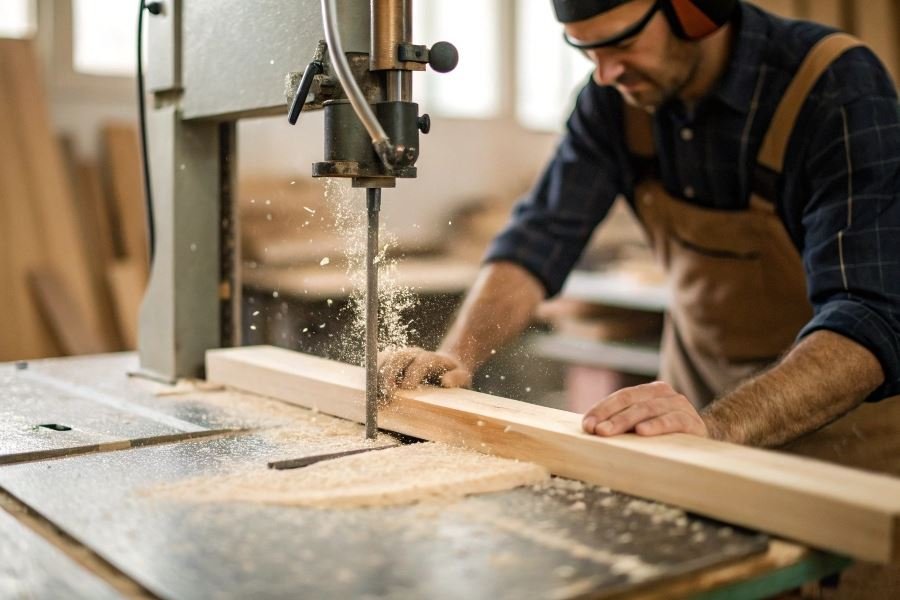
Ever watched a master craftsman slice through metal like butter while your DIY attempts end in broken blades and frustration? The secret isn’t superhuman strength—it’s selecting the right band saw for the specific material. This single decision can mean the difference between professional results and costly mistakes.
Band saw selection is where science meets craftsmanship. When you understand the relationship between your saw and your material, you unlock efficiency, precision, and longevity for both your tools and projects.
Material matters more than you think. Each substance—from hardwoods like oak and maple to metals like aluminum and steel—demands specific blade characteristics. The perfect band saw for pine will fail miserably on stainless steel. Why? Because materials vary dramatically in:
- Density and hardness (affecting required motor power)
- Abrasiveness (determining blade durability)
- Thermal properties (influencing cutting speed)
The foundation of smart selection
Three critical factors determine your ideal band saw configuration:
- Blade teeth per inch (TPI) – Finer materials generally require more teeth
- Cutting speed – Metals typically need slower speeds than wood
- Power requirements – Denser materials demand more horsepower
“The right band saw doesn’t fight the material—it works with its unique properties.”
Wood responds beautifully to high-speed cuts with fewer TPI, while metals require patience, slower speeds, and cooling considerations. Plastics present their own challenges, often melting under excessive friction rather than cutting cleanly.
Understanding these material-specific requirements isn’t just technical knowledge—it’s the gateway to precision results that will transform your projects from acceptable to exceptional.
Essential Features That Make or Break Your Band Saw
Selecting the perfect band saw transforms your workshop capabilities, opening doors to precision cuts across diverse materials. The right machine becomes an extension of your craftsmanship, while the wrong one creates nothing but frustration and wasted materials.
When learning how to choose a band saw for different materials, three critical factors determine success: power specifications, blade characteristics, and dimensional considerations. These elements work together to create either your most valuable workshop ally or an expensive disappointment.
Power That Matches Your Materials
The heart of any band saw is its motor, and matching power to material density prevents both underpowered struggles and wasteful overkill.
Hardwood demands muscle: For dense hardwoods like oak or maple, look for motors delivering at least 1-1.5 HP. Anything less will strain the motor and produce rough, inconsistent cuts.
Metal cutting requires torque: Metal-cutting band saws need specialized motors with high torque at low speeds, typically 1 HP or greater with variable speed controls ranging from 100-3000 FPM (feet per minute).
Light materials need finesse: For plastics, thin woods, and foam, 1/2 to 3/4 HP provides sufficient power while offering better speed control for delicate materials.
| Material Type | Recommended Motor Power | Ideal Speed Range |
|---|---|---|
| Hardwoods | 1-1.5+ HP | 2500-3500 FPM |
| Softwoods | 3/4-1 HP | 3000-4000 FPM |
| Metals | 1+ HP | 100-1500 FPM |
| Plastics | 1/2-3/4 HP | 1000-2500 FPM |
Blade Types That Transform Performance
The blade is where theory meets material, and choosing correctly dramatically affects both cut quality and machine longevity.
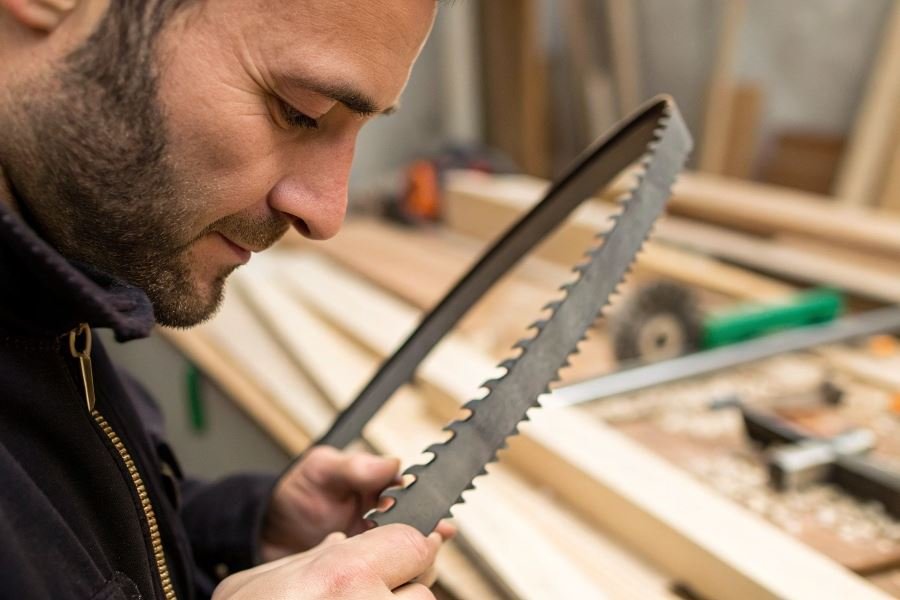
Tooth configuration matters: Skip-tooth blades excel in softwoods and plastics, hook-tooth designs aggressively cut thick hardwoods, while wavy-set teeth deliver smooth finishes in thin materials.
Blade width dictates versatility: Narrow 1/8″ to 1/4″ blades navigate intricate curves but sacrifice stability, while wider 1/2″ to 3/4″ blades provide straight, stable cuts through thick stock.
TPI determines finish quality: For rough cutting hardwoods, 3-6 TPI (teeth per inch) blades remove material efficiently. Fine finishing requires 10-14 TPI, while metal cutting demands 14-32 TPI for clean, controlled cuts.
Workshop wisdom: Always keep at least three blade types on hand—a general-purpose blade, a fine-cutting option, and a specialized blade for your most common material.
Dimensional Considerations That Define Capability
Physical specifications determine what projects your band saw can handle, with three measurements proving most critical.
Throat capacity limits width: This measurement from blade to frame determines the maximum width of material you can cut. Professional shops benefit from 14″ or greater, while hobbyists might find 10-12″ sufficient.
Table size supports your work: Cast iron tables ranging from 15″x15″ to 21″x21″ provide stability and vibration dampening. Larger tables support bigger workpieces and improve safety during complex cuts.
Cutting height determines thickness: Standard models offer 6″ vertical cutting capacity, while premium Laguna Tools or Powermatic band saws provide 12″ or more for resawing thick lumber.
The perfect band saw balances these specifications against your specific material needs, creating a precision tool that elevates your craftsmanship rather than limiting it.
Making the Final Cut: Your Band Saw Decision Guide
When you’ve spent hours researching band saws, comparing specs, and watching demonstration videos, it’s time to make that final decision. This isn’t just about buying a tool—it’s about investing in your craft’s future. Let’s cut through the noise and focus on what truly matters.
Smart budgeting without performance compromise
The price-performance equation doesn’t have to be a zero-sum game. The sweet spot typically falls between 400−1,200 for hobbyists and small business owners, while professional-grade machines can command $2,500+.
Wisdom nugget: The most expensive band saw isn’t necessarily the best for your specific needs. Focus on the features that directly impact your most common cutting tasks.
Consider this approach to maximize value:
- Identify your non-negotiable features (cutting capacity, motor power)
- Determine which “nice-to-have” features justify additional cost
- Factor in long-term operational costs (blade replacement, maintenance)
For example, spending an extra $200 for variable speed control makes perfect sense if you’ll be cutting multiple materials, but might be unnecessary if you’re exclusively cutting hardwoods.
Trust factors that protect your investment
Manufacturer reputation isn’t just marketing—it’s your insurance policy against headaches. The band saw market has consolidated around several trusted names that have proven their reliability over decades.
When evaluating warranty options, look beyond the years covered:
| Warranty Factor | What It Tells You |
|---|---|
| Duration | Basic confidence level in product |
| Parts vs. Labor | True cost of potential repairs |
| Transferability | Resale value protection |
| Service Network | Convenience of warranty fulfillment |
Laguna Tools and Jet Tools typically offer 5-year warranties with robust service networks, while Grizzly Industrial provides excellent value with 1-year coverage but exceptional parts availability.
Three versatility champions worth your attention
After analyzing dozens of models across price points, these three band saws consistently deliver exceptional versatility across material types:
- JET JWBS-14DXPRO ($1,000-1,200)
- 13.5″ resaw capacity handles large stock
- 1.25 HP motor powers through hardwoods and light metals
- Two-speed operation (1,500/3,000 FPM) adapts to different materials
- Cast iron frame minimizes vibration for precision cuts
- Grizzly G0555LX ($600-700)
- Exceptional value-to-performance ratio
- 1 HP motor sufficient for most hobbyist applications
- Quick-change blade guides reduce downtime between material switches
- Smaller footprint ideal for space-constrained workshops
- Laguna Tools 14bx ($1,300-1,500)
- Premium ceramic guides for superior blade stability
- Illuminated cutting area enhances precision
- Micro-adjustable fence system for perfect drift compensation
- European-engineered for exceptional durability
The right band saw becomes an extension of your craftsmanship—choose one that not only meets today’s requirements but has the capacity to grow with your ambitions. Remember that the perfect band saw isn’t just about specifications; it’s about how those specifications translate to your specific cutting challenges.
Discover how to select the perfect band saw for wood, metal, plastic, and composite materials with our comprehensive guide covering power requirements, blade types, and essential features for optimal cutting performance.
Discover how to select the perfect band saw for wood, metal, plastic, and composite materials with our comprehensive guide covering power requirements, blade types, and essential features for optimal cutting performance.