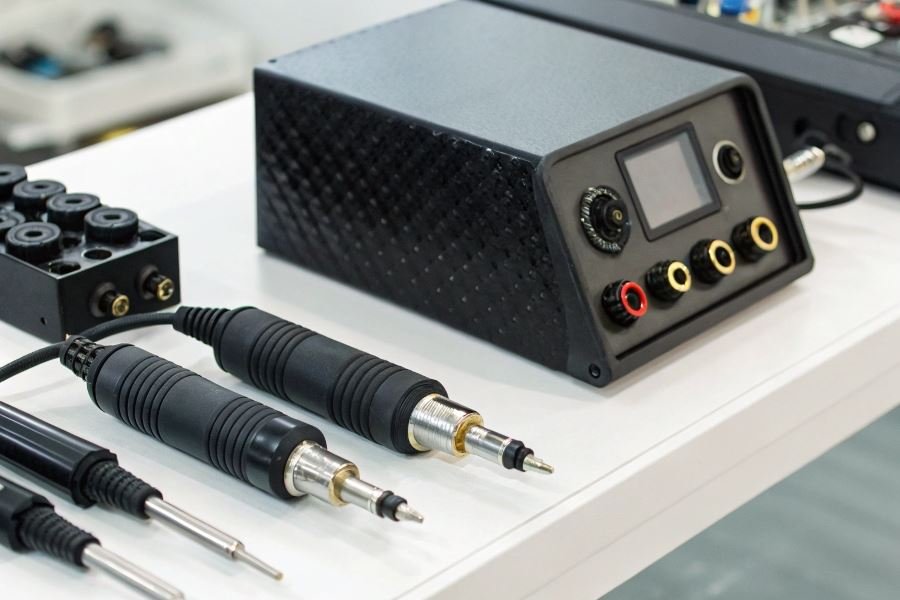
The difference between a seamless workflow and constant frustration often comes down to what’s literally at your fingertips.
When a surgeon performs a delicate procedure, a sound engineer mixes a platinum record, or a machinist crafts precision parts, they’re all relying on the same critical component: control units that translate human intention into perfect execution. These specialized interfaces—whether mixing consoles, CNC controllers, or medical equipment panels—represent the command center where professional expertise meets technological capability.
The market for professional control units has evolved dramatically since the early 2000s, splitting into distinct tiers that challenge buyers to make crucial decisions. Today’s landscape features everything from $500 entry-level controllers to sophisticated systems commanding $50,000 or more, with the gap between budget and premium options growing increasingly nuanced.
The professional’s dilemma
For professionals, selecting between budget and premium control units involves weighing several critical factors:
- Precision and reliability: Will the unit maintain calibration through thousands of hours of operation?
- Workflow efficiency: Does the interface eliminate friction or create it?
- Longevity: Is this a three-year investment or a decade-long commitment?
- Support infrastructure: What happens when something goes wrong at 2 AM before a major deadline?
The true cost of control units extends far beyond the initial price tag. A budget option that causes even minor inefficiencies can compound into significant opportunity costs over time, while premium units must justify their substantial upfront investment through tangible performance advantages.
The True Cost of Control: Budget vs Premium Units
Performance That Pays the Bills
When evaluating control units for professional applications, the performance gap between budget and premium options often determines project success. Budget controllers typically offer processing speeds of 200-400 MHz with 2-4MB of memory, while premium units from manufacturers like Allen-Bradley or Siemens deliver 1.5+ GHz processors and 16-32MB of memory. This translates to real-world differences in scan times—budget units average 10-20ms while premium controllers achieve sub-millisecond responses.
The decision between budget vs premium control units for professional use ultimately hinges on application demands. A small machine shop might function perfectly with a $500 economy controller, but manufacturing lines processing thousands of units hourly demand the microsecond precision of $5,000+ premium systems. The performance ceiling becomes apparent when scaling: budget units typically max out at 256 I/O points, while premium controllers handle thousands.
Built to Last or Built to Price?
Material quality creates the most visible distinction between price tiers. Economy controllers often use plastic housings and consumer-grade components with MTBF (Mean Time Between Failures) ratings of 50,000-100,000 hours. Premium units feature:
- Machined aluminum or steel enclosures
- Military-spec components
- MTBF ratings exceeding 500,000 hours
- Operating temperature ranges of -40°F to 158°F (versus 32°F to 122°F)
| Feature | Budget Units | Premium Units |
|---|---|---|
| Housing Material | Plastic | Metal/Industrial Grade |
| Operating Temperature | 32°F-122°F | -40°F-158°F |
| Vibration Resistance | 2G | 5G+ |
| Warranty | 1-2 years | 5-10 years |
| IP Rating | IP20-IP54 | IP65-IP69K |
Feature Sets That Define Value
Premium controllers don’t just perform better—they offer technological advantages that transform workflows. While budget units provide basic ladder logic programming, premium controllers from Beckhoff or Omron deliver:
- Advanced motion control capabilities
- Integrated safety functions (SIL3/PLe)
- Native cloud connectivity
- Predictive maintenance algorithms
- Multi-protocol communication
The technological gap extends to software support. Budget controllers typically offer basic programming environments, while premium systems include simulation tools, digital twins, and extensive libraries that can cut development time by 40-60%.
The ROI Equation
The true cost-benefit analysis extends beyond purchase price. A $600 budget controller might seem attractive compared to a $3,500 premium unit, but consider:
- Downtime costs: At $5,000/hour in lost production, a single failure pays for the premium difference
- Integration time: Premium units reduce programming hours by 30-50%
- Lifecycle expenses: Budget units typically require replacement every 3-5 years versus 10-15 for premium options
- Expansion flexibility: Premium controllers accept future modules without replacement
For operations running 24/7, the ROI calculation typically favors premium units, with total cost of ownership averaging 30% less over a 10-year period despite higher initial investment. However, for intermittent use or non-critical applications, budget controllers deliver sufficient value without unnecessary expenditure.
The professional’s choice ultimately depends on calculating the true cost of control—not just the price on the invoice.
Making the Smart Control Unit Decision
Industry Requirements Shape Your Choice
Control units aren’t one-size-fits-all tools. Manufacturing environments demand rugged units with precise timing capabilities, while creative industries prioritize intuitive interfaces and color accuracy. Medical settings require units with impeccable reliability and certification to ISO 13485 standards. The industry-specific requirements should drive your decision first and foremost.
For example, Allen-Bradley premium controllers excel in industrial environments where millisecond precision matters, justifying their $3,000+ price tag. Meanwhile, budget-friendly Arduino systems (starting around $35) might perfectly serve educational institutions or prototype development.
The most expensive control unit isn’t always the best—it’s the one that meets your specific industry requirements without unnecessary features you’ll never use.
Security considerations vary dramatically by sector too. Financial services demand premium units with advanced encryption and authentication, while retail operations might function perfectly with mid-range solutions offering basic security protocols.
Assessing Project Scale and Complexity
The scope of your project directly impacts which control unit makes sense:
| Project Complexity | Budget Option | Premium Option | Key Differentiator |
|---|---|---|---|
| Simple (1-3 processes) | Raspberry Pi ($75) | Siemens S7-1200 ($450) | Reliability under load |
| Medium (4-10 processes) | BeagleBone ($125) | Omron CJ2M ($1,200) | Expansion capabilities |
| Complex (10+ processes) | CLICK PLC ($250) | Mitsubishi Q Series ($3,500) | Advanced diagnostics |
For small-scale operations with limited I/O requirements, budget controllers often provide sufficient functionality. However, as your project scales, the hidden costs of budget options emerge—more programming time, limited troubleshooting capabilities, and potential reliability issues.
Complex projects benefit from premium units’ superior diagnostic tools. When downtime costs thousands per hour, spending an extra $2,000 on a controller that identifies problems in minutes rather than hours represents sound business logic.
Aligning with Long-term Business Goals
Your control system choice should reflect where your business is heading, not just where it stands today:
-
Growth trajectory: Budget controllers might require complete replacement as you scale, while premium units often allow modular expansion through add-on cards and software upgrades.
-
Technology integration: Premium units typically offer better compatibility with emerging technologies like AWS IoT or Microsoft Azure, positioning your operation for future innovations.
-
Workforce considerations: If skilled programmers are scarce in your region, premium units with intuitive interfaces and extensive documentation may prove more cost-effective despite higher initial investment.
Calculating total cost of ownership reveals that premium units often deliver better long-term value through reduced maintenance costs, longer service life (typically 10+ years versus 3-5 for budget options), and better vendor support when problems arise.
The wisest approach combines strategic thinking with pragmatism—premium units for critical processes where failure isn’t an option, and budget-friendly alternatives for secondary systems where occasional hiccups won’t derail operations.
Discover the key differences between budget and premium control units for professional applications. Learn how performance, durability, features, and ROI should influence your purchasing decision based on industry needs and project complexity.
Discover the key differences between budget and premium control units for professional applications. Learn how performance, durability, features, and ROI should influence your purchasing decision based on industry needs and project complexity.