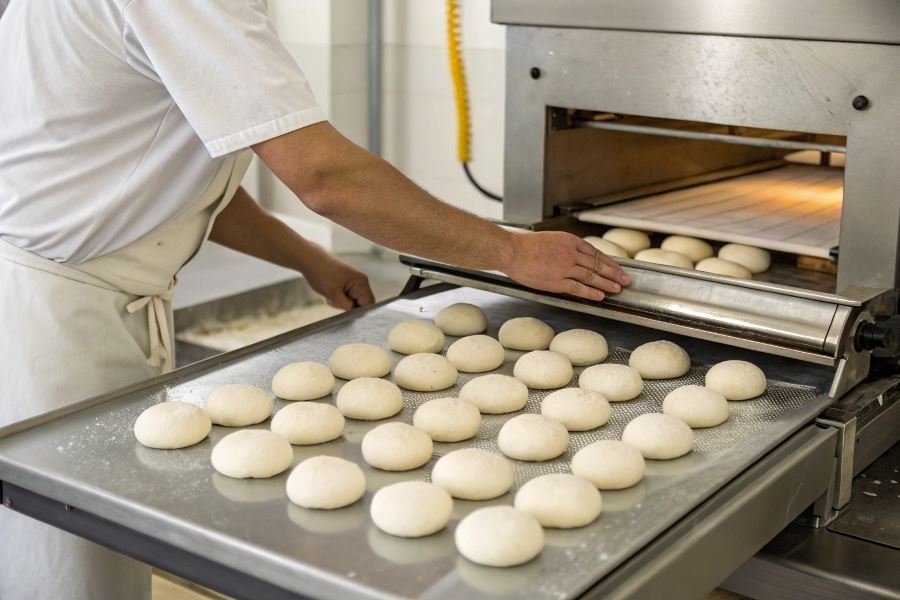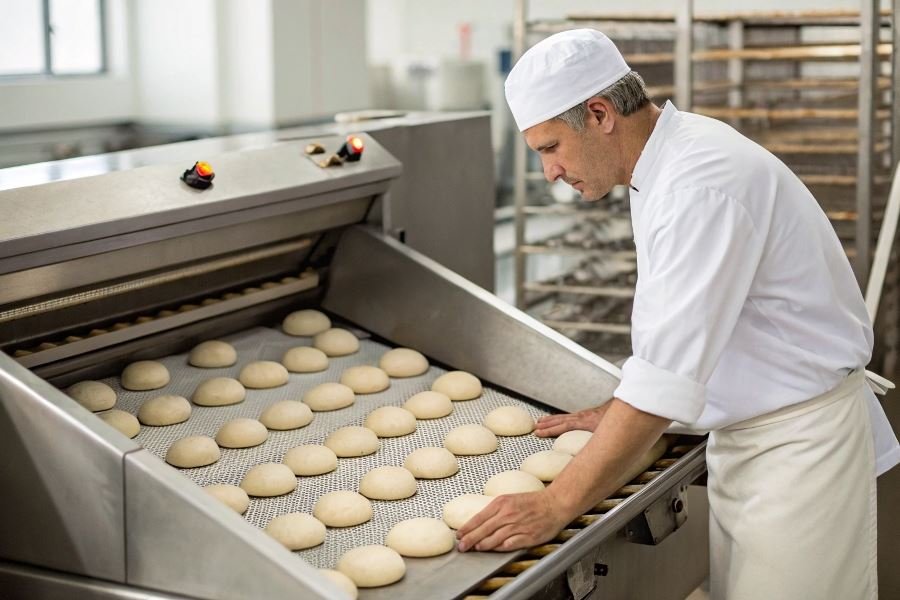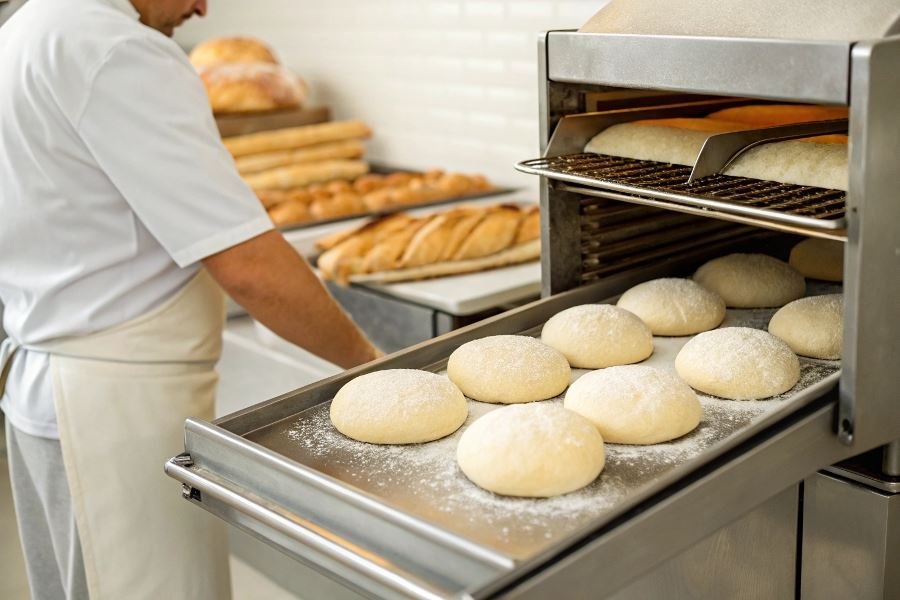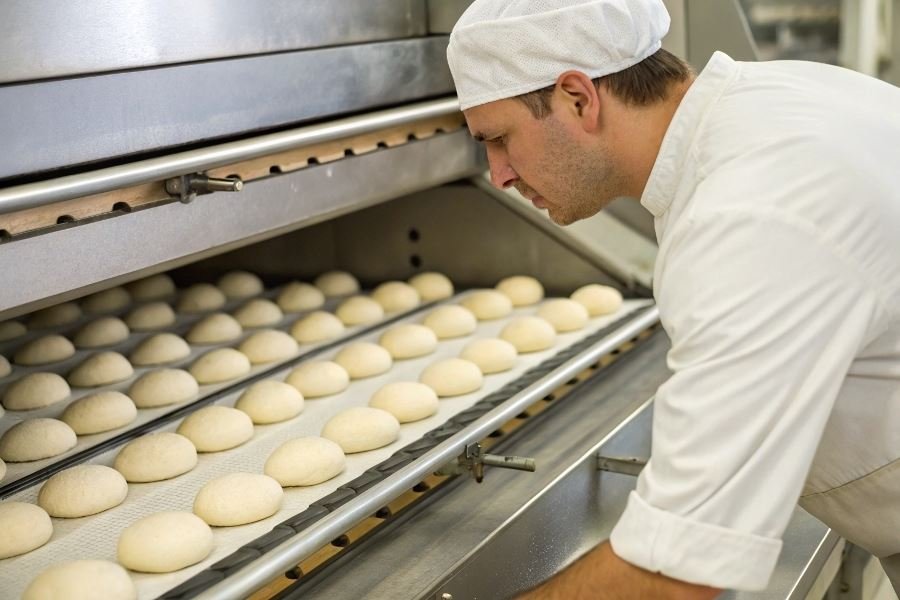
Ever watched a master baker transform a massive blob of dough into perfectly uniform rolls with mesmerizing speed? Behind this bakery magic often stands an unsung hero: the dough divider-rounder.
For commercial bakeries and confectionery operations, these specialized machines represent the critical intersection where precision meets productivity. A dough divider-rounder performs two essential functions simultaneously: it portions dough into precise weights and shapes these portions into smooth, consistent balls—all while maintaining the dough’s delicate structure and gas retention properties.
The journey to today’s sophisticated equipment tells a fascinating story of innovation. Early bakeries relied entirely on skilled hands and simple tools, with bakers developing an almost mystical ability to portion dough by feel. The first mechanical dividers appeared in the early 1900s, revolutionizing production capacity but often sacrificing dough quality. By the 1950s, hydraulic systems improved consistency, while the digital revolution of the 1990s introduced programmable controls that could handle multiple recipes.
“The right divider-rounder doesn’t just increase production—it elevates your entire product line.”
Selecting the appropriate divider-rounder impacts every aspect of a bakery’s operation. When properly matched to production needs, these machines deliver:
- Consistent product quality – Uniform size, shape, and weight create professional appearance and reliable baking times
- Reduced labor costs – Automating repetitive tasks allows skilled staff to focus on creative aspects
- Minimized waste – Precise portioning eliminates overages that eat into profit margins
- Increased production capacity – Output can increase 5-10 fold compared to manual methods
The criteria for choosing the ideal divider-rounder extend far beyond price point—they touch the very heart of what makes your bakery unique.
Technical Essentials for Your Perfect Dough Divider-Rounder
When investing in bakery equipment, the technical specifications of a dough divider-rounder can make or break your confectionery operation. These machines aren’t just metal workhorses—they’re precision instruments that directly impact your product quality, consistency, and ultimately, your bottom line.
Selecting the right equipment requires careful consideration of several technical factors. The criteria for choosing a dough divider-rounder for confectionery production should focus on three critical areas: production capacity, weight accuracy, and dough compatibility. Let’s dive into what makes these specifications so crucial for your operation.
Production Capacity That Matches Your Ambition
Your production needs should drive your equipment selection—not the other way around. Modern divider-rounders come with vastly different throughput capabilities:
- Entry-level models: 1,000-1,500 pieces per hour
- Mid-range equipment: 1,500-2,500 pieces per hour
- Industrial powerhouses: 3,000+ pieces per hour
The Adamatic ADR-2 exemplifies mid-range capacity with its 2,200 pieces per hour capability, making it ideal for growing bakeries. Meanwhile, the Koenig Minis can handle up to 4,000 pieces hourly for industrial-scale operations.
Wisdom nugget: Always purchase a divider-rounder with 20-30% more capacity than your current needs to accommodate business growth without immediate reinvestment.
Consider not just your daily production volume but also peak season demands. A machine running at 70-80% capacity typically delivers optimal performance and longevity.
Weight Accuracy That Delivers Consistency
Weight precision directly impacts product uniformity, customer satisfaction, and profitability. Modern divider-rounders offer different accuracy levels:
| Precision Level | Weight Variance | Typical Applications |
|---|---|---|
| Standard | ±3-5% | Rustic breads, large rolls |
| High | ±2-3% | Dinner rolls, burger buns |
| Premium | ±1-2% | Pastries, specialty confections |
The Glimek SD-180 offers exceptional ±1.5% accuracy across a weight range of 30-180g, making it perfect for precision confectionery work. For broader applications, the Benier Dough Ball Line handles weights from 25g to 300g with ±2% variance.
Weight range flexibility is equally important. Most bakeries need equipment that can handle multiple product lines. Look for machines offering:
- Minimum weight capabilities (often 25-30g for small pastries)
- Maximum weight capabilities (typically 150-300g for larger products)
- Quick changeover times between weight settings
Dough Compatibility That Embraces Versatility
Different confectionery products demand different dough formulations. Your divider-rounder must accommodate this variety without damaging the dough structure.
Hydration levels represent one of the most challenging variables. Premium equipment like the Rondo Dough-how Line can handle hydration ranges from 55% (stiff dough) to 80% (high-hydration dough) without adjustments.
Critical compatibility factors include:
- Ability to process enriched doughs (containing butter, eggs, sugar)
- Gentle handling for delicate doughs with minimal gluten development
- Temperature control to prevent dough warming during processing
- Quick-release surfaces for sticky, high-sugar formulations
The VMI Divider excels with its patented stress-free dividing system that preserves dough integrity across multiple formulations.
Remember that the most expensive divider-rounder isn’t necessarily the best—it’s the one that aligns perfectly with your specific production requirements, dough types, and quality standards.
The Smart Money Behind Your Dough Divider-Rounder
When investing in bakery equipment, the dough divider-rounder represents more than just another machine—it’s the heartbeat of your production line. Let’s dive into the business considerations that separate a strategic investment from an expensive mistake.
Beyond the price tag
The sticker shock of a premium divider-rounder can be intimidating—ranging from $8,000 for entry-level models to upwards of $50,000 for fully automated systems. But focusing solely on purchase price is a rookie mistake.
Total Cost of Ownership (TCO) encompasses the complete financial picture:
- Initial purchase price
- Installation and training costs
- Energy consumption (typically 1.5-5 kWh)
- Maintenance requirements
- Replacement parts availability
- Labor savings over time
The cheapest machine on day one often becomes the most expensive over a five-year period.
Consider this comparison of ownership costs:
| Cost Factor | Economy Model | Mid-Range | Premium Automated |
|---|---|---|---|
| Purchase | $8,000 | $22,000 | $48,000 |
| Annual Energy | $1,200 | $900 | $750 |
| Annual Maintenance | $1,800 | $1,200 | $900 |
| 5-Year TCO | $23,000 | $32,500 | $56,500 |
| Hourly Operating Cost | $4.60 | $3.25 | $2.82 |
Many Rondo and Koenig users report breaking even on premium equipment within 3-4 years through reduced labor and waste costs.
The spatial equation
Your production floor is valuable real estate. Modern divider-rounders vary dramatically in their footprint requirements:
Compact models occupy as little as 10 square feet, while industrial systems with conveyors and additional features can command 40+ square feet. Beyond the machine itself, you’ll need:
- Clearance space for operators (minimum 3 feet on working sides)
- Utility connections (power, sometimes water)
- Ingredient staging areas
- Product outfeed space
A machine that fits your space today but limits tomorrow’s growth becomes an obstacle, not an asset.
When planning facility integration, consider:
- Ceiling height clearance for taller models
- Floor load capacity for heavier units
- Proximity to other production equipment
- Workflow optimization
- Noise levels (especially important in retail settings)
The company behind the machine
The relationship with your equipment manufacturer extends far beyond the purchase transaction. Fritsch and Rheon have built reputations on responsive service networks.
Warranty terms vary significantly:
- Standard coverage ranges from 1-3 years
- Parts-only vs. parts-and-labor coverage
- On-site service vs. ship-to-repair options
- Emergency service response times
After-sales support separates industry leaders from the pack:
- Availability of technicians in your region
- Spare parts inventory and shipping times
- Technical phone support hours
- Training programs for new staff
- Software updates for computerized models
The true value of manufacturer support becomes apparent at 2 AM when production has stopped and orders are due at sunrise.
Before finalizing any purchase, speak with multiple current users of the equipment. Their real-world experiences will reveal more about long-term satisfaction than any sales brochure ever could.
Discover the 7 essential criteria for selecting the ideal bakery divider-rounder for your confectionery business. Learn how to evaluate production capacity, dough compatibility, and cost-effectiveness to maximize quality and efficiency.
Discover the 7 essential criteria for selecting the ideal bakery divider-rounder for your confectionery business. Learn how to evaluate production capacity, dough compatibility, and cost-effectiveness to maximize quality and efficiency.