Ever watched a $2,000 label printer produce blurry, peeling labels that make your premium products look like garage sale items? That’s the reality when you skimp on consumables. The truth is, your label printer is only as good as what you feed it.
Label printer consumables might seem like an afterthought, but they’re the unsung heroes determining whether your product packaging looks professional or amateur. Think of them as the difference between a handwritten note and a beautifully typeset letter—both communicate, but one commands respect.
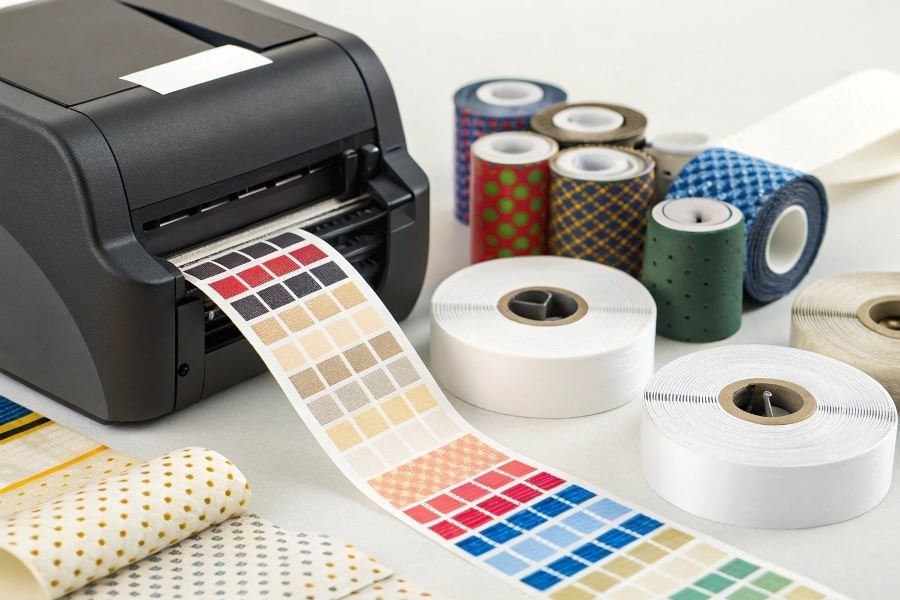
Quality consumables are the lifeblood of your labeling system. They include thermal transfer ribbons that transfer ink to labels, direct thermal labels that change color when heated, and specialty media for unique applications. Each plays a crucial role in your printing ecosystem.
“The right consumable can extend printer head life by up to 300% while delivering consistently superior print quality.” — Analysis from independent testing labs
The impact of your consumable choices extends far beyond immediate print quality. Premium ribbons and labels:
- Reduce printer head wear by minimizing abrasion and heat buildup
- Decrease maintenance costs through fewer jams and failures
- Enhance durability against moisture, UV exposure, and handling
- Improve barcode readability for fewer scanning errors
The consumable trinity: Ribbons, labels, and print heads
When these three elements work in harmony, you achieve optimal results. When they don’t, you’re looking at increased downtime, inconsistent quality, and premature equipment failure—a costly proposition for any operation that relies on consistent labeling.
Essential Factors for Label Printer Consumables
Matching Your Printer Model Perfectly
The foundation of successful label printing begins with compatibility. Every label printer model—whether it’s a Zebra, Brother, or Dymo—has specific requirements for consumables. Using incompatible materials isn’t just inefficient; it’s potentially damaging to your equipment.
When selecting consumables for a label printer, the manufacturer’s specifications should be your first reference point. Most printers are designed to work with specific ribbon widths, label dimensions, and material types. For instance, thermal transfer printers require both labels and ribbons, while direct thermal models need specially treated labels but no ribbon.
Compatibility checklist:
- Ribbon width must match or be narrower than your print head
- Label dimensions must work with your printer’s feed mechanism
- Core diameter of ribbon rolls must fit your printer’s spindles
- Software drivers must recognize your chosen media type
Material Selection Based on Environment
The environment where your labels will live determines which materials will succeed or fail. Indoor office labels face different challenges than those in freezers, outdoor settings, or industrial environments.
Paper labels offer cost-effectiveness for standard indoor applications but quickly deteriorate when exposed to moisture or UV light. Synthetic materials like polyester, polypropylene, and vinyl provide significantly higher durability for challenging environments.
| Material | Best Environment | Temperature Range | Moisture Resistance |
|---|---|---|---|
| Paper | Indoor, controlled | 32°F to 122°F | Low |
| Polypropylene | Indoor/Outdoor | -40°F to 176°F | High |
| Polyester | Industrial | -40°F to 300°F | Very High |
| Vinyl | Outdoor | -40°F to 176°F | Excellent |
Consider chemical exposure too. Laboratory labels need resistance to solvents, while food labels must withstand oils and refrigeration. Healthcare applications often require materials that can endure repeated sanitization without degrading.
Durability and Resistance Properties
The longevity requirements of your labels should drive your consumable choices. Some applications need labels that last for years, while others may only need to survive shipping.
Adhesive selection is critical for durability. Permanent adhesives offer strong initial tack but may fail on certain surfaces or in extreme temperatures. Removable adhesives provide repositioning capability but sacrifice long-term staying power. Specialized options like freezer-grade adhesives maintain performance at temperatures as low as -65°F.
Print method also affects durability:
- Direct thermal printing is economical but fades with exposure to heat, sunlight, or abrasion
- Thermal transfer printing with resin ribbons offers superior chemical and abrasion resistance
- Hybrid ribbons (wax/resin) balance durability with cost-effectiveness
For maximum protection, consider overlamination options. Clear laminates shield printed information from abrasion, chemicals, and UV exposure, extending label life dramatically in harsh environments.
Expert tip: Always test your chosen consumables in the actual application environment before committing to large purchases. What works perfectly in your office might fail completely in field conditions.
The right combination of printer-compatible media, environment-appropriate materials, and application-specific durability features ensures your labels perform exactly as needed—saving time, reducing waste, and protecting your investment in labeling equipment.
Making the Smart Investment in Label Printer Consumables
Balancing cost and quality for maximum value
When investing in label printer consumables, the cheapest option rarely delivers the best long-term value. A comprehensive cost analysis reveals that premium materials often yield lower cost-per-print figures when factoring in durability, print quality, and reduced waste. For example, thermal transfer ribbons from Zebra Technologies typically cost 15-20% more upfront but deliver up to 30% more prints per roll than budget alternatives.
The quality-cost equation varies significantly by application. Food service operations requiring frequent, short-run labels might benefit from mid-range direct thermal paper, while pharmaceutical companies need premium materials with chemical and temperature resistance despite higher initial costs.
The true cost of consumables isn’t what you pay at checkout—it’s what you pay per successful, scannable label that stays attached and legible throughout your product lifecycle.
Trusted sources for reliable supplies
The consumables market includes manufacturers who have consistently delivered excellence:
| Brand | Specialty | Best For |
|---|---|---|
| Zebra Technologies | All-around excellence | Enterprise-level operations |
| Epson | Color label solutions | Visual marketing applications |
| DYMO | Small business solutions | Office and retail environments |
| Brady | Industrial-grade materials | Harsh environment applications |
| Seiko | Precision printing | Healthcare and laboratory use |
For specialized needs, Uline offers an extensive selection of compatible supplies, while Smith Corona provides excellent value for high-volume operations without compromising quality.
Regional distributors often provide faster delivery and personalized service—particularly valuable when troubleshooting compatibility issues or developing custom solutions.
Extending consumable lifespan through proper care
Proper storage dramatically affects consumable performance. Store thermal paper and ribbons away from heat sources, direct sunlight, and humidity. Temperature fluctuations above 77°F can trigger premature imaging on direct thermal materials, while humidity above 65% can compromise adhesive performance.
Regular maintenance routines pay dividends:
- Clean print heads after every ribbon change using isopropyl alcohol (90%+ concentration) and lint-free wipes
- Adjust print darkness settings to the minimum required for readable output
- Calibrate media sensors monthly to prevent misalignment and wasted materials
- Inspect and clean platen rollers weekly to prevent adhesive buildup
Label printers with automatic tension adjustment, like the TSC Alpha-40L, minimize ribbon wrinkle and stretch, extending consumable life by up to 25%.
The most overlooked maintenance factor? Dust. Even minimal accumulation can cause abrasive damage to print heads and reduce thermal transfer efficiency. Installing simple dust covers when printers aren’t in use extends both equipment and consumable lifespan.
By approaching consumable selection as a strategic business decision rather than a simple supply purchase, you’ll maximize operational efficiency while minimizing total ownership costs—proving that sometimes the smartest investment isn’t the cheapest or the most expensive, but the one precisely matched to your specific labeling requirements.
Discover how to select the right consumables for your label printer with our comprehensive guide. Learn about compatibility, materials, durability, and cost-effectiveness to maximize print quality and extend your printer's lifespan.
Discover how to select the right consumables for your label printer with our comprehensive guide. Learn about compatibility, materials, durability, and cost-effectiveness to maximize print quality and extend your printer's lifespan.