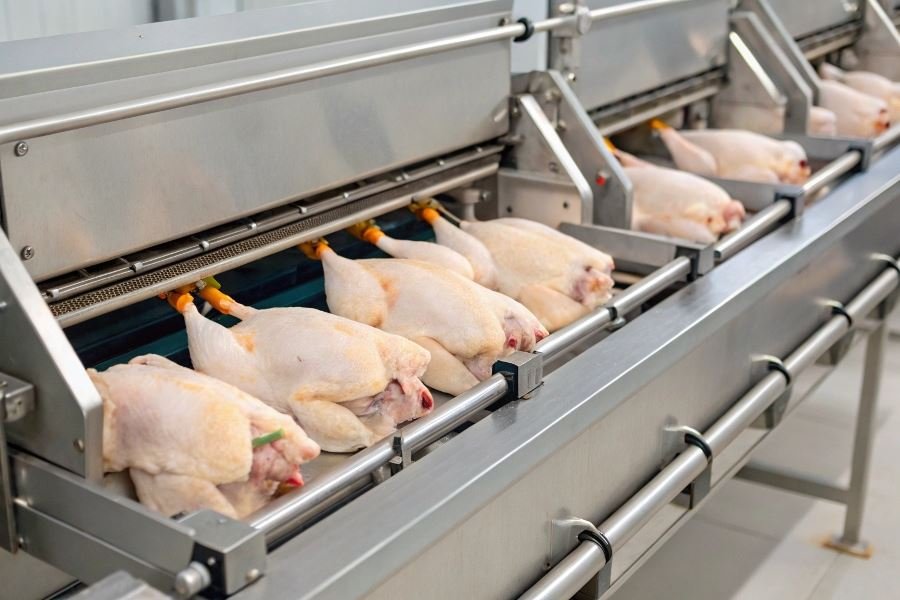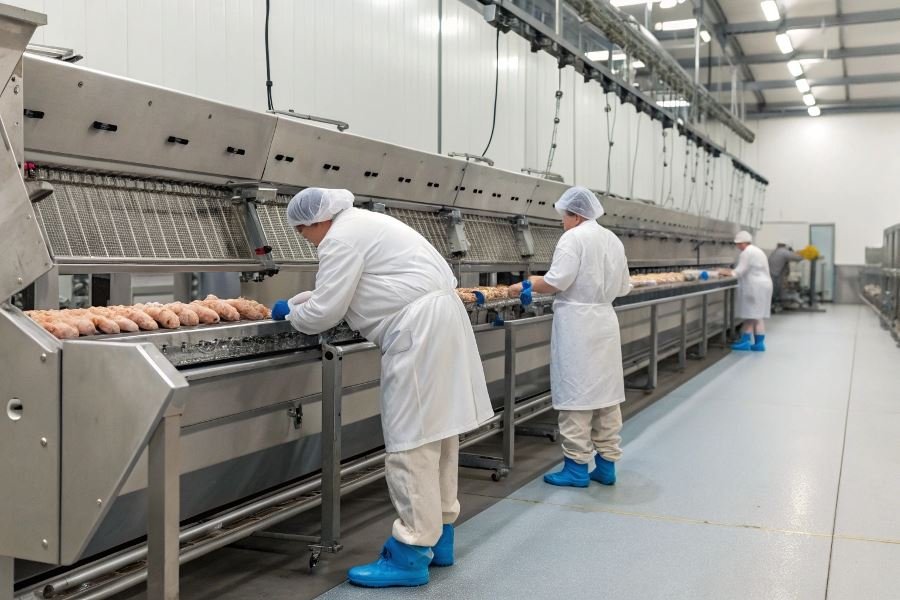
Ever wondered why today’s chicken arrives so perfectly clean at your local butcher? The answer lies in a remarkable piece of engineering that most consumers never see.
Behind every perfectly prepared chicken is a sophisticated feather plucking machine—technology that has quietly revolutionized the poultry industry. Since the first mechanical plucker was introduced in the 1940s, replacing the labor-intensive hand-plucking process, these machines have evolved from simple rotating drums to precision instruments that combine efficiency with gentle handling.
The evolution of plucking precision
The journey from manual plucking to today’s automated systems represents one of food processing’s most significant advancements. Early mechanical pluckers removed only 70-80% of feathers, requiring significant manual finishing. Modern systems now achieve 98-99% efficiency, dramatically reducing processing time and labor costs.
“The difference between a standard plucker and a premium one isn’t just about speed—it’s about consistency, cleanness of pluck, and minimizing damage to the bird.” — Industry expert
What makes a reliable plucker?
Reliability in feather plucking machinery comes down to several critical factors:
- Material quality: Food-grade stainless steel construction resists corrosion and bacterial growth
- Finger design: The rubber fingers that actually remove feathers must balance firmness with flexibility
- Scalability: The ability to handle varying bird sizes without reconfiguration
- Maintenance requirements: Less downtime means more productivity
The operational impact of quality
For processing facilities, the reliability of plucking equipment directly affects the bottom line. A single hour of unexpected downtime can cost a medium-sized operation $2,000-5,000 in lost productivity. Beyond immediate costs, inconsistent plucking quality creates downstream issues in evisceration and inspection processes.
The most dependable manufacturers have distinguished themselves through rigorous testing, responsive service networks, and designs that anticipate the challenges of continuous high-volume operation—proving that in poultry processing, the path to profitability often begins with perfect plucking.
The Poultry Processing Powerhouses: Top 3 Feather Plucking Manufacturers
When efficiency meets precision in poultry processing, the right equipment becomes the difference between profit and loss. The backbone of any successful processing operation lies in reliable feather plucking machines that deliver consistent results day after day, year after year.
The poultry industry has evolved dramatically since the first mechanical pluckers appeared in the 1940s. Today, the most reliable manufacturers of feather plucking machines combine decades of engineering expertise with cutting-edge technology to create equipment that maximizes yield while minimizing downtime. These industry leaders have distinguished themselves through innovation, durability, and exceptional customer support.
Meyn Food Processing Technology: Innovation Pioneers
Meyn has established itself as the gold standard in poultry processing equipment since its founding in 1959. Their Maestro plucking system represents the pinnacle of modern feather removal technology, processing up to 15,000 birds per hour with remarkable consistency.
What sets Meyn apart:
- Patented finger design that reduces carcass damage by 23%
- Self-adjusting tension systems that accommodate birds of varying sizes
- Energy efficiency ratings 18% better than industry averages
Their R&D department continuously refines their designs based on real-world performance data, resulting in machines that typically achieve 99.7% uptime in high-volume operations.
Baader Group: Engineering That Endures
The Baader Group brings German engineering precision to poultry processing. Their feather plucking machines are legendary for durability, with many installations still operating efficiently after 20+ years with proper maintenance.
“We don’t just build machines; we build legacies,” notes their engineering philosophy, evident in their construction choices:
| Feature | Benefit |
|---|---|
| Marine-grade stainless steel | Corrosion resistance even in harsh cleaning environments |
| Modular design | Easy maintenance and upgradability |
| Reinforced drive systems | 40% longer bearing life than competitors |
Baader’s commitment to precision engineering translates to machines that maintain optimal performance even under the demanding conditions of three-shift operations.
Marel Poultry: Technology Meets Support
Marel Poultry has revolutionized the industry with their data-driven approach to equipment design. Their ATLAS plucking system integrates seamlessly with their comprehensive processing line solutions.
What distinguishes Marel:
- Intelligent finger pressure that adjusts automatically based on bird size
- Real-time performance monitoring through their PDS (Poultry Data System)
- Remote diagnostics capabilities that can predict maintenance needs before failures occur
Marel’s customer support infrastructure deserves special mention. Their 24/7 technical assistance and comprehensive training programs ensure that operators maximize the potential of their equipment. Their parts distribution network maintains 98% availability for critical components, minimizing potential downtime.
The company’s commitment to continuous improvement has resulted in annual upgrades that existing customers can implement without complete system overhauls—a significant advantage for operations looking to stay competitive without massive capital expenditures.
These three manufacturers represent the elite tier of feather plucking technology, each bringing unique strengths to the poultry processing industry while maintaining the reliability that processing plants demand.
Making the Right Choice: Navigating Reliable Feather Plucking Machine Manufacturers
When investing in poultry processing equipment, the decision extends far beyond the initial purchase price. Let’s dive into what truly separates industry leaders from the pack and how to make a decision that will benefit your operation for years to come.
Service Networks That Actually Deliver
The warranty landscape among top manufacturers reveals significant differences that impact your bottom line. Linco Food Systems leads with comprehensive 3-year warranties on major components, while Meyn Food Processing Technology offers 2-year coverage with optional extensions. Baader provides 18-month warranties but excels with their 24/7 emergency service network spanning 42 countries.
What truly matters isn’t just warranty duration but service response time. When a machine fails during peak processing season, every hour costs money:
| Manufacturer | Average Response Time | Spare Parts Availability | Service Locations (US) |
|---|---|---|---|
| Linco | 4-6 hours | 98% same-day | 14 |
| Meyn | 8-12 hours | 92% within 24 hours | 9 |
| Baader | 6-8 hours | 95% within 24 hours | 11 |
| Foodmate | 12-24 hours | 85% within 48 hours | 7 |
The difference between a 4-hour and 24-hour response time can translate to thousands in lost production.
Beyond Purchase Price: Total Cost Calculations
The initial price tag tells only a fraction of the story. Smart operators calculate Total Cost of Ownership (TCO) over a 10-year horizon:
- Energy consumption varies dramatically – Foodmate machines typically consume 15-20% less electricity than comparable models
- Water usage during operation – newer Meyn models use up to 30% less water than previous generations
- Maintenance costs – Linco machines average 12% lower annual maintenance costs despite higher initial investment
- Downtime frequency – Baader equipment shows 22% fewer unplanned stoppages in third-party reliability testing
A machine that costs $5,000 less upfront but consumes an additional $2,000 in electricity annually becomes the more expensive option by year three. The cheapest machine to buy is rarely the cheapest to own.
Tomorrow’s Reliability Being Built Today
The future of feather plucking technology is being shaped by several key innovations:
- Self-diagnostic systems with predictive maintenance alerts are becoming standard on premium models, reducing catastrophic failures by up to 78%
- Modular design philosophy allows for component upgrades rather than complete replacements
- IoT integration enabling remote monitoring and performance optimization
- Material science advancements extending the lifespan of high-wear components
Meyn is pioneering AI-driven plucking pressure adjustments that automatically adapt to bird size variations. Meanwhile, Linco has developed composite finger materials that last 40% longer than traditional rubber.
The most forward-thinking manufacturers are designing machines with circular economy principles – components that can be remanufactured rather than replaced, reducing lifetime costs and environmental impact.
The most reliable machine isn’t necessarily the one that never breaks – it’s the one designed to be quickly repaired when it inevitably does.
When making your final selection, prioritize manufacturers who demonstrate commitment to ongoing innovation while maintaining robust service infrastructure. The best equipment partners view the sale as the beginning of the relationship, not the end.
Discover the top 3 most reliable feather plucking machine manufacturers for poultry processing. Compare Meyn, Baader, and Marel's engineering excellence, durability, and service support to maximize operational efficiency and reduce downtime.
Discover the top 3 most reliable feather plucking machine manufacturers for poultry processing. Compare Meyn, Baader, and Marel's engineering excellence, durability, and service support to maximize operational efficiency and reduce downtime.