
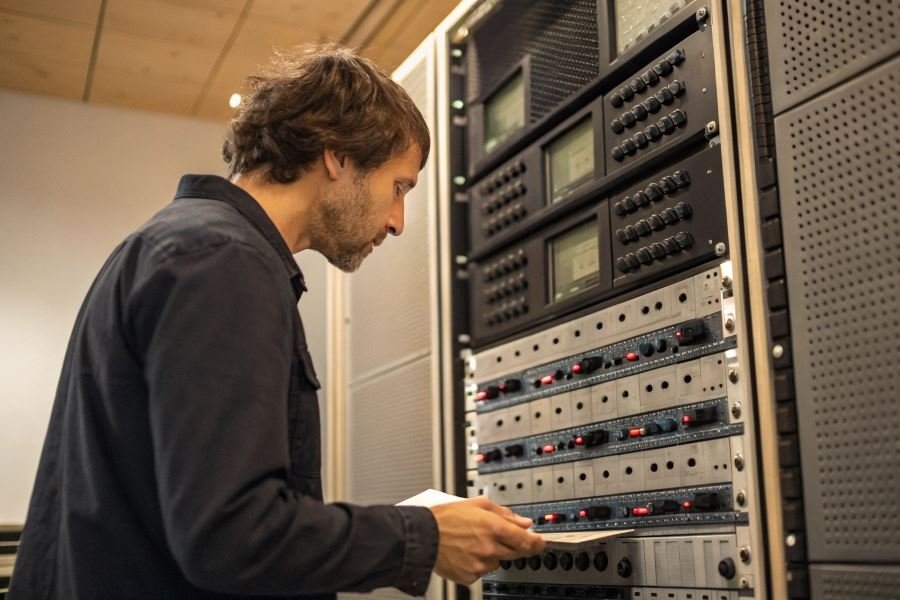
That pop, that hiss, that mysterious buzz destroying your perfect take? It’s not your microphone—it’s your power. In recording studios where milliseconds and microdetails make the difference between amateur and professional results, electricity quality isn’t just a technical footnote—it’s the foundation everything else builds upon.
When selecting power distribution for your recording sanctuary, you’re not just buying a fancy surge protector. You’re investing in the invisible architecture that protects $10,000+ worth of sensitive equipment while simultaneously ensuring your recordings remain pristine and noise-free.
The audio quality connection
Clean power translates directly to cleaner recordings. Period. Studio-grade power distributors eliminate common electrical enemies like:
- Ground loops causing that infamous 60Hz hum
- Voltage fluctuations that stress sensitive preamps and converters
- EMI/RFI interference that sneaks into your signal chain
The studio power battlefield
Recording environments face unique electrical challenges. Your vintage tube microphone preamp sits mere feet from computers, hard drives, and digital processors—all generating electromagnetic noise. Meanwhile, the building’s HVAC system, fluorescent lighting, and even the coffee maker in the lounge create power demands that cause voltage sags exactly when your monitoring system needs stable current.
Equipment protection beyond the basics
Professional power distributors don’t just filter noise—they provide comprehensive protection through:
“After lightning struck near our studio and fried $7,000 worth of equipment despite having ‘surge protectors,’ I learned the hard way that not all power protection is created equal.” — Veteran producer
The right power distributor becomes the silent guardian of your creative space, ensuring both sonic purity and equipment longevity.
Essential Factors for Studio Power Distribution
When setting up a recording studio, the power distribution system forms the backbone of your entire operation. Professional studios require clean, consistent power to capture pristine audio without unwanted noise or equipment damage. Selecting the right power distributor involves understanding several critical specifications that directly impact your recordings.
The process of how to choose a power distributor for a recording studio requires balancing technical requirements with practical considerations. Engineers often overlook power management until they encounter issues like ground loops or equipment failures. A thoughtful approach to power distribution can prevent these problems before they arise.
Power Capacity and Outlet Configuration
Your power distributor must handle the combined load of all studio equipment without approaching its maximum capacity. Professional recording setups typically require:
- Minimum 15-20 amps for small project studios
- 20-30 amps for mid-sized facilities
- Multiple 20-amp circuits for commercial studios
The number and type of outlets matter significantly. Look for:
| Feature | Benefit |
|---|---|
| Individual switching | Power up equipment in proper sequence |
| Spaced outlets | Accommodate bulky power adapters |
| Rear and front outlets | Flexible installation options |
| Sequential power-up | Protect sensitive equipment from inrush current |
Furman PL-PLUS C power conditioners offer excellent outlet configuration with individual switches, while Monster Pro 3500 provides high-capacity options for larger studios.
Noise Filtering and Isolation Technology
Studio-grade power distributors must eliminate electromagnetic interference (EMI) and radio frequency interference (RFI) that can manifest as audible noise in recordings.
Superior filtering technology separates professional units from consumer-grade power strips.
Effective noise filtering includes:
- Multi-stage filtering that targets different frequency ranges
- Isolation transformers that physically separate your equipment from the main power grid
- Common-mode rejection capabilities of at least 60dB
- Differential-mode filtering to eliminate noise between line and neutral
The Furman Elite-15 PFi incorporates Linear Filtering Technology that reduces noise without limiting current to power-hungry amplifiers. For ultimate isolation, Torus Power units feature toroidal isolation transformers that create a physical barrier between wall power and your equipment.
Surge Protection Ratings and Response Time
Power surges can instantly destroy expensive studio equipment. Professional-grade protection requires:
- Joule ratings of at least 1000 joules (higher is better)
- Response times under 1 nanosecond
- Multi-stage protection with sacrificial components
- Automatic shutdown when protection is compromised
The best surge protectors don’t just absorb surges—they disconnect your equipment entirely when dangerous voltage levels are detected.
Look for units with Series Mode Protection rather than standard MOV (Metal Oxide Varistor) technology. Series Mode systems, like those in SurgeX products, eliminate surges without producing ground contamination and offer longer service life.
The API PowerWedge combines exceptional surge protection with audio-focused filtering, making it particularly suitable for analog recording equipment that’s sensitive to power fluctuations.
Investing in quality power distribution isn’t merely about protection—it’s about creating the optimal foundation for capturing flawless audio in your studio environment.
Critical Power Features That Define Studio Excellence
Sequential Power-Up/Down: The Unsung Hero
Professional recording studios represent a delicate ecosystem where equipment worth thousands of dollars operates in perfect harmony. At the heart of this system lies sequential power-up/down functionality—a feature that prevents potentially catastrophic power surges when equipment is turned on simultaneously.
When you power up multiple devices at once, the initial current draw (inrush current) can be 3-10 times higher than normal operating current. This momentary spike can damage sensitive preamps, converters, and other studio equipment. Sequential power distributors eliminate this risk entirely by powering up each connected device in a predetermined sequence, typically with 1-3 second delays between outlets.
The benefits extend beyond equipment protection:
- Prevents circuit breaker trips from combined inrush current
- Reduces wear on power supplies in expensive equipment
- Creates a systematic, repeatable startup procedure
Premium models like the Furman P-1800 AR offer programmable delay sequences, allowing engineers to customize power-up order based on signal chain requirements—powering up preamps before interfaces, interfaces before monitors, and so on.
Voltage Regulation: Consistency in an Inconsistent World
Studio equipment performs optimally when supplied with clean, consistent power. Voltage regulation systems maintain stable output regardless of input fluctuations, ensuring your gear receives exactly what it needs.
Voltage irregularities can manifest as subtle but recordable artifacts in your audio chain, particularly in analog equipment.
| Regulation Type | Protection Level | Typical Price Range |
|---|---|---|
| Basic Filtering | Minimal | $100-300 |
| True Regulation | ±5V stability | $400-800 |
| Advanced AVR | ±2V with waveform correction | $800-1500+ |
The most sophisticated units, like the Monster Power HTS 5100, employ Automatic Voltage Regulation (AVR) technology that continuously monitors incoming voltage and makes real-time adjustments. These systems include digital displays showing current voltage readings, allowing engineers to verify power quality at a glance.
Grounding Options: The Foundation of Noise-Free Recording
Perhaps the most critical yet overlooked feature in studio power distribution is proper grounding and isolation. Ground loops—caused when equipment connects to ground through multiple paths—create the infamous 60Hz hum that can ruin otherwise perfect recordings.
Isolation transformers physically separate your equipment from the power grid, breaking ground loops while maintaining safety. High-end power distributors incorporate multiple isolation banks, allowing digital and analog equipment to be properly segregated.
Advanced grounding features to look for include:
- Balanced power outputs (60V leg-to-ground instead of 120V/0V)
- Ground lift switches for problematic equipment
- Star-grounding architecture that minimizes potential differences
- Dedicated technical ground connections
The Radial Engineering Tonebone Power-2 exemplifies this approach with isolated outlet banks specifically designed for sensitive preamps and converters, plus additional filtering for digital equipment.
When evaluating grounding options, remember that proper implementation is as important as the technology itself. The best power distributors provide comprehensive documentation on optimal connection strategies for different studio configurations.
Discover how to select the ideal power distributor for your recording studio that delivers clean power, protects equipment, and enhances audio quality. Learn about essential features including noise filtering, surge protection, and voltage regulation for professional results.
Discover how to select the ideal power distributor for your recording studio that delivers clean power, protects equipment, and enhances audio quality. Learn about essential features including noise filtering, surge protection, and voltage regulation for professional results.


