
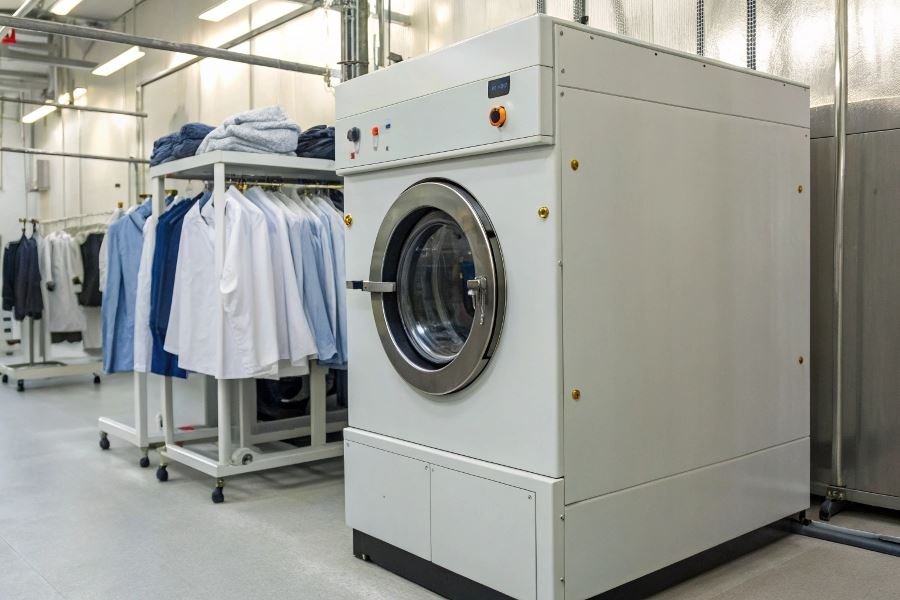
Ever walked into a dry cleaning shop and noticed how every square inch matters? Behind the counter, a ballet of efficiency unfolds where space constraints meet business necessities. For small dry cleaning operations, this dance has become increasingly challenging.
The typical small dry cleaner today operates in approximately 800-1,200 square feet—often in prime retail locations where rent can exceed $30 per square foot annually. That’s potentially $36,000 yearly just to keep your doors open before a single garment is cleaned! This economic reality has transformed compact equipment from a luxury to an absolute necessity.
Traditional drying machines once dominated the industry with their bulky footprints and energy-hungry operations. Now, a new generation of compact drying solutions is changing the game. These space-efficient marvels deliver professional-grade performance while occupying up to 40% less floor space than their predecessors.
The technological evolution has been remarkable. Modern compact dryers incorporate advanced moisture sensors that prevent over-drying, microprocessor controls that optimize energy usage, and specialized drum designs that maximize airflow even in smaller dimensions. Some cutting-edge models even feature stackable configurations, effectively doubling capacity without expanding horizontal footprint.
For small business owners, these innovations translate directly to operational flexibility. A dry cleaner in Manhattan recently shared how switching to compact equipment allowed them to add a pressing station that increased their service offerings by 30%—all without expanding their storefront.
The message is clear: in the dry cleaning business, thinking small might be the biggest business decision you’ll make.
Game-Changing Compact Dryers for Small Dry Cleaners
Small dry cleaning businesses face unique challenges in urban environments where every square foot counts. The right compact drying machine can transform your operation, boosting efficiency while maintaining quality. Let’s dive into the most innovative solutions that are revolutionizing the industry.
When evaluating compact drying machines for small dry cleaners, the overview of solutions reveals three distinct categories that address different business priorities: space optimization, energy efficiency, and multifunctionality. Each represents a different approach to solving the fundamental challenges of modern dry cleaning operations.
Space-Saving Ventless Wonders
Urban dry cleaners operating in premium real estate know that space equals money. Ventless condensing dryers offer the perfect solution by eliminating the need for external venting infrastructure.
The Miele PT 8257 WP stands out with its remarkably small 4.6 sq ft footprint while delivering 25 lb capacity. Its closed-loop system recirculates heated air, extracting moisture without external ducting requirements.
Similarly, the Girbau ED340 provides impressive performance in tight spaces, featuring:
- 30 lb capacity in just 5.2 sq ft of floor space
- Integrated moisture sensing technology
- Programmable drying cycles for different fabric types
Key advantage: These units can be installed virtually anywhere, even in basement locations or interior rooms where traditional venting would be impossible.
Eco-Friendly Heat Pump Systems
Heat pump technology has revolutionized drying efficiency, reducing energy consumption by up to 60% compared to conventional systems.
The Schulthess Spirit topLine Pro 9240 exemplifies this technology with:
- 40% faster drying cycles than previous models
- Energy efficiency rating of A+++
- Smart moisture detection to prevent over-drying
For businesses prioritizing sustainability, the Electrolux Professional EcoDryer delivers exceptional results with its closed-loop heat recovery system that captures and reuses thermal energy.
| Model | Energy Consumption | Capacity | Recovery Time |
|---|---|---|---|
| Schulthess Spirit | 1.8 kWh/cycle | 24 lbs | 35 minutes |
| Electrolux EcoDryer | 2.1 kWh/cycle | 30 lbs | 40 minutes |
| Industry Average | 5.2 kWh/cycle | 25 lbs | 45 minutes |
These systems typically pay for themselves within 24-36 months through energy savings alone, making them financially sound investments for forward-thinking businesses.
Multi-Function Marvels
The ultimate space-maximizers are integrated systems that combine drying with finishing capabilities.
The Unimac FCU Series represents the pinnacle of this approach, featuring:
- Combined drying and finishing in one compact unit
- Wrinkle-prevention technology
- Programmable finishing cycles for different garment types
- 40% smaller footprint than separate machines
Game-changer alert: The Sankosha SDU-1200U takes integration further by incorporating a shirt finishing function directly into the drying process, eliminating an entire step in your workflow.
These multi-function systems deliver exceptional ROI for small operations by reducing labor costs and increasing throughput without expanding your footprint. One owner reported processing 35% more garments after upgrading to an integrated system, all while using the same floor space.
By selecting the right compact drying solution for your specific business needs, you’ll position your dry cleaning operation for maximum efficiency and profitability in today’s competitive market.
Maximizing ROI with Compact Drying Solutions
Small dry cleaning operations face a perpetual challenge: delivering professional results with limited square footage. Compact drying machines represent a potential game-changer, but implementing these solutions requires strategic planning and careful analysis. Let’s dive into the financial implications, space considerations, and maintenance realities that determine whether these space-saving marvels are right for your business.
The dollars and sense of compact drying
The financial equation of compact vs. traditional drying equipment extends far beyond the initial price tag. A comprehensive cost-benefit analysis reveals several key factors:
Initial investment vs. operational savings
Compact dryers from manufacturers like Miele Professional typically command a 15-30% premium over their full-sized counterparts. However, this upfront cost difference often dissolves when factoring in:
- Energy efficiency improvements of 20-35% with newer compact models
- Reduced utility costs from smaller heating elements
- Lower installation expenses due to simplified ventilation requirements
The true cost of drying equipment isn’t what you pay at purchase—it’s what you pay every month for the next decade.
For a small operation processing 30-50 loads weekly, the energy savings alone can recoup the price difference within 18-24 months.
Space optimization strategies
The physical implementation of compact drying solutions demands thoughtful planning:
Vertical thinking pays dividends
Modern compact dryers can be stacked or wall-mounted, transforming unused vertical space into productive assets. Key installation considerations include:
| Installation Type | Space Saved | Weight Requirements | Ventilation Needs |
|---|---|---|---|
| Stacked units | 50% floor space | Reinforced flooring (400+ lbs) | 6″ clearance minimum |
| Wall-mounted | 100% floor space | Structural wall support | Side venting capability |
| Side-by-side | 30% vs. traditional | Standard flooring | Standard rear venting |
Ventilation innovations
Condensing dryers from Electrolux Professional eliminate traditional venting requirements, opening installation possibilities previously impossible in historic buildings or shared commercial spaces.
Utility connections
Compact equipment often requires standard 220V outlets rather than specialized industrial connections, potentially eliminating costly electrical upgrades for smaller operations.
Maintenance realities and longevity expectations
The compact format introduces specific maintenance considerations that impact total ownership costs:
Component accessibility
Densely packed components in compact models can complicate certain repairs. However, manufacturers like Speed Queen have addressed this with modular designs allowing front-panel access to critical components.
Lifecycle expectations
Modern compact commercial dryers typically deliver:
- 15,000-20,000 operating hours (vs. 25,000+ for full-sized units)
- 7-10 year service life with proper maintenance
- Comparable parts availability to standard models
Preventative maintenance imperatives
The confined spaces of compact dryers make regular maintenance non-negotiable:
- Lint removal from condensers and heat exchangers (daily)
- Bearing lubrication (quarterly)
- Belt tension checks (monthly)
- Moisture sensor calibration (bi-annually)
Implementing these maintenance protocols can extend equipment life by 30-40%, dramatically improving lifetime value calculations.
The compact drying revolution offers compelling advantages for space-constrained operations, but success depends on thoughtful implementation strategies that balance immediate space benefits against long-term operational considerations.
Discover space-saving, energy-efficient drying solutions transforming small dry cleaning businesses. Compare ventless condensing dryers, heat pump systems, and multi-function equipment to maximize limited space while reducing operational costs.
Discover space-saving, energy-efficient drying solutions transforming small dry cleaning businesses. Compare ventless condensing dryers, heat pump systems, and multi-function equipment to maximize limited space while reducing operational costs.


