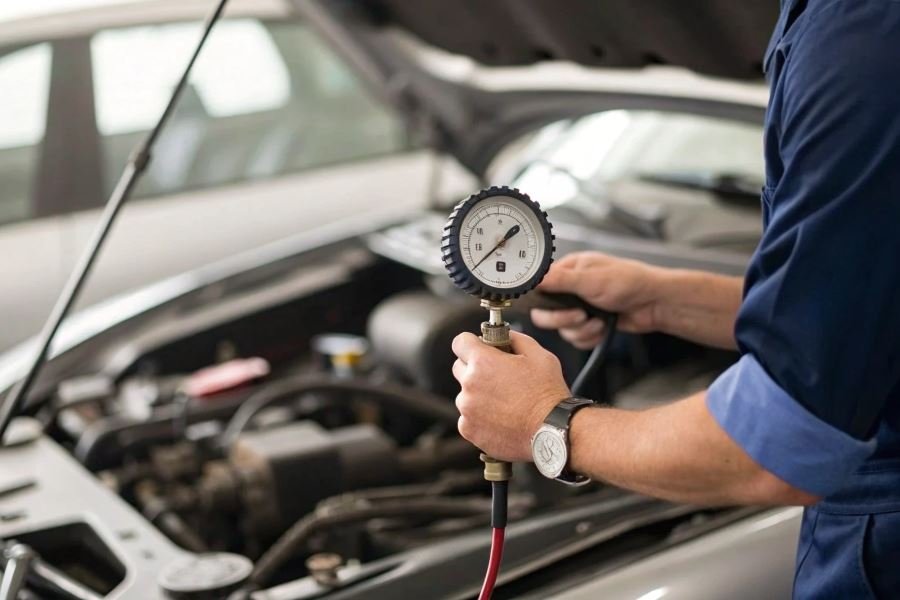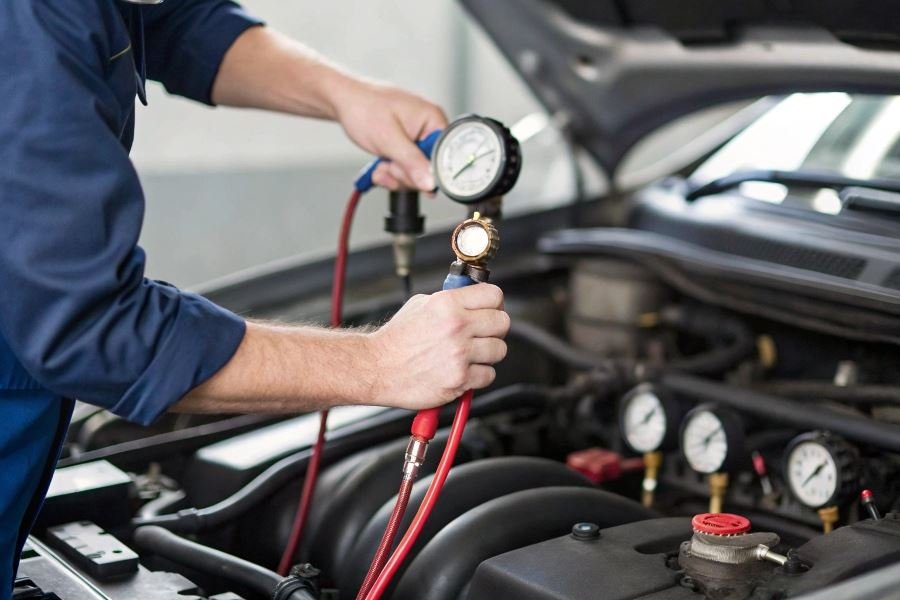
Ever wondered why some mechanics can diagnose engine problems with almost supernatural precision? Their secret weapon might be sitting in their toolbox: a compression gauge. This unassuming tool reveals what’s happening inside your engine’s combustion chambers—where the real magic happens.
At its core, a compression gauge measures the pressure generated when your engine’s pistons compress air (and fuel) in the cylinders. Think of it as taking your engine’s blood pressure—it tells you if the heart of your vehicle is pumping efficiently or struggling to maintain proper pressure. When compression falls below manufacturer specifications, performance suffers, fuel economy plummets, and reliability becomes questionable.
Why compression testing matters more than you think
Compression testing isn’t just another diagnostic procedure—it’s the foundation of engine health assessment. A properly functioning engine maintains specific compression ratios that directly impact power output, fuel efficiency, and emissions. When seals fail, valves leak, or piston rings wear, compression drops, creating a cascade of problems that can lead to catastrophic failure.
The diesel-gasoline divide
Diesel and gasoline engines operate on fundamentally different principles, and their compression requirements reflect this divide:
- Gasoline engines typically operate at compression ratios between 8:1 and 12:1, igniting fuel with spark plugs
- Diesel engines function at much higher compression ratios—often 14:1 to 23:1—using heat from compression alone to ignite fuel
This difference isn’t just academic—it necessitates entirely different approaches to compression testing. The tools, pressure ranges, and interpretation methods vary significantly between these engine types. Understanding these distinctions is crucial for accurate diagnostics and preventing the costly consequences of misdiagnosis.
The Engineering Behind Compression Gauges
When diagnosing engine health, using the right tool makes all the difference. Compression gauges for diesel and gasoline engines might look similar at first glance, but their differences are as significant as the engines they’re designed to test. Understanding these variations isn’t just technical trivia—it’s essential knowledge for accurate diagnostics and preventing costly mistakes.
The fundamental concept of compression gauge for diesel and gasoline engines: what is the difference revolves around the unique operating principles of these engine types. These differences manifest in three critical areas: pressure range capabilities, structural design elements, and connection systems.
Pressure Range: Not Just a Number Game
Gasoline engines typically operate with compression ratios between 8:1 and 12:1, requiring gauges calibrated for 0-300 PSI (pounds per square inch). This range provides the precision needed to detect subtle variations that could indicate problems like worn piston rings or leaking valves.
Diesel engines, with their higher compression ratios of 14:1 to 25:1, demand gauges capable of measuring 0-1000 PSI or higher. This dramatic difference isn’t arbitrary—it’s a direct response to the fundamental operation of diesel engines, which rely on compression-induced heat rather than spark plugs for ignition.
A diesel compression gauge used on a gasoline engine would show such minimal needle movement that minor problems could go completely undetected.
Structural Engineering Differences
The internal components of these gauges reflect their specialized purposes:
| Feature | Gasoline Compression Gauge | Diesel Compression Gauge |
|---|---|---|
| Housing | Typically lighter construction | Reinforced to handle higher pressures |
| Pressure Relief Valve | Often present for safety | Heavy-duty design with enhanced durability |
| Dial Face | Smaller increments for precision | Wider range with larger increments |
| Internal Components | Standard springs and seals | High-pressure rated materials |
Diesel gauges incorporate more robust internal mechanisms with specialized pressure chambers and reinforced diaphragms. The materials used must withstand not just higher pressures but also the pulsation characteristics unique to diesel combustion.
Connection Systems: The Critical Interface
The adapter systems for these gauges represent perhaps the most visible difference:
Gasoline engine adapters typically feature:
- 14mm or 18mm threaded connections for spark plug ports
- Shorter, straight adapters
- Rubber-tipped connectors for positive sealing
- Quick-release mechanisms for multi-cylinder testing
Diesel engine adapters are characterized by:
- Specialized fittings for injector ports or glow plug openings
- Longer, often angled adapters to navigate complex diesel heads
- Metal-to-metal sealing surfaces
- Heavy-duty locking mechanisms to prevent blowouts under pressure
Professional-grade kits like those from Mityvac or OTC Tools often include multiple adapter sets to accommodate the wide variety of engine designs in today’s market.
The differences between these specialized tools highlight the engineering precision required for effective engine diagnostics. Using the correct gauge type isn’t just about getting a reading—it’s about getting the right reading that accurately reflects your engine’s condition.
Mastering Compression Testing for Peak Engine Performance
Decoding compression readings across engine types
Compression readings tell a story about your engine’s health, but diesel and gasoline engines speak different languages. For gasoline engines, ideal compression typically ranges between 125-160 PSI, with no more than 10% variation between cylinders. Diesel engines demand significantly higher compression—typically 275-400 PSI—reflecting their compression-ignition design principles.
The critical difference: While gasoline engines can sometimes limp along with slightly low compression, diesel engines are utterly unforgiving. A diesel cylinder with 15% compression loss isn’t just underperforming—it’s likely not running at all.
When interpreting results, remember:
- Consistency matters more than absolute numbers in gasoline engines
- Both absolute pressure and consistency are critical for diesel engines
- Sequential drops across adjacent cylinders often indicate head gasket issues
- Universal low readings typically point to timing problems or severe wear
Precision testing procedures that professionals swear by
Gasoline Engine Testing
- Preparation: Ensure the engine is warm but not hot. Remove all spark plugs and disable the ignition system by disconnecting the coil wire.
- Setup: Insert the compression gauge adapter into the first spark plug hole and ensure a tight seal.
- Testing: Have an assistant crank the engine through 4-6 complete revolutions with the throttle wide open.
- Recording: Note the final reading, then release pressure and repeat for each cylinder.
- Wet test: If readings are low, introduce a teaspoon of engine oil into the cylinder and retest—improved numbers indicate worn rings rather than valve issues.
Diesel Engine Testing
- Preparation: Warm the engine to operating temperature. Disable the fuel system by disconnecting the fuel shut-off solenoid.
- Access: Remove glow plugs (not injectors) to access the combustion chamber.
- Setup: Connect the high-pressure diesel compression gauge with the appropriate adapter.
- Testing: Crank the engine for 4-6 revolutions per cylinder.
- Analysis: Record and compare readings—remember that diesel engines require much tighter tolerances than gasoline engines.
The most revealing moment in compression testing isn’t finding the lowest cylinder—it’s understanding why it’s low.
Top-tier compression gauges for professional results
| Engine Type | Recommended Model | Pressure Range | Special Features | Approximate Price |
|---|---|---|---|---|
| Gasoline | OTC 5606 | 0-300 PSI | Dual-scale, Flex hose | $45-60 |
| Gasoline | Innova 3612 | 0-300 PSI | Color-coded dial, Case | $30-40 |
| Diesel | Mityvac MV5532 | 0-1000 PSI | Glycerin-filled, Adapters | $120-150 |
| Diesel | OTC 5021 | 0-1000 PSI | Dual-calibration, Quick-connect | $180-220 |
| Universal | Snap-on EEPV304A | 0-600 PSI | Digital, Data logging | $280-350 |
For weekend mechanics, the OEMTOOLS 27194 offers excellent value with its dual-engine capability and comprehensive adapter set. Professional shops might justify the investment in the digital Snap-on EEPV304A with its ability to store and compare readings over time.
Application specifics matter: For modern gasoline direct injection engines, ensure your gauge can handle higher pressures up to 200 PSI. For common rail diesels, nothing less than a 1000 PSI gauge will deliver accurate readings.
Remember that the best compression gauge is one that’s appropriate for your specific application—and one you’ll actually use regularly to monitor engine health before problems become catastrophic.
Discover the critical differences between diesel and gasoline compression gauges, from pressure ranges to testing procedures. Learn how to select the right tool for accurate engine diagnostics and performance evaluation.
Discover the critical differences between diesel and gasoline compression gauges, from pressure ranges to testing procedures. Learn how to select the right tool for accurate engine diagnostics and performance evaluation.