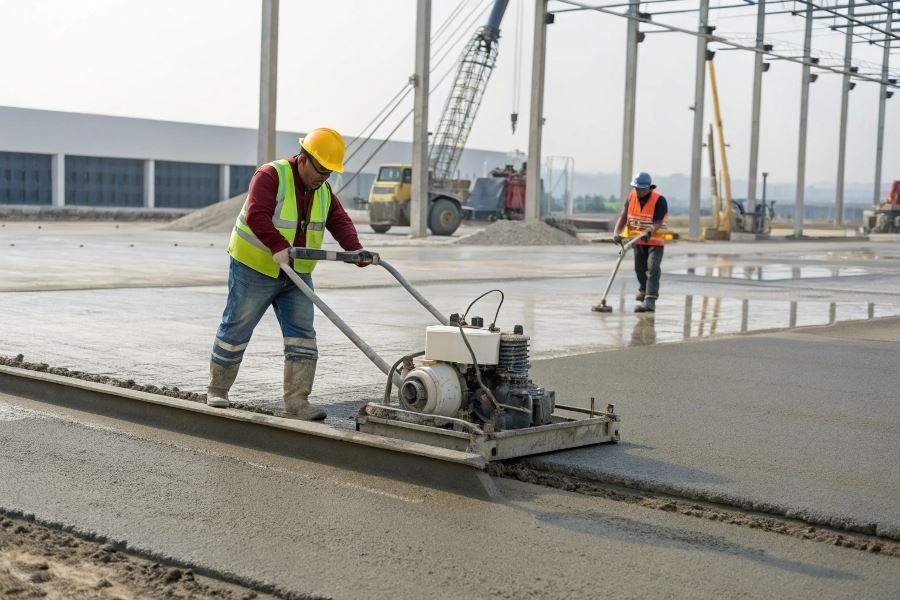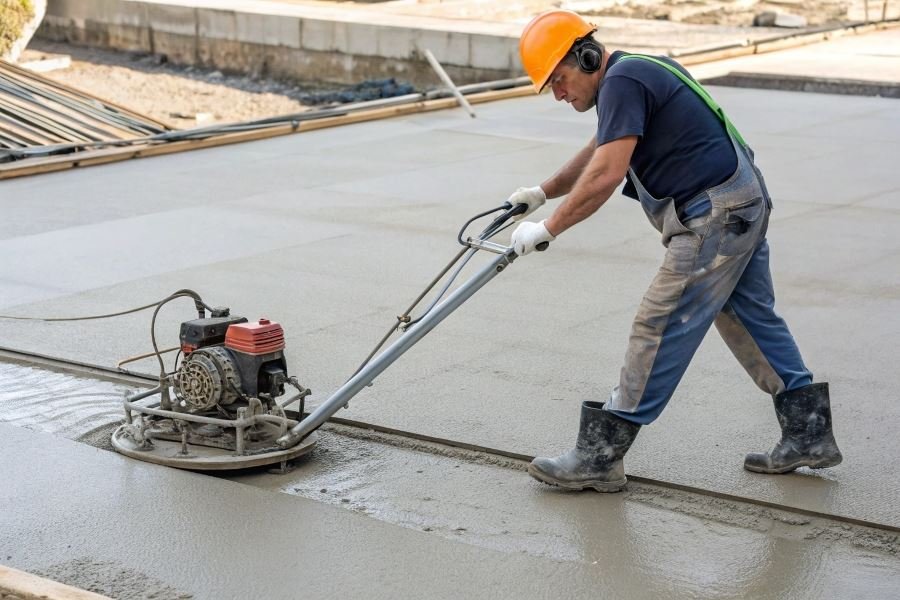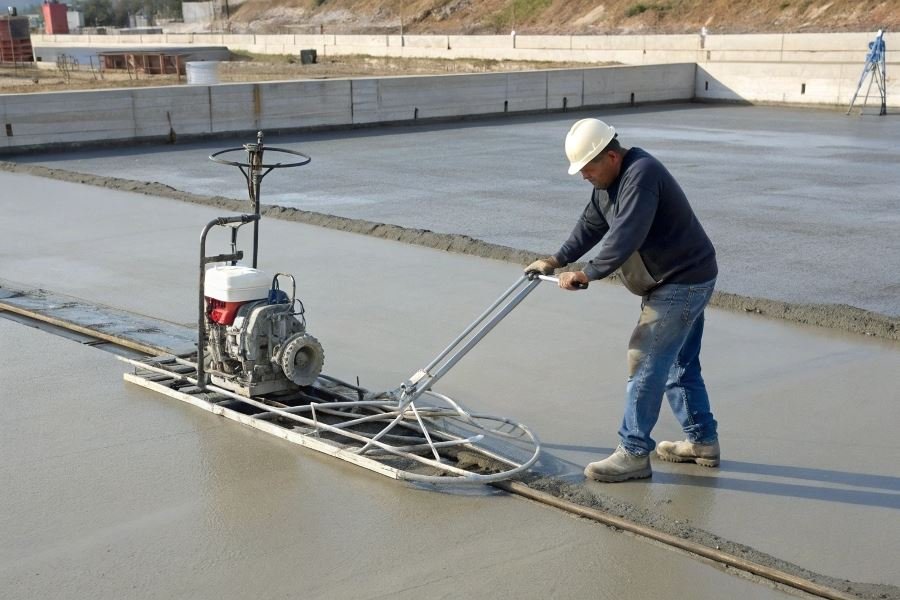
Ever watched a perfectly smooth concrete surface being created and wondered how professionals achieve that flawless finish? Behind every immaculate concrete floor, driveway, or patio lies a crucial tool that separates amateur work from professional results: the floating vibratory screed.
Floating vibratory screeds are specialized concrete finishing tools that combine leveling capabilities with vibration technology to create smooth, uniform concrete surfaces. Unlike manual screeding methods that rely entirely on physical effort, these power-driven tools use vibration to consolidate concrete while simultaneously leveling it—essentially “floating” across the wet surface while removing air voids and bringing cream to the top.
“The difference between good concrete and great concrete often comes down to proper consolidation and screeding.”
When concrete placement challenges arise—particularly with larger slabs, specialized mix designs, or projects requiring exceptional flatness—vibratory screeds become not just helpful but necessary. They excel in situations where traditional hand tools would leave inconsistencies, including:
- Large surface areas where manual methods would be impractical
- Thicker slabs requiring deeper consolidation
- Air-entrained concrete that needs proper vibration to maintain integrity
- Projects with strict flatness tolerances
The evolution of concrete finishing technology tells an interesting story of innovation. Early concrete workers in the 1920s relied entirely on wooden boards and manual labor. The first mechanical screeds appeared in the 1940s, but the true revolution came in the 1970s when vibration technology was integrated, dramatically improving concrete consolidation and surface quality.
Today’s floating vibratory screeds represent decades of refinement, offering contractors precision tools that deliver consistent results while reducing physical strain and increasing productivity.
Where Floating Vibratory Screeds Become Essential
When concrete flatness makes the difference between project success and costly rework, floating vibratory screeds step into the spotlight. These specialized tools have transformed how professionals approach concrete finishing in demanding applications, delivering precision that manual methods simply cannot match.
The question of floating vibratory screeds: when they are necessary often comes down to three critical scenarios where their unique capabilities prove indispensable. Understanding these applications helps contractors make informed equipment decisions that directly impact project outcomes and bottom-line profitability.
Commercial Slabs Demanding Superior Flatness
Large commercial floors represent perhaps the most compelling case for vibratory screed technology. In warehouse facilities exceeding 100,000 square feet, where automated picking systems and high-stack forklifts operate, floor flatness tolerances measured in FF (floor flatness) and FL (floor levelness) numbers become non-negotiable specifications.
Modern distribution centers require FF numbers of 50+ and FL numbers of 35+—specifications virtually impossible to achieve with manual screeding methods. The vibration frequency of 3,000-5,000 VPM (vibrations per minute) provided by tools like the Wacker Neuson P35A ensures proper consolidation while maintaining consistent surface elevation.
The difference becomes particularly evident in facilities using wire-guided picking systems, where even minor floor variations can cause equipment malfunctions costing thousands in downtime.
Projects With Specific Concrete Consolidation Requirements
Certain concrete mixes and structural applications demand precise consolidation that only vibratory technology can deliver consistently:
| Application | Consolidation Challenge | Vibratory Screed Benefit |
|---|---|---|
| High-strength concrete (6,000+ PSI) | Dense mix difficult to consolidate | Eliminates air voids without overworking surface |
| Fiber-reinforced concrete | Fibers can create finishing difficulties | Properly orients fibers while maintaining flatness |
| Thick slabs (6″+ depth) | Ensuring consolidation throughout depth | Vibration penetrates deeper than manual methods |
Industrial facilities with heavy machinery foundations particularly benefit from this technology. The vibration effectively eliminates air pockets that could otherwise create weak points in the concrete, compromising structural integrity under continuous equipment loads.
When Manual Screeding Becomes Impractical
The economics of concrete placement shift dramatically on larger projects. Manual screeding becomes not just physically demanding but financially unsustainable in several scenarios:
Time-sensitive pours where concrete setting time limits the finishing window make vibratory screeds essential. A single operator with a powered screed can finish approximately 4,000 square feet per hour—quadruple what’s possible with manual methods.
Projects with limited labor resources face particular challenges in today’s construction market. When skilled finishers are scarce, mechanical assistance becomes necessary rather than optional.
Temperature-sensitive environments present another compelling case. In hot weather conditions where concrete sets rapidly, the efficiency of vibratory screeds allows crews to maintain pace with setting times, preventing cold joints and ensuring monolithic placement.
The investment in quality floating vibratory equipment typically pays for itself within 3-5 major projects through labor savings, reduced rework, and the ability to meet increasingly stringent flatness specifications that clients demand for modern commercial and industrial applications.
Making the Right Decision for Your Concrete Project
The Financial Equation of Floating Vibratory Screeds
When evaluating the cost-benefit ratio of floating vibratory screeds, contractors must consider both immediate expenses and long-term value. The initial investment for quality equipment like the WYCO Tool or Multiquip models ranges from $2,000 to $5,000—significantly higher than manual screeding methods. However, this upfront cost quickly transforms into savings through dramatically increased productivity.
A typical floating vibratory screed can finish 2,000-3,000 square feet per hour compared to 500-800 square feet with manual methods. This efficiency translates to approximately 75% labor reduction on medium to large projects. For a 10,000 square foot commercial slab:
| Screeding Method | Equipment Cost | Labor Hours | Labor Cost ($45/hr) | Total Project Cost |
|---|---|---|---|---|
| Manual Screeding | $200-500 | 20 | $900 | $1,100-1,400 |
| Floating Vibratory | $3,500 | 5 | $225 | $3,725 |
While the initial project shows higher costs for vibratory methods, the equipment amortizes across multiple projects. After just 5-7 medium-sized jobs, the investment typically pays for itself through labor savings and improved quality that reduces callbacks.
Choosing Your Ideal Screeding Approach
Selecting between different screeding methods requires honest assessment of your specific project parameters:
Project Scale Considerations
For areas under 500 square feet, manual screeding remains economically viable. However, as project size increases, the efficiency gap widens dramatically in favor of vibratory methods.
Concrete Mix Compatibility
Low-slump mixes with larger aggregate benefit tremendously from vibration. The consolidation power of floating vibratory screeds creates proper aggregate distribution that hand methods simply cannot match.
Surface Finish Requirements
When specification tolerances are tight (FF/FL numbers above 35), mechanical vibration provides the consistency manual methods struggle to achieve. Projects requiring ACI Class A or B finishes practically demand vibratory assistance.
The decision ultimately hinges on whether your projects consistently require the precision and efficiency that only vibration can deliver.
Tomorrow’s Concrete Finishing Landscape
The evolution of vibratory screed technology continues at an impressive pace. Several emerging trends deserve attention:
-
Battery-powered systems are gaining traction, eliminating cumbersome power cords while maintaining performance. The Wacker Neuson P35A exemplifies this shift toward cordless operation.
-
Integrated laser-guided systems that automatically adjust screed height based on predetermined elevations are becoming more affordable for mid-sized contractors.
-
Lightweight composite materials are replacing traditional aluminum components, reducing operator fatigue without sacrificing durability.
-
Smart vibration technology that adjusts frequency based on concrete slump and aggregate size is moving from high-end models to mainstream equipment.
The most significant advancement may be the development of remote-controlled units that allow a single operator to manage the entire screeding process from an ergonomic position, dramatically reducing physical strain while improving quality.
As concrete mix designs continue trending toward lower water-cement ratios and specialized performance characteristics, the role of proper vibration becomes increasingly critical. Contractors who invest in understanding and implementing appropriate vibratory technology position themselves at a significant competitive advantage in an industry where margins and schedules grow tighter each year.
Discover when floating vibratory screeds become essential for achieving flawless concrete surfaces. Learn about applications requiring superior flatness, proper consolidation techniques, and how to determine if this specialized equipment is right for your construction project.
Discover when floating vibratory screeds become essential for achieving flawless concrete surfaces. Learn about applications requiring superior flatness, proper consolidation techniques, and how to determine if this specialized equipment is right for your construction project.