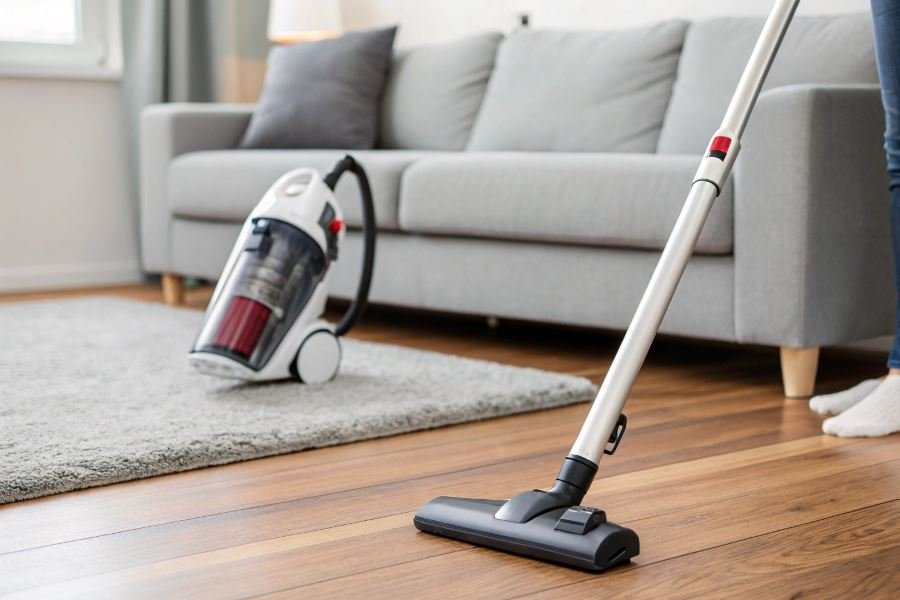
What if the cord that’s been tethering you to wall outlets is actually holding back your cleaning efficiency? The vacuum cleaner—that essential household workhorse—has undergone a remarkable transformation since its invention in the early 1900s. Today’s homeowners face a critical decision that impacts their cleaning routine, storage options, and even energy consumption.
The landscape of home cleaning has dramatically shifted as battery technology has evolved. What began with Hubert Cecil Booth’s massive horse-drawn vacuum apparatus in 1901 has miniaturized into powerful cordless machines that fit in a closet. Market research shows cordless models now account for over 45% of vacuum sales, reflecting a significant shift in consumer preferences.
When evaluating the practicality of vacuum cleaners, several factors demand consideration: cleaning power, maneuverability, runtime, maintenance requirements, and long-term value. The battery versus corded debate isn’t simply about freedom from outlets—it’s about matching your specific cleaning needs with the right technology.
“The most practical vacuum isn’t necessarily the most powerful one—it’s the one that fits seamlessly into your cleaning habits and home environment.”
Corded vacuums offer unlimited runtime and typically stronger suction, while battery-powered models provide liberation from outlet-hopping and cord management. The decision ultimately hinges on your home’s layout, flooring types, and cleaning frequency. Modern lithium-ion batteries have narrowed the performance gap, but each technology still maintains distinct advantages worth understanding before making your investment.
The Ultimate Showdown: Battery vs Corded Vacuum Performance
Power That Packs a Punch
When evaluating vacuum cleaners, suction power remains the gold standard of performance. Corded models have traditionally dominated this arena, drawing continuous electricity to fuel motors capable of generating 1200-1400 watts of power. The Miele Complete C3 exemplifies this advantage with its 1200-watt motor delivering consistent suction across all floor types.
The question of battery vs corded household vacuum cleaners: which is more practical often hinges on this fundamental power difference. However, recent technological leaps have narrowed this gap considerably. Premium cordless models like the Dyson V15 Detect now generate suction power comparable to mid-range corded units, despite operating at lower wattages (typically 350-550 watts). This efficiency comes from advanced cyclonic technology and redesigned motors that maximize airflow with minimal energy consumption.
Freedom vs Endurance
The runtime equation presents perhaps the clearest distinction between these vacuum types:
| Feature | Cordless Vacuums | Corded Vacuums |
|---|---|---|
| Runtime | 20-120 minutes depending on power mode | Unlimited (while plugged in) |
| Mobility | Complete freedom of movement | Limited by cord length (typically 20-30 ft) |
| Weight | 5-8 lbs on average | 8-18 lbs on average |
| Multi-floor cleaning | Seamless transitions | Requires finding new outlets |
The Samsung Bespoke Jet offers up to 120 minutes of runtime on its lowest setting—impressive, but still finite. Meanwhile, corded models provide uninterrupted cleaning power for marathon sessions, eliminating the anxiety of a dying battery mid-clean.
The Maintenance Marathon
Long-term ownership considerations reveal significant differences:
Battery models require:
- Battery replacement every 2-4 years (50−150)
- More frequent filter cleaning due to compact design
- Emptying dust bins after nearly every use
Corded models demand:
- Occasional belt replacements
- Less frequent maintenance overall
- Bag replacements (for bagged models)
The Shark Navigator corded vacuum demonstrates remarkable longevity, with many units functioning optimally after 7+ years with minimal maintenance. Conversely, even premium cordless models like the LG CordZero typically see battery degradation after 500-1000 charging cycles.
Space and Home Compatibility
Your home’s layout plays a crucial role in determining the most practical option:
- Multi-story homes: Cordless models eliminate the frustration of finding outlets on each floor
- Open-concept spaces: Corded vacuums with long power cords (30+ feet) provide sufficient reach
- Small apartments: Wall-mounted cordless systems offer superior space efficiency
- Homes with stairs: The lightweight maneuverability of cordless units (like the 5.6 lb Tineco Pure One) reduces cleaning effort
Storage solutions have evolved dramatically, with cordless models offering wall-mounted docking stations that charge while storing. Meanwhile, corded uprights require more floor space but remain ready for immediate use without charging concerns.
The practical choice ultimately depends on your specific cleaning needs, home configuration, and personal preferences—with each option offering distinct advantages in this ever-evolving cleaning technology landscape.
Making the Practical Choice for Your Home Vacuum
Let your home dictate your vacuum
The perfect vacuum cleaner isn’t universal—it’s personal. A sprawling suburban home with wall-to-wall carpeting demands different solutions than a compact urban apartment with hardwood floors. For larger homes with multiple stories, cordless models like the Dyson V15 Detect offer the freedom to move between floors without hunting for outlets. However, homes with extensive square footage might find battery limitations frustrating, as most cordless models provide only 30-60 minutes of runtime.
Homes with pets present unique challenges that both types address differently. Corded models from Miele and Shark often feature superior suction power for embedded pet hair, while premium cordless options now include specialized pet attachments and enhanced filtration systems.
Wisdom nugget: The best vacuum isn’t the most expensive or the most powerful—it’s the one that matches your specific cleaning patterns and home environment.
For households with mobility concerns, the lighter weight of battery vacuums (typically 6-8 pounds) offers significant advantages over traditional corded models (12-18 pounds). Storage considerations also matter—cordless stick vacuums occupy minimal closet space compared to their bulkier corded counterparts.
The true cost equation
The initial price tag tells only part of the story. Premium cordless vacuums from manufacturers like Dyson and Samsung typically range from 300−700, while quality corded models from Miele or Kenmore start around 200−400.
However, the long-term value calculation must include:
| Cost Factor | Corded Vacuums | Battery Vacuums |
|---|---|---|
| Electricity | $5-10 annually | $2-5 annually for charging |
| Replacement parts | Bags/filters: $20-50/year | Filters: $20-40/year |
| Battery replacement | N/A | $50-150 every 2-3 years |
| Expected lifespan | 8-12+ years | 5-7 years |
The math reveals that while cordless models offer convenience, they typically cost 30-40% more over a 10-year period. A quality corded vacuum might cost $600 over its lifetime (including purchase price and maintenance), while a premium cordless model could reach $900+ when factoring in battery replacements.
Matching machines to cleaning needs
For high-traffic homes requiring daily cleaning, a cordless vacuum with multiple batteries or a reliable corded model with a long hose reach like the Shark Navigator provides consistent performance.
For quick cleanup households that spot-clean frequently, battery-powered options excel. The Tineco Pure One series offers impressive performance for apartments and smaller homes with mixed flooring.
Multi-surface homes benefit from versatile options. Corded models with adjustable height settings handle transitions between carpet and hard floors effectively, while premium cordless vacuums now feature intelligent suction adjustment technology.
For allergy sufferers, sealed HEPA filtration matters more than power source. Both the corded Miele Complete C3 and cordless Dyson V15 offer exceptional filtration, capturing 99.97% of particles down to 0.3 microns.
The most practical choice ultimately aligns with your specific cleaning habits, home layout, and budget priorities. For most households, the ideal solution might be a hybrid approach—a powerful corded model for deep cleaning sessions paired with a lightweight cordless vacuum for daily maintenance and quick spills.
Discover which vacuum cleaner truly suits your lifestyle - battery or corded? Compare suction power, runtime, maintenance, and cost factors to make a practical choice for your specific home cleaning needs.
Discover which vacuum cleaner truly suits your lifestyle - battery or corded? Compare suction power, runtime, maintenance, and cost factors to make a practical choice for your specific home cleaning needs.