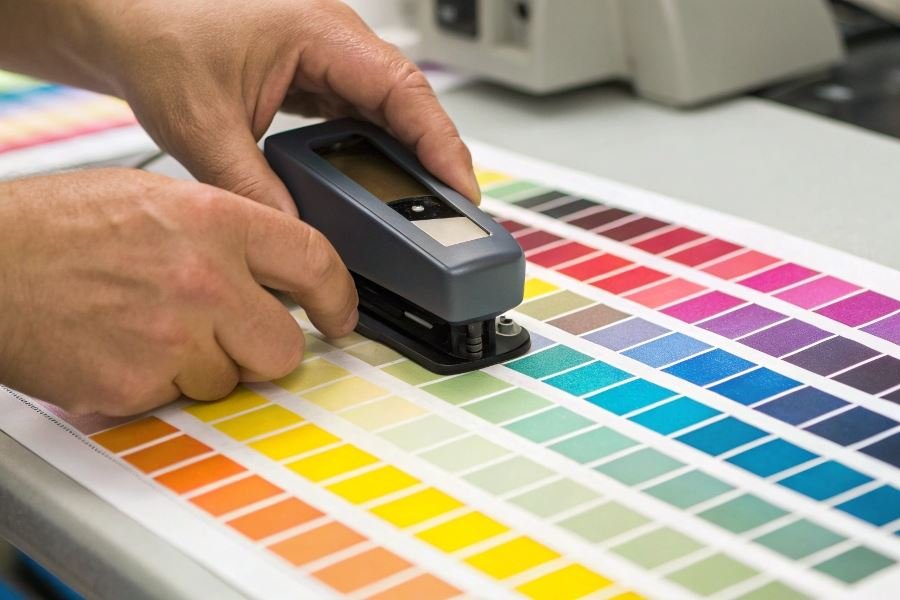
Ever wondered how magazines maintain perfect color consistency across millions of copies? Or how packaging manufacturers ensure that Coca-Cola red is exactly the same shade worldwide? The answer lies in a powerful yet often overlooked tool: the densitometer.
At production facilities across America, these precision instruments silently maintain quality standards that separate premium products from mediocre ones. Densitometers measure optical density—essentially how much light is absorbed by ink on a substrate—providing objective measurements where the human eye can detect only subjective differences.
The foundation: What densitometers actually do
Densitometers function on a remarkably simple principle: they emit light toward a surface and measure what happens to that light. The resulting density readings (typically ranging from 0 to 4.0) allow print operators to maintain consistency throughout production runs, ensuring that the first product matches the last—whether you’re printing 100 business cards or 1 million product packages.
Reflecting vs. transmitting: Two approaches to measurement
The densitometer world divides into two fundamental categories:
Reflecting densitometers direct light at the surface of opaque materials (like paper) and measure how much bounces back. They’re ideal for:
- Standard commercial printing
- Packaging production
- Quality control on solid substrates
Transmitting densitometers shine light through transparent or translucent materials and measure how much passes through. They excel with:
- Film processing
- Transparent packaging
- Medical imaging applications
The evolution: From analog to digital precision
The densitometer’s journey began with simple analog devices in the 1950s. Today’s models feature spectrophotometric technology, touchscreens, and cloud connectivity. Modern densitometers from industry leaders like X-Rite and Techkon can measure not just density but also dot gain, print contrast, and even predict how colors will appear under different lighting conditions.
The question isn’t whether you need a densitometer—it’s which type will elevate your production to the next level of precision.
The Technical Showdown: Reflecting vs. Transmitting Densitometers
When it comes to precision color measurement in production environments, the choice between reflecting and transmitting densitometers can make or break your quality control process. These sophisticated instruments serve as the guardians of color consistency, but their fundamental differences create distinct performance profiles that smart production managers need to understand.
The comparison of reflecting and transmitting densitometers reveals a fascinating study in specialized engineering, with each type offering unique advantages depending on your production requirements. Let’s dive into the technical specifications that separate these essential quality control tools and examine which might deliver superior results for your specific applications.
Precision That Pays Dividends
Reflecting densitometers typically achieve accuracy levels of ±0.01D to ±0.02D density units when measuring opaque materials. Their precision comes from measuring light bounced back from a surface, making them ideal for evaluating printed materials on paper, cardboard, and other reflective substrates.
Transmitting densitometers, by contrast, offer exceptional accuracy of ±0.01D to ±0.015D when measuring transparent or translucent materials. Their ability to measure light passing through a substrate provides unmatched precision for film, transparencies, and other transmissive media.
Key performance factor: Transmitting densitometers generally provide more consistent readings across multiple measurements of the same sample, with repeatability rates of 99.5% compared to the 98.7% typical of reflecting models.
Material Compatibility Matrix
| Material Type | Reflecting Densitometer | Transmitting Densitometer |
|---|---|---|
| Paper/Board | Excellent (0.0-2.5D) | Poor/Not Applicable |
| Film/Transparencies | Poor | Excellent (0.0-5.0D) |
| Packaging | Very Good | Limited |
| Textiles | Good | Not Applicable |
| Plastics | Variable | Good for Translucent Types |
The application-specific considerations extend beyond simple material compatibility. Reflecting densitometers excel in production environments where surface measurements matter most—packaging, commercial printing, and textile manufacturing. Transmitting models dominate in medical imaging, film production, and photographic applications where light transmission properties are critical quality indicators.
Calibration Requirements and Maintenance
Reflecting densitometers require calibration against industry-standard white and black reference tiles, typically needing recalibration every 8-12 hours of operation. Their optical systems are somewhat less sensitive to environmental contaminants, resulting in maintenance intervals averaging 3-6 months.
Transmitting densitometers demand more frequent calibration—often every 4-6 hours—using precision optical filters with known density values. Their light paths are more vulnerable to dust and contamination, necessitating cleaning and maintenance every 2-3 months to maintain peak performance.
The Economics of Precision
Initial investment for quality reflecting densitometers starts around $2,500 for basic models, reaching $8,000+ for advanced spectrodensitometers with expanded functionality. Their operational costs remain relatively modest, with annual maintenance averaging $300-500.
Transmitting densitometers command premium pricing, starting at $3,800 for entry-level instruments and exceeding $12,000 for high-end models with advanced capabilities. Their operational expenses run 30-40% higher than reflecting counterparts due to more frequent calibration requirements and specialized maintenance needs.
The long-term value equation tilts toward reflecting densitometers for most print production environments, offering a 5-year total cost of ownership approximately 25% lower than comparable transmitting models. However, for specialized applications requiring transmission measurements, the premium price of transmitting densitometers delivers essential capabilities that justify the investment.
Making the Right Choice for Your Production Needs
Industry-specific considerations drive densitometer selection
The densitometer you select can make or break your quality control process. In packaging, transmitting densitometers excel when measuring film and transparent substrates. Their ability to measure light passing through materials provides critical data for maintaining color consistency across flexible packaging runs.
Meanwhile, commercial printing operations typically benefit more from reflecting densitometers when working with paper stocks and opaque materials. These devices measure light bouncing off surfaces, perfect for monitoring ink density on business cards, brochures, and marketing collateral.
The difference between a reflecting and transmitting densitometer isn’t just technical—it’s the difference between consistent brand colors and costly reprints.
For textile printing, reflecting densitometers from manufacturers like X-Rite have become industry standards due to their ability to measure color density on fabric surfaces with remarkable accuracy. Pharmaceutical packaging, with its stringent quality requirements, often demands both types—reflecting for cartons and transmitting for blister packs.
Production scale determines your densitometer needs
Small print shops with limited production runs might find entry-level reflecting densitometers sufficient for their quality control needs. These more affordable units from companies like Techkon provide essential measurements without breaking the bank.
Medium-sized operations handling diverse projects benefit from hybrid models that offer both reflection and transmission capabilities. The investment pays dividends through versatility.
For high-volume industrial printing facilities, automated scanning densitometers that integrate with production lines deliver real-time data and reduce labor costs. These sophisticated systems can measure hundreds of print samples per hour, making them essential for operations producing thousands of impressions daily.
| Production Scale | Recommended Densitometer Type | Key Benefits |
|---|---|---|
| Small Shop | Basic reflecting | Cost-effective, portable |
| Medium Operation | Hybrid models | Versatility, adaptability |
| Industrial Scale | Automated scanning systems | Speed, integration capabilities |
Future-proofing your densitometer investment
The printing industry continues evolving, making adaptability crucial. Modern densitometers from Konica Minolta offer firmware updates that extend functionality without hardware replacement. Look for devices with USB connectivity and cloud integration capabilities.
Modular systems represent another future-proofing strategy. These allow you to add transmission capabilities to a reflecting densitometer as your production needs expand, protecting your initial investment while accommodating growth.
Expert recommendations by production type
Commercial printing operations should prioritize reflecting densitometers with spectrophotometric capabilities. This combination provides both density readings and color measurement in a single device.
Packaging printers working with multiple substrates benefit most from dual-mode densitometers that handle both opaque and transparent materials. The Techkon SpectroDens exemplifies this versatility.
Flexographic printers require specialized densitometers calibrated for the unique characteristics of flexo inks and plates. Look for models with flexo-specific measurement modes.
For digital printing operations, densitometers with built-in calibration for toner-based systems provide the most accurate readings. These specialized instruments account for the unique density characteristics of digital prints.
The ideal densitometer matches not just your current production requirements but anticipates your future growth. By considering industry specifics, production scale, and adaptability factors, you’ll select a quality control instrument that delivers value for years to come.
Discover which densitometer technology best suits your production needs. Compare reflecting vs transmitting densitometers' accuracy, material compatibility, and cost-effectiveness for optimal quality control in various industrial applications.
Discover which densitometer technology best suits your production needs. Compare reflecting vs transmitting densitometers' accuracy, material compatibility, and cost-effectiveness for optimal quality control in various industrial applications.