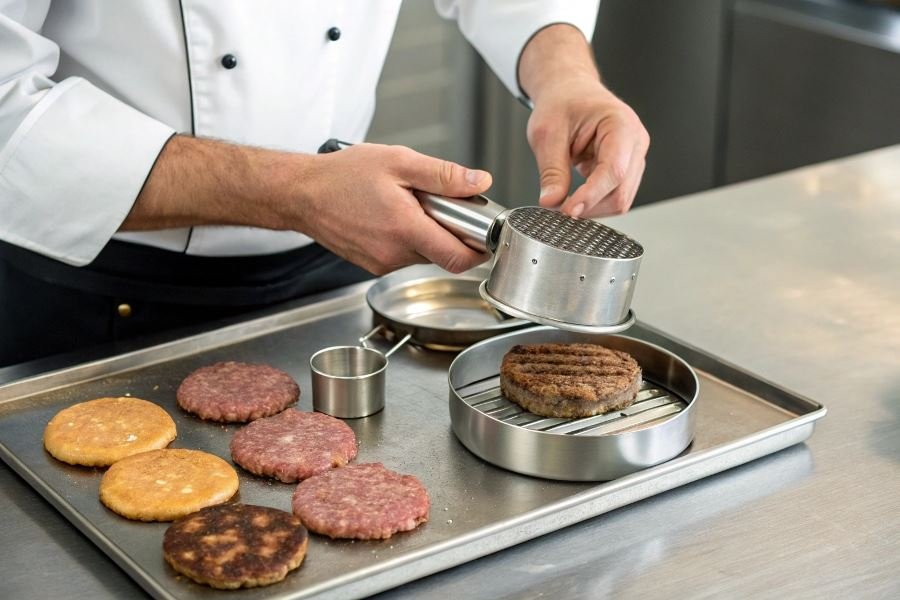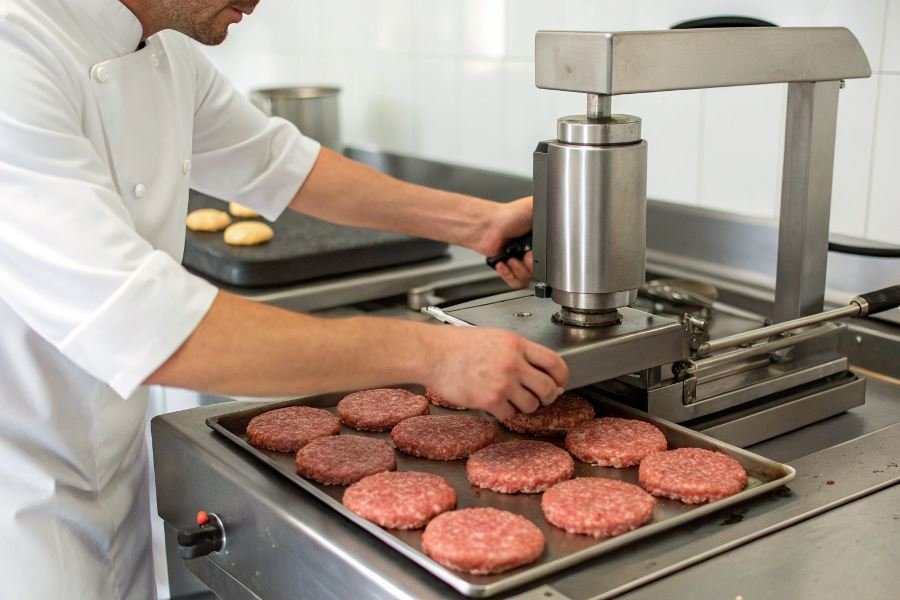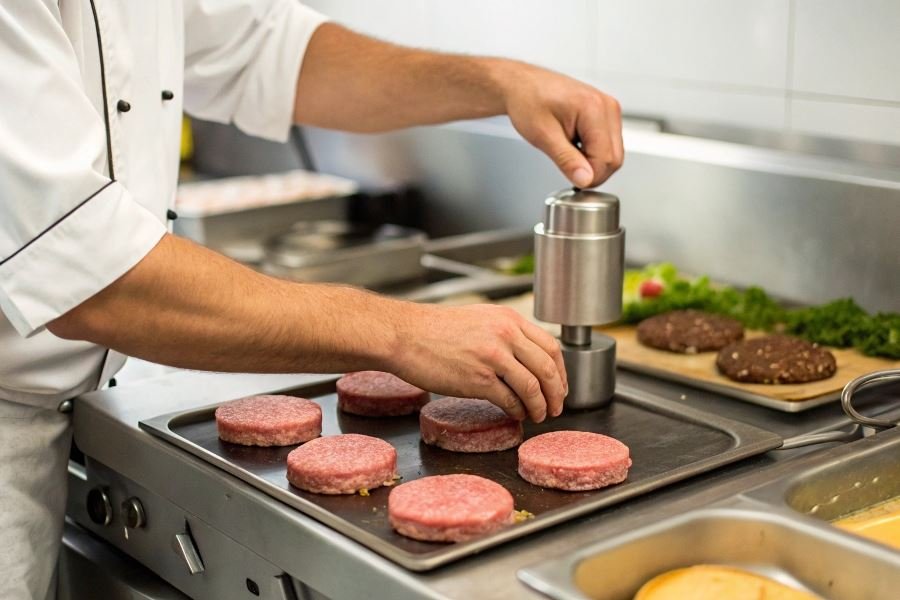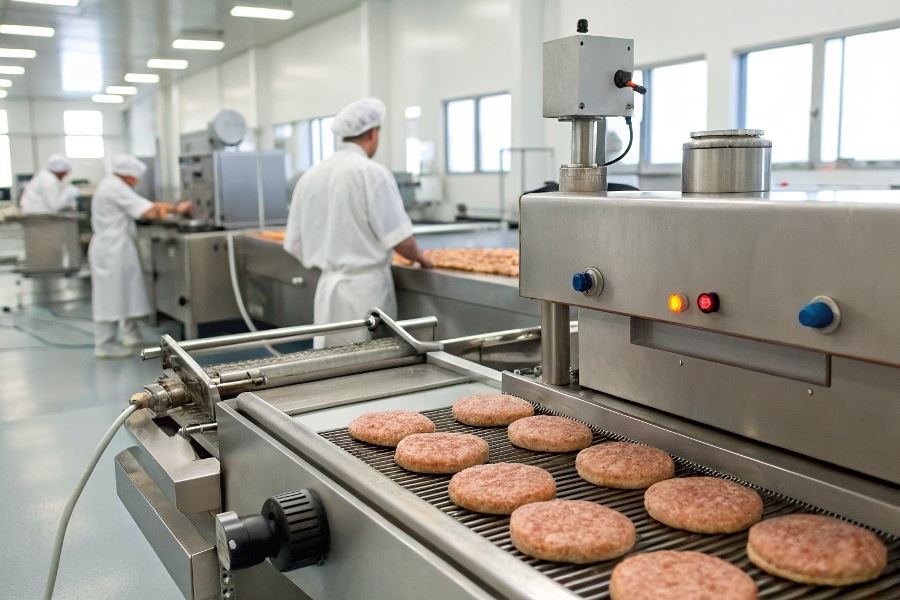
What if the perfect burger patty wasn’t made by hand, but by a machine that could replicate a master chef’s technique with microscopic precision? This isn’t science fiction—it’s happening right now on production floors across America.
The humble patty former has undergone a remarkable transformation since its introduction in the mid-20th century. What began as simple mechanical presses has evolved into sophisticated systems that combine artificial intelligence, precision engineering, and food science. Early models from the 1960s could produce basic shapes at modest speeds, but today’s advanced formers create complex products with consistent weight, density, and texture at rates exceeding 10,000 patties per hour.
From mechanical to digital precision
The journey from manual patty forming to today’s automated systems reflects broader changes in food manufacturing. Traditional methods—while cherished for their artisanal quality—simply cannot meet modern production demands. As consumer expectations for consistency and quality have risen, manufacturers have embraced technologies that deliver unprecedented precision and efficiency.
Why automation matters now
The labor challenges facing food processors have accelerated technology adoption. With skilled labor increasingly difficult to find and retain, automated forming systems offer compelling advantages:
- Consistency: Every patty identical in weight, thickness, and density
- Throughput: Production rates 5-10× higher than manual methods
- Reduced waste: Precise portion control minimizing costly product loss
- Food safety: Minimized handling reducing contamination risks
These innovations aren’t just changing how patties are made—they’re redefining what’s possible in meat processing, creating opportunities for products that would be impossible to produce consistently by hand.
The Technology Revolution Reshaping Patty Production
Servo-Driven Systems: Precision Redefined
The food manufacturing landscape has been dramatically transformed by servo-driven forming systems that bring unprecedented precision to patty production. These advanced systems replace conventional hydraulic or pneumatic mechanisms with digitally controlled servo motors that offer micron-level accuracy in patty formation. The difference is immediately apparent in product consistency—where traditional machines might show 8-12% weight variation, servo-driven systems reduce this to an impressive 1-3%.
Marel’s RevoPortioner exemplifies how innovative technologies in modern patty forming machines are creating new possibilities for food processors. Their servo-driven system allows operators to adjust density, thickness, and texture parameters with digital precision, resulting in patties that maintain consistent quality even during high-volume production runs of 10,000+ units per hour.
The precision extends beyond mere aesthetics—it directly impacts cooking performance and customer satisfaction.
3D Food Printing: Customization Meets Production
The integration of 3D printing technology into patty forming represents perhaps the most visually striking advancement in the field. These systems use specialized food-grade extrusion mechanisms to create intricate internal structures and surface textures that were previously impossible with traditional forming methods.
| Feature | Traditional Forming | 3D Food Printing |
|---|---|---|
| Texture Variation | Limited (1-2 textures) | Extensive (5+ textures in single patty) |
| Internal Structure | Homogeneous | Customizable density gradients |
| Shape Complexity | Basic shapes only | Complex geometries possible |
| Production Speed | 4,000-8,000 units/hour | 500-2,000 units/hour |
Redefine Meat has pioneered systems that can create plant-based patties with fibrous structures that mimic animal muscle tissue—something conventional forming machines simply cannot achieve. While production speeds remain lower than traditional methods, the customization possibilities have opened new premium market segments.
“The ability to control internal structure at the millimeter level means we can engineer how a patty cooks, retains moisture, and delivers flavor in ways that were science fiction just five years ago.” — Food Engineering Quarterly
IoT and Smart Monitoring: The Connected Production Line
The integration of Internet of Things (IoT) capabilities has transformed patty forming from an isolated production step to a connected node in a smart manufacturing ecosystem. Modern forming machines now incorporate multiple sensor arrays that continuously monitor:
- Temperature variations across the forming plate
- Protein viscosity and consistency
- Force distribution during compression
- Real-time weight verification
- Texture analysis via pressure mapping
GEA Food Solutions has developed systems that not only collect this data but use machine learning algorithms to make predictive adjustments before quality issues occur. Their SmartFormer technology can detect subtle changes in raw material properties and automatically adjust forming parameters to maintain consistent output.
The production optimization extends to maintenance as well. Predictive analytics can identify potential mechanical issues before they cause downtime, with some systems reporting 30-40% reductions in unplanned stoppages. For facilities producing 50,000+ patties daily, this translates to significant operational savings.
These technological advancements have collectively elevated patty production from a basic mechanical process to a sophisticated, data-driven manufacturing operation that delivers unprecedented quality, consistency, and customization possibilities.
The Future Trajectory of Patty Forming Technology
Sustainable innovations changing the game
The patty forming industry is undergoing a remarkable transformation. Leading manufacturers like Formax and Marel have introduced systems that reduce trim waste by up to 42% compared to conventional forming methods. These next-generation machines incorporate closed-loop material recovery systems that automatically reincorporate edge trimmings back into the production flow.
Energy efficiency has become the new battleground for innovation. The latest Provisur models have reduced power consumption by nearly 30% through advanced servo motor technology and intelligent power management. These systems dynamically adjust energy usage based on production demands rather than running at constant power.
“The sustainability revolution isn’t just about being green—it’s about creating systems that are economically superior while reducing environmental impact.”
Water conservation technologies are making significant inroads as well. New cleaning systems use high-pressure, low-volume water delivery that cuts water usage by up to 65% during sanitation cycles. This translates to thousands of gallons saved annually while maintaining rigorous food safety standards.
AI transforms maintenance and quality control
Predictive maintenance has evolved beyond simple scheduled service intervals. Modern patty forming equipment now incorporates sensor arrays that monitor dozens of operational parameters in real-time. These systems use machine learning algorithms to detect subtle changes in vibration patterns, temperature fluctuations, and motor performance that indicate potential failures before they occur.
The quality control revolution is equally impressive. Computer vision systems powered by deep learning can now:
| Capability | Traditional QC | AI-Enhanced QC |
|---|---|---|
| Inspection rate | 60-80 units/minute | 500+ units/minute |
| Defect detection | Visual defects only | Structural and density anomalies |
| Consistency tracking | Basic weight checks | Complete shape, texture, and density analysis |
| Data utilization | Limited reporting | Continuous process optimization |
These systems don’t just identify problems—they actively suggest parameter adjustments to improve product consistency. JBT FoodTech’s latest forming systems can automatically fine-tune die pressure and plate temperature based on real-time feedback from the vision system.
Implementation strategies that maximize ROI
The financial case for upgrading patty forming technology has never been stronger, but implementation requires strategic planning. Modular upgrades have emerged as the preferred approach for many processors. Rather than complete system replacement, manufacturers like Handtmann offer component-level technology upgrades that can be integrated into existing production lines.
Calculating true ROI requires looking beyond the obvious metrics. While reduced waste and labor savings provide immediate returns, the long-term value often comes from:
- Increased production flexibility to handle specialty products
- Enhanced traceability for regulatory compliance
- Reduced downtime through predictive maintenance
- Extended equipment lifecycle through component upgrades
The most successful implementations follow a phased approach. Starting with data collection systems allows processors to identify their specific bottlenecks before committing to major equipment investments. This data-first strategy typically yields ROI improvements of 15-20% compared to traditional replacement approaches.
For mid-sized operations, equipment-as-a-service models are gaining traction. These arrangements allow access to cutting-edge technology without the capital expenditure, with payments structured based on production volume or subscription terms.
Discover how servo-driven systems, 3D food printing, and IoT capabilities are revolutionizing patty forming machines. Learn about AI-powered quality control and sustainable technologies transforming modern food production efficiency.
Discover how servo-driven systems, 3D food printing, and IoT capabilities are revolutionizing patty forming machines. Learn about AI-powered quality control and sustainable technologies transforming modern food production efficiency.