
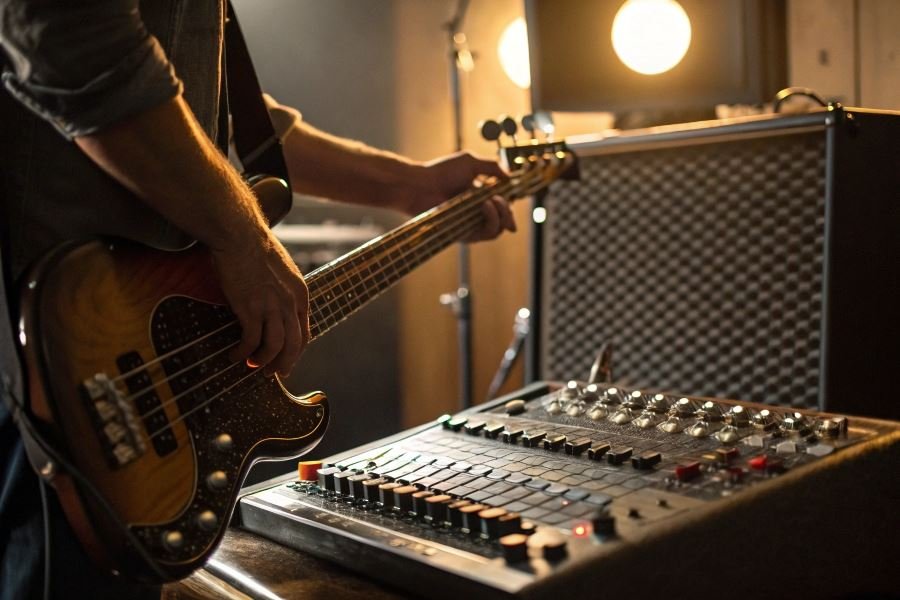
Ever wondered why some bassists sound pristine through massive PA systems while others disappear in the mix? The secret weapon might be sitting quietly on their pedalboard—a direct box (DI box). These unassuming devices are the critical bridge between your thunderous low-end and the front-of-house engineer’s mixing console.
Direct boxes serve as tone-preserving translators, converting your bass guitar’s high-impedance signal into a balanced, low-impedance signal that can travel long distances without degradation. Whether you’re recording in a professional studio or performing on stage, a quality DI box ensures your carefully crafted tone reaches listeners exactly as intended.
What makes a great bass DI box?
When evaluating direct boxes for bass, several critical features determine performance:
- Passive vs. Active: Passive DIs require no power but may color your tone. Active DIs need power (battery or phantom) but offer cleaner signals and often include tone-shaping options.
- Frequency response: Bass-specific DIs handle extended low frequencies without distortion.
- Transformer quality: The heart of any DI, premium transformers preserve transients and dynamic range.
- Ground lift: Essential for eliminating hum in complex stage setups.
- Tone-shaping options: Features like EQ controls, saturation, or compression can enhance your sound.
Our testing approach
For our comparison, we evaluated popular DI models across multiple real-world scenarios: recording sessions, small club gigs, and large venue performances. Each unit was tested with various bass types (passive, active, 5-string) through identical signal chains. We measured technical specifications while also conducting blind listening tests with experienced engineers and bassists to capture both objective data and subjective impressions.
Direct Box Showdown: The Ultimate Bass Guitar DI Comparison
When tone matters and every nuance of your bass performance needs to translate perfectly from instrument to PA system, the humble direct box becomes your most crucial ally. These unassuming devices serve as the critical bridge between your bass guitar’s raw signal and the mixing console, shaping how your instrument ultimately sounds to the audience.
The world of direct boxes for bass guitar offers a spectrum of options that can dramatically impact your tone. Comparing popular models reveals significant differences in how they handle your instrument’s voice, with each box imparting its own character to the signal chain. Whether you’re tracking in a professional studio or performing on stage, the right DI can be the difference between a muddy, lifeless tone and a punchy, articulate bass sound that cuts through the mix.
Passive DI Boxes: The Reliable Workhorses
Passive direct boxes operate without external power, relying on transformers to do the heavy lifting. This simplicity makes them remarkably reliable options for bassists.
Radial ProDI stands as the industry standard for many reasons. Its custom-wound transformer delivers a warm, slightly colored tone that flatters most bass guitars. The ProDI handles high SPL without breaking a sweat, making it ideal for aggressive players.
The Countryman Type 85 offers exceptional transparency with minimal coloration. Its transformer provides a notably flat frequency response, preserving the natural character of your instrument. Bass players seeking an unaltered signal path gravitate toward this model.
Completing our passive trio, the Whirlwind IMP 2 delivers remarkable performance at a more accessible price point. Its TRHL transformer provides a slightly warmer bottom end that many bassists find complementary to their instrument’s natural voice.
Active DI Boxes: Precision and Control
Active direct boxes incorporate powered circuitry to manipulate and enhance your signal, offering additional features and flexibility.
The Radial J48 utilizes 48V phantom power to deliver exceptional headroom and transient response. Its active circuitry preserves the attack and definition of slap techniques while maintaining a balanced low-end response. The J48’s Merge function allows blending of stereo sources to mono—particularly useful for bassists using effects processors.
For those seeking studio-grade quality, the Avalon U5 represents the premium tier. This direct box/preamp hybrid features discrete Class A circuitry that delivers unparalleled clarity and depth. Its variable gain and impedance controls allow precise tailoring of your tone, though this versatility comes with a significant price tag.
The Rupert Neve RNDI combines Neve’s legendary transformer design with active circuitry for a best-of-both-worlds approach. Its custom transformer imparts a musical harmonic content that many describe as “three-dimensional,” while the active section ensures consistent performance regardless of instrument impedance.
Performance Comparison
| Model | Tonal Quality | Noise Handling | Durability | Price Range |
|---|---|---|---|---|
| Radial ProDI | Warm, colored | Excellent | Outstanding | $100-130 |
| Countryman Type 85 | Transparent, flat | Very good | Excellent | $160-200 |
| Whirlwind IMP 2 | Warm low-end | Good | Very good | $60-80 |
| Radial J48 | Detailed, balanced | Excellent | Outstanding | $200-230 |
| Avalon U5 | Rich, pristine | Superior | Excellent | $700-800 |
| Rupert Neve RNDI | Harmonically rich | Excellent | Outstanding | $270-300 |
The passive options excel in simplicity and reliability, with the ProDI offering the most character and the Type 85 delivering the most transparent signal path. Among active models, the J48 provides exceptional versatility, while the RNDI delivers that coveted “Neve sound” at a relatively accessible price point compared to the premium Avalon U5.
Your choice ultimately depends on your specific needs—recording demands different characteristics than live performance, and your bass’s inherent tone might pair better with certain DI characteristics than others.
Choosing Your Perfect Bass DI: Expert Recommendations
Matching DIs to Your Playing Style
Finding the right direct box for your bass isn’t just about budget—it’s about understanding how your playing style demands specific features. Aggressive slap players benefit tremendously from the headroom and transparency of the Radial JDI Passive, which handles transient peaks without breaking a sweat. Meanwhile, fingerstyle players often prefer the warmth and subtle coloration of the Ampeg SCR-DI, with its tube-emulation circuitry that adds just the right amount of harmonic content.
For budget-conscious players who still demand quality, the Tech 21 SansAmp Bass Driver DI delivers exceptional versatility at around $209—a fraction of high-end options while still offering professional-grade performance. Recording-focused bassists should consider the Darkglass Microtubes B7K Ultra with its extensive EQ options and parallel processing capabilities.
The difference between the right DI and the wrong one isn’t just subtle coloration—it’s the difference between being heard exactly as intended or fighting your sound all night.
Installation and Performance Optimization
Maximizing your direct box’s potential starts with proper placement in your signal chain. For the cleanest signal, position your DI:
- After your instrument but before any effects that might color your tone
- After compression if you want that effect to be part of your DI sound
- Before any amp simulation unless you’re using the DI’s built-in preamp features
When connecting to a PA system, use the balanced XLR output to send your signal to the front-of-house mixer while simultaneously using the thru/parallel output to feed your stage amplifier. This dual-path approach ensures consistent monitoring while delivering pristine sound to the audience.
| Connection Type | Best For | Common Mistake to Avoid |
|---|---|---|
| Pre-EQ DI | Capturing pure bass tone | Sending already colored signal |
| Post-EQ DI | Your curated tone | Too much bass boost causing mud |
| Parallel Processing | Studio-quality layered sound | Phase issues between paths |
Always carry spare batteries for active DIs—even if you’re using phantom power. When that one venue has faulty phantom, you’ll thank yourself.
The Future of Bass Direct Boxes
The direct box landscape is evolving rapidly, with several key trends reshaping what bassists can expect in the coming years:
Digital integration is becoming standard, with units like the Neural DSP Quad Cortex blurring the line between traditional DIs and full-featured modeling platforms. These systems offer unprecedented flexibility with impulse responses that can transform your direct signal into virtually any bass rig imaginable.
Wireless connectivity is the next frontier, with manufacturers developing DIs that can stream high-resolution audio directly to recording interfaces or front-of-house systems without latency concerns. This technology promises to eliminate the cable clutter that has plagued bassists for decades.
Hybrid analog/digital architecture represents perhaps the most exciting development—combining the warmth and responsiveness of analog circuits with the precision and flexibility of digital processing. The Origin Effects BassRIG exemplifies this approach, delivering authentic analog compression and drive alongside digital cabinet simulation.
The most forward-thinking bassists are already embracing these technologies, recognizing that the perfect direct box isn’t just about preserving your tone—it’s about expanding your sonic possibilities while maintaining the fundamental character that makes your playing unique.
Discover the ultimate comparison of 7 top bass guitar direct boxes, from passive classics to premium active models. Learn which DI delivers the best tone, noise handling, and durability for your playing style and budget.
Discover the ultimate comparison of 7 top bass guitar direct boxes, from passive classics to premium active models. Learn which DI delivers the best tone, noise handling, and durability for your playing style and budget.
